


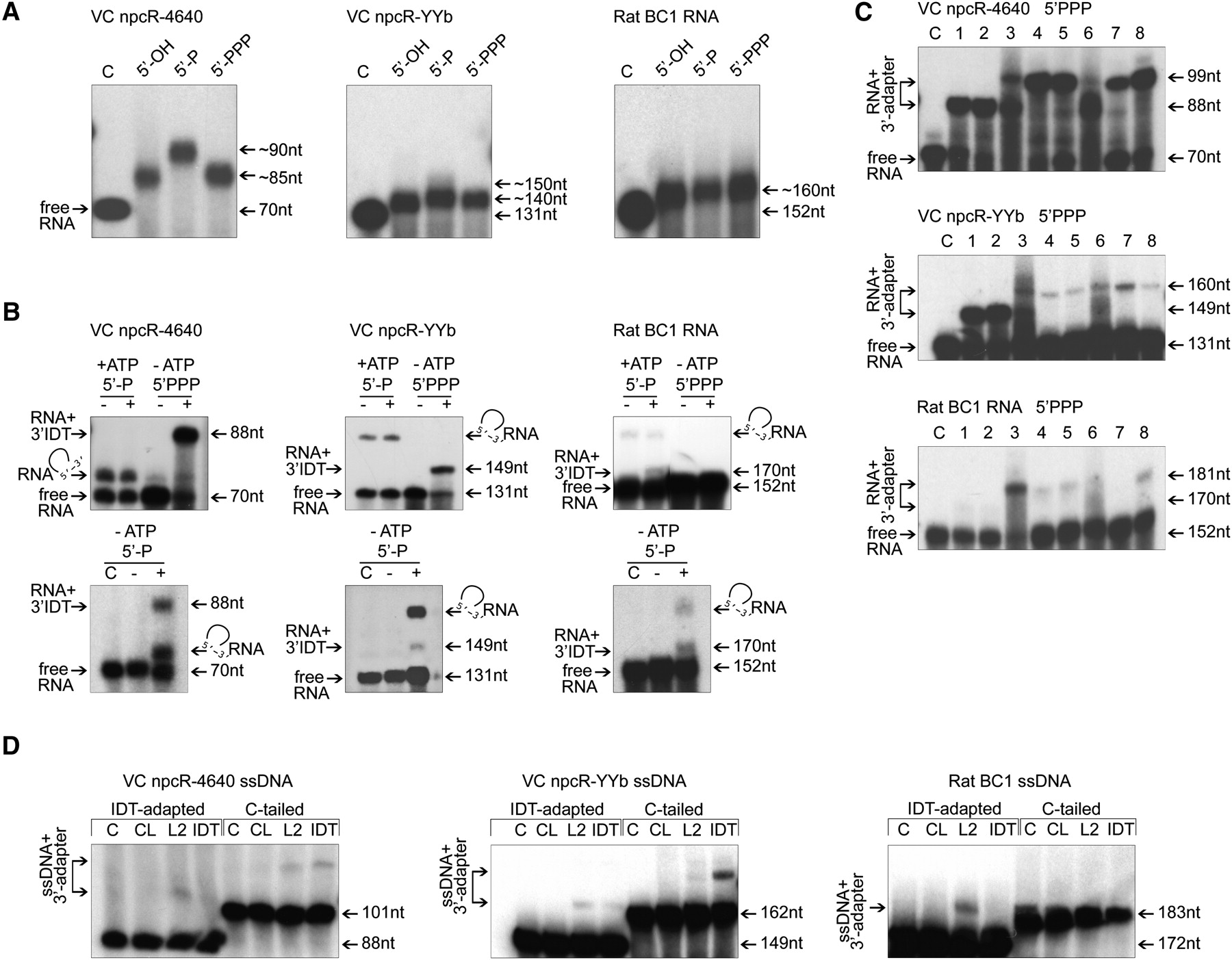
Comparisons of C-tailing and adapter ligations to the 3′-ends of RNA or ssDNA templates. (A) 3′-end C-tailing reactions were performed with 5′-hydroxyl (5′-OH), 5′-monophosphate (5′-P), and 5′-triphosphate (5′-PPP) group-containing RNAs. The corresponding 5′-monophosphate RNAs served as controls (C). (B) IDT adapter (Liu et al. 2009) ligation to 3′-ends of 5′-monophosphorylated (5′-P) and 5′-triphosphorylated (5′-PPP) RNAs (Table 2). The presence or absence of the IDT adapter in the ligation reaction is indicated above the gel by “+” or “−”, respectively. +ATP or –ATP indicates the presence or absence, respectively, of ATP in the reactions. Potential RNA circularization products are depicted by half-circles. (C) Ligation of different adapters (1-IDT; 2-L2; 3-Ad1RNA; 4-Ad1; 5-UNC; 6-Ad7RNA; 7-Ad7; 8-Ad10) to 3′-ends of 5′-triphosphorylated (5′-PPP) RNAs (Table 2). The corresponding 5′-triphosphorylated RNAs served as controls (C). (D) DNA blot analysis for ligation of L2 and IDT adapters to tailed ssDNAs with ssDNA-specific probes. As controls, ssDNA was incubated in ligation buffer in the absence (C) or presence (CL) of T4 RNA ligase. (A–D) Values to the right represent molecular sizes.




