


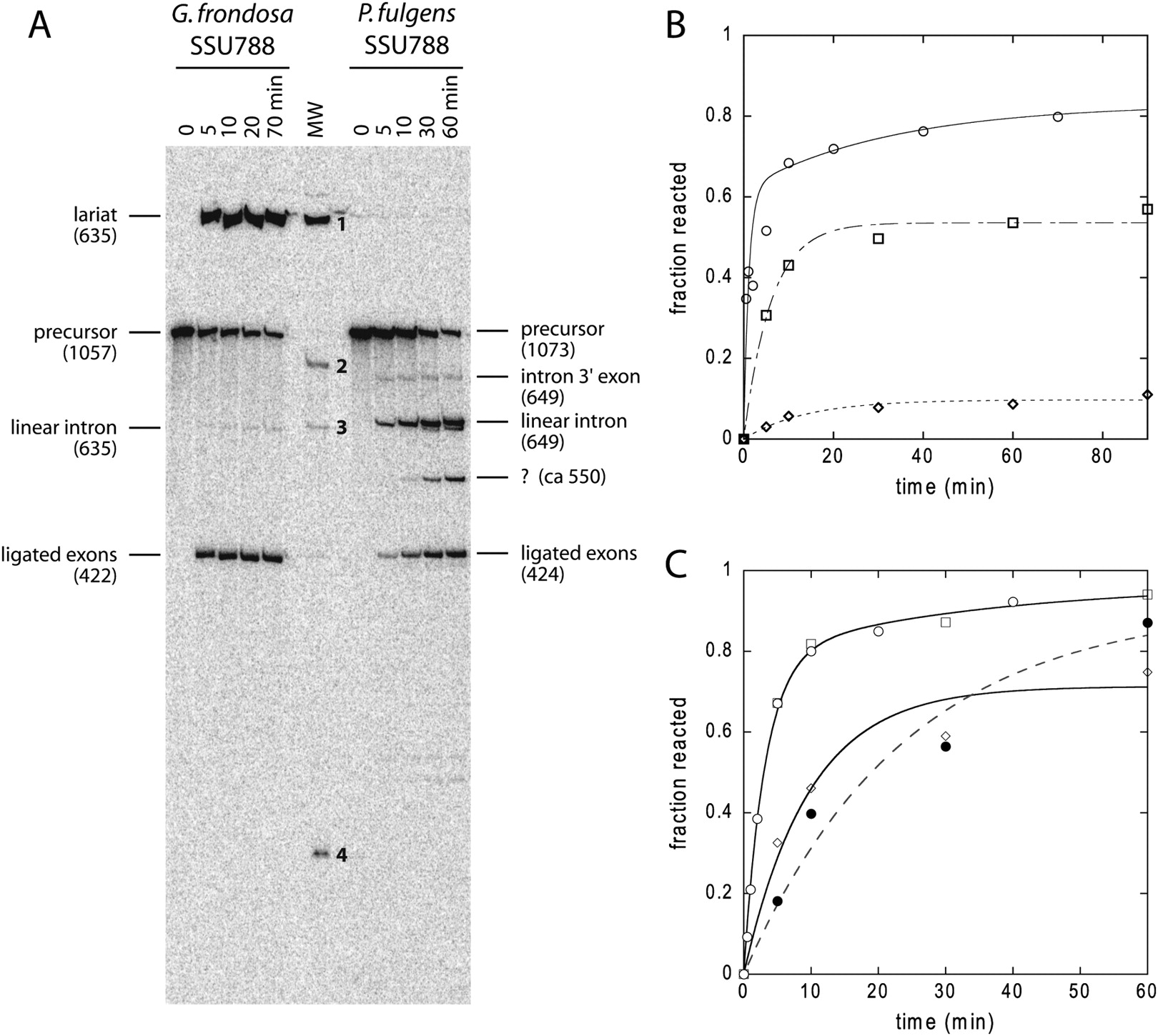
Self-splicing of the Grifola and Pycnoporellus SSU788 introns. (A) Time course of self-splicing reactions at 42°C in 1 M NH4Cl, 20 mM MgCl2, 40 mM Na-MES (pH 6.2). Products were identified based on (1) reverse transcription of gel-extracted molecules (see Fig. 4) and (2) their electrophoretic mobility, compared to that of known splicing products of a P. littoralis LSU1787 (Table 1; Costa et al. 1997b) precursor transcript (MW lane: band 1, 640 nt, lariat; band 2, 872 nt, precursor; band 3, 640 nt, linear intron; band 4, 232 nt, ligated exons). (B) Time course of self-splicing reactions of a Grifola SSU788 precursor RNA at 42°C in 40 mM Tris-Cl (pH 7.5 at 25°C), 20 mM MgCl2, and 1 M NH4Cl (circles and solid curve, generated by a biphasic exponential fit with k1 = 0.9 ± 0.2 min−1 and k2 = 0.03 min−1) (see Materials and Methods) or 1 M KCl (squares and dashed curve, lariat intron; lozenges and dotted curve, linear intron; both from single exponential fits). (C) Time course of self-splicing reactions of a Pycnoporellus SSU788 precursor RNA in 40 mM Tris-Cl (pH 7.5 at 25°C), 1 M NH4Cl, and 10 mM MgCl2 (empty squares), 20 mM MgCl2 (empty circles), 50 mM MgCl2 (empty lozenges), or in 40 mM Na-MES (pH 6.2) and 20 mM MgCl2 (filled circles and dashed curve). Reactions at 10 and 20 mM Mg (pH 7.5) were fitted to a biphasic process (k1 = 0.32 ± 0.03 min−1, k2 = 0.030 ± 0.016 min−1), the other ones to simple exponentials.




