


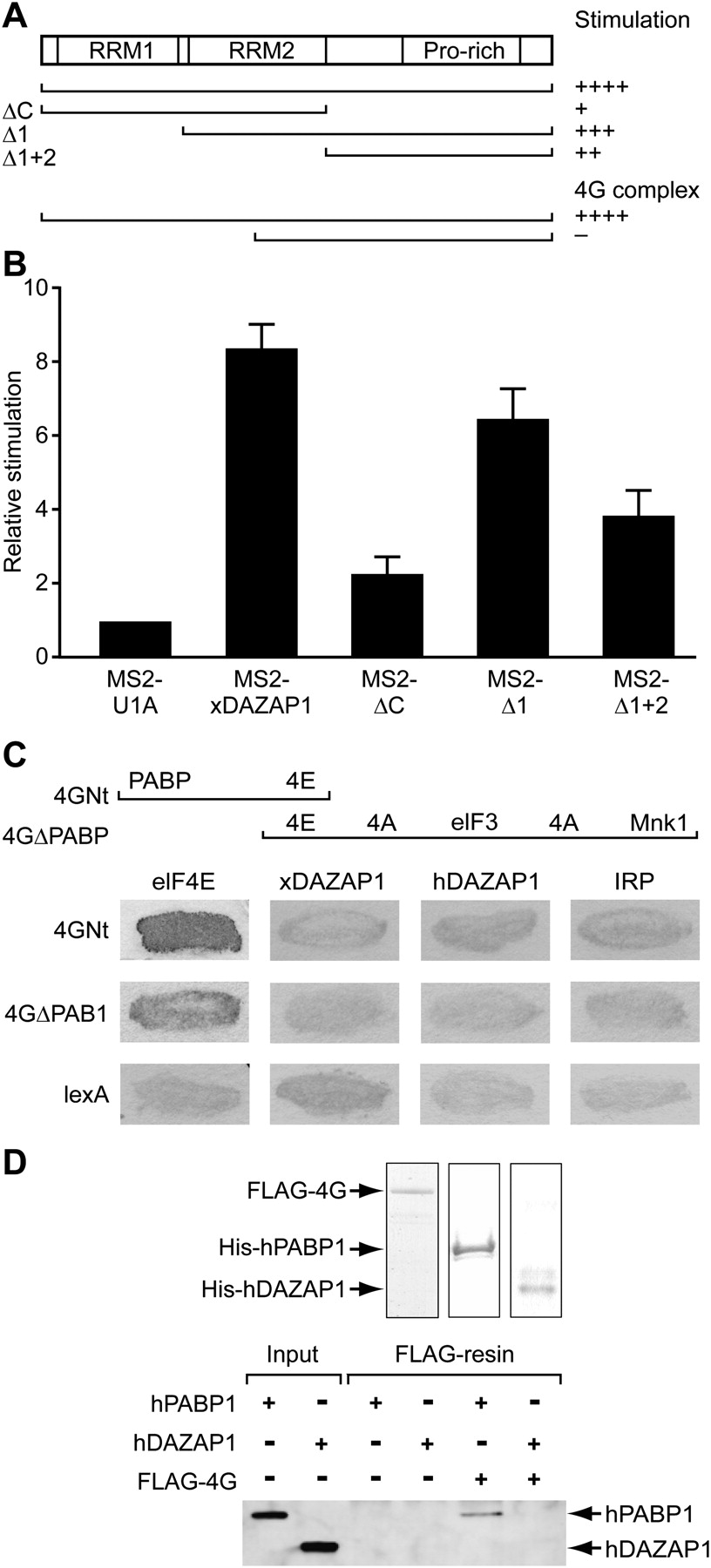
DAZAP1 C-terminal regions stimulate translation independently of a direct interaction with eIF4G. (A) Cartoon showing the constructs utilized in B, summarizing their relative ability to stimulate translation, and the co-isolation of eIF4G with full-length but not truncated GST-DAZAP1 in Yang et al. (2009). (B) Oocytes expressing MS2-U1A, MS2-xDAZAP1, MS2-ΔC (amino acids 1–192), MS2-Δ1 (amino acids 106–360), or MS2-Δ1+2 (amino acids 193–360) were co-injected with the luc-MS2 reporter and β-galactosidase control mRNAs. Data are plotted as in Figure 1A. (C, top) Cartoon showing the eIF4G truncations used and the relative locations of binding sites for the indicated partner proteins. (Bottom) Yeast two-hybrid assay using 4GNt or 4GΔPABP or MS2 (negative control; indicated by lexA) fused to the LexA-DNA-binding domain and xDAZAP1, hDAZAP1, eIF4E (positive control), or IRP (iron-responsive protein, negative control) fused to the GAL4-activation domain. Interactions were detected by qualitative β-galactosidase filter assays. (D, top) SDS-PAGE analysis of the indicated purified recombinant proteins visualized with Gelcode Blue. (Bottom) Pull-down of Flag-tagged eIF4G (FLAG-4G) in the presence of purified His-tagged PABP1 or DAZAP1 analyzed by Western blot using anti-His antibodies.




