


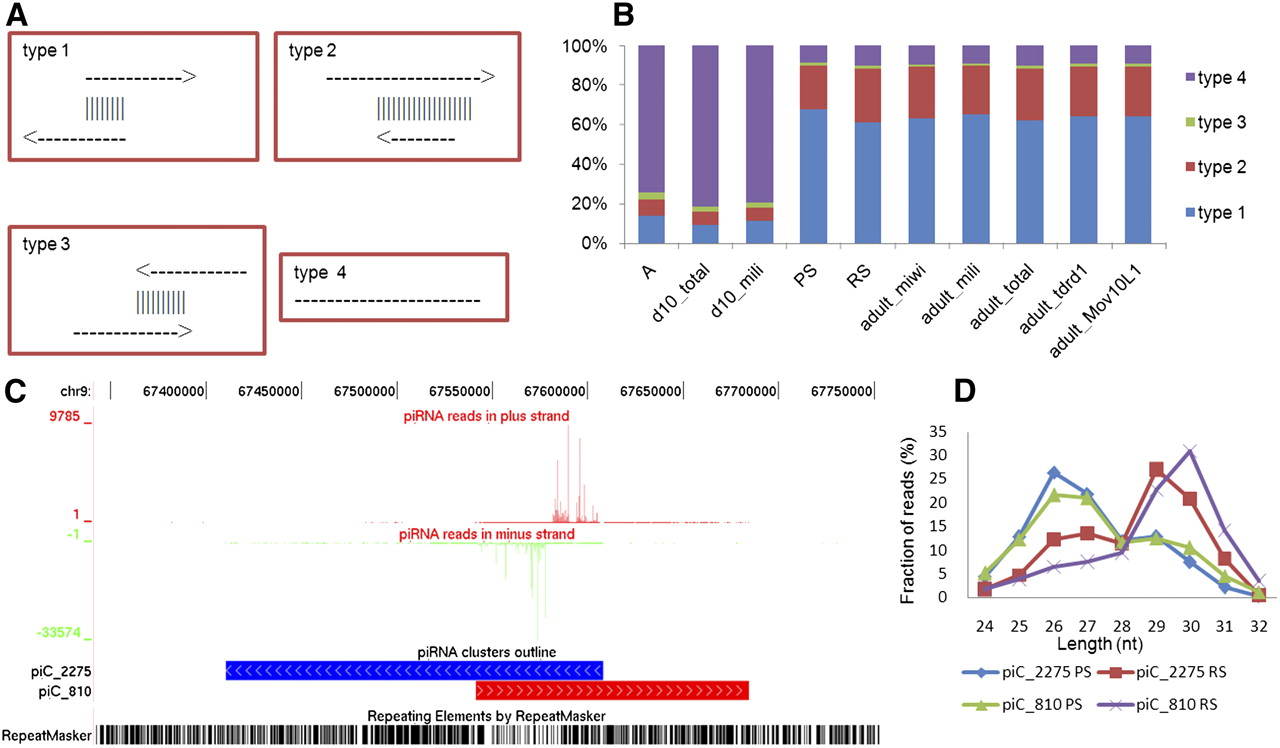
Types of intergenic piRNA clusters. (A) Four types of clusters of IGPRs are illustrated according to the locations of piRNAs in sense and antisense strands. Arrows indicate the transcriptional orientations of the piRNA clusters. The vertical lines indicate the overlap region of two clusters. Types 1–3 show pairs of clusters with different overlapping patterns. Type 4 is a single cluster that does not overlap with other clusters. (B) Distribution of IGPRs from different libraries in these four types. (C) Annotation of a two type 1 clusters. piRNA clusters on the plus strands (red boxes) and minus strands (blue boxes). The vertical coordinate indicates the number of piRNA reads. (Green bars) Negative values show piRNAs that are on the minus strand of the chromosome. (Red bars) Positive values indicate piRNAs that are on the plus strand. Repeat elements were marked at the bottom. (D) The length distribution of the sense and antisense piRNAs of two type 1 clusters in pachytene spermatocytes (PS) and round spermatid (RS) piRNAs. It is noted that the lengths of piRNAs from the same cluster at different stages have different distributions.




