


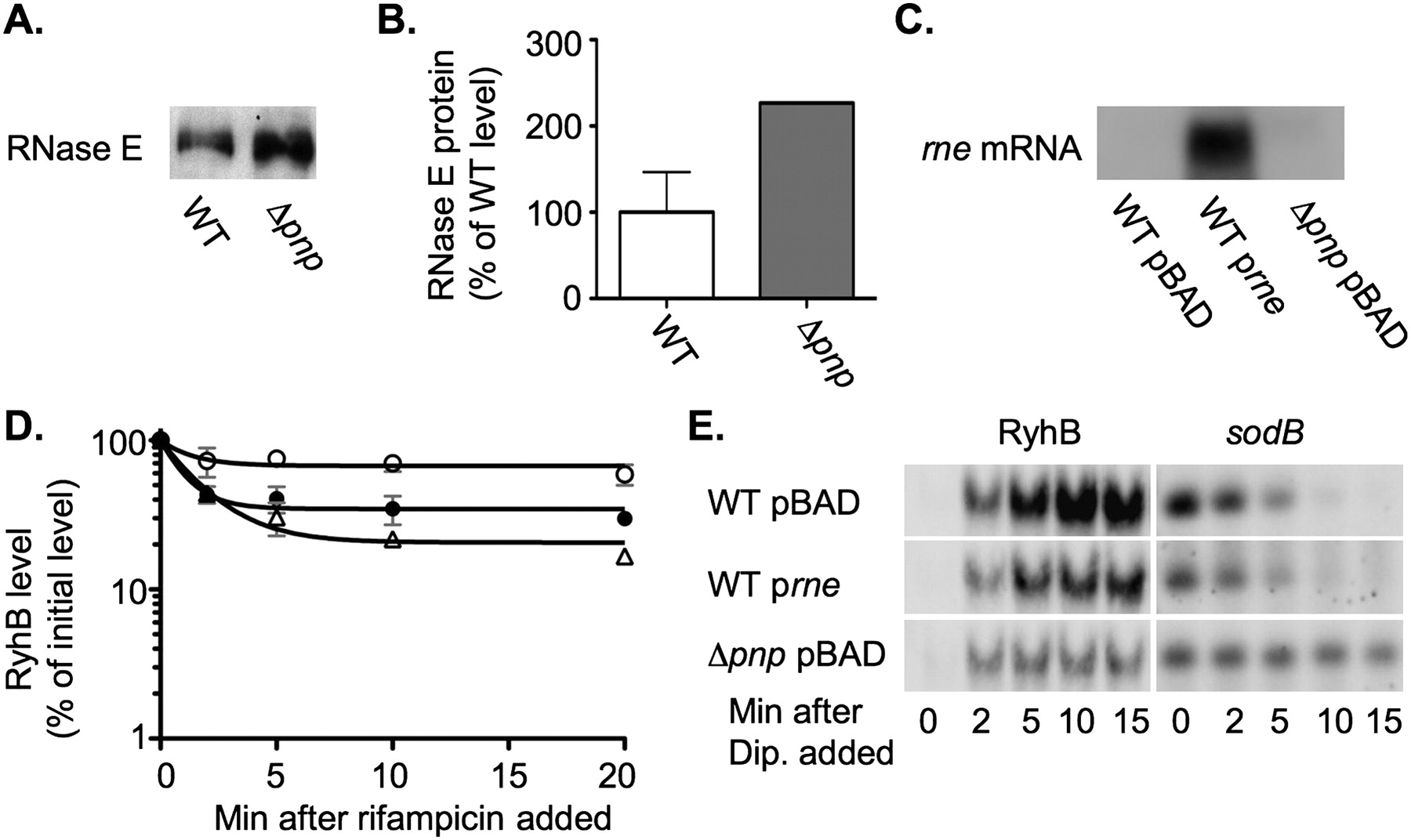
RNase E levels in pnp mutants and the effect of overexpression of RNase E on sRNA function. (A,B) Overnight cultures of the wild-type strain TM338 that expresses a FLAG-tagged RNase E from its native promoter (WT; white bars) or the isogenic pnp deletion mutant NRD558 (Δpnp; gray bars) were diluted 200-fold into fresh LB. The strains were grown at 37°C to an OD600 between 0.3 and 0.4, and a sample was removed from each culture and TCA-precipitated. An equal amount of protein based on the cell density was processed as described in Materials and Methods and developed using an anti-FLAG monoclonal affinity-purified antibody. A representative blot is shown in A. The results shown in B represent the mean of two independent experiments. (C,D,E) Overnight cultures of the wild-type strain (NM534; WT; circles) or a derivative harboring a pnp deletion (NRD571; Δpnp; triangles) and carrying the empty vector (pBAD30; pBAD; open symbols) or a plasmid that expresses RNase E from an araBAD promoter (pNRD416; prne; solid symbols) were diluted 200-fold in LB-ampicillin medium containing arabinose at a final concentration of 0.0009%. The strains were grown at 37°C to an OD600 between 0.3 and 0.4, a sample was taken, and dipyridyl was added to each culture. Additional samples were taken after dipyridyl addition as indicated in E. Sixteen minutes after dipyridyl addition, rifampicin was added to the cultures, and samples were taken as indicated in D. The RNA was extracted and processed as described in Figure 4, using the 5′-biotinylated rne probe, RyhB probe, and sodB probe. The Northern blot in C contains the RNA taken from each sample prior to dipyridyl addition. The blots C and E are representative of two experiments. The results in D represent the mean of two experiments, and the standard deviation is indicated by the gray bars.




