


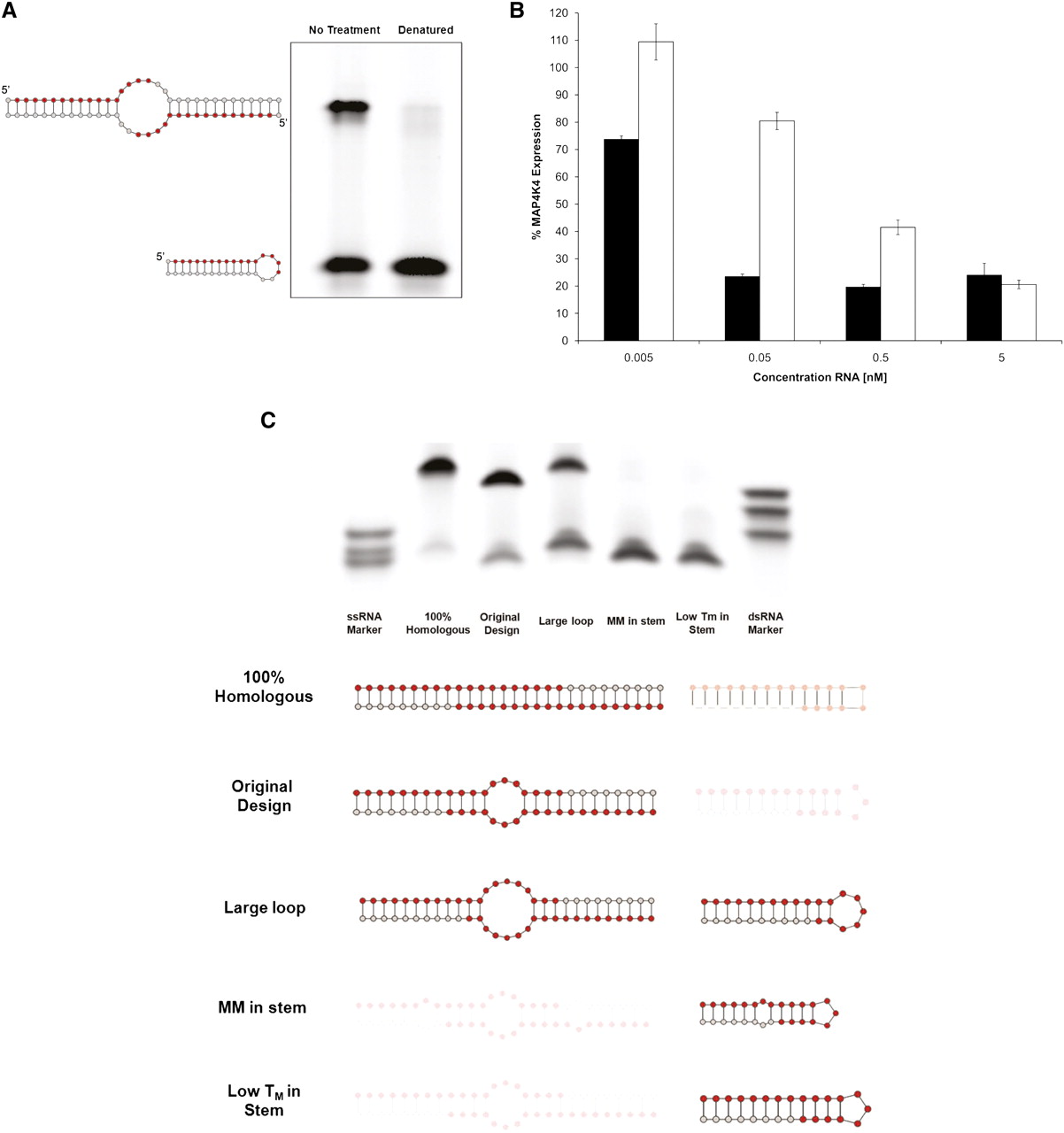
Single oligo compound conformation (monomer versus homodimer) affects RNAi activity. (A) Native polyacrylamide gel electrophoresis demonstrates the ability of the soloRNAs to fold into two conformations—the homodimer (upper band) and the self-annealing mini-hairpin monomer (lower band). The monomer formation is favored upon heat-denaturation followed by snap cooling at low concentration (right lane). The gel image has been inverted for visual clarity. (B) Analysis of the efficacy of original (black bars) and monomer-enriched conformations (white bars) in tissue culture experiments reveals substantial differences in efficacy. MAP4K4-targeting constructs were transfected at various concentrations in HEK293 cells, and gene expression was measured after 48 h using the QuantiGene bDNA assay. Error bars represent the standard deviation of biological triplicates. (C) Native gel analysis of a panel of RNA oligonucleotides with various stem and loop structures. Lack of shading (bottom panel) indicates a preferred conformation based on native polyacrylamide gel (top panel). Oligonucleotides were resuspended at 10 mM, and a fraction of the sample (10 pmol) was run on a native 20% polyacrylamide gel. The gel was run alongside ssRNA markers (17, 19, and 25 nt; left-most lane; bottom to top) and dsRNA markers (17, 19, and 25 bp; right-most lane; bottom to top). The gel was stained with SYBR Green, and the image was inverted to increase visual clarity.




