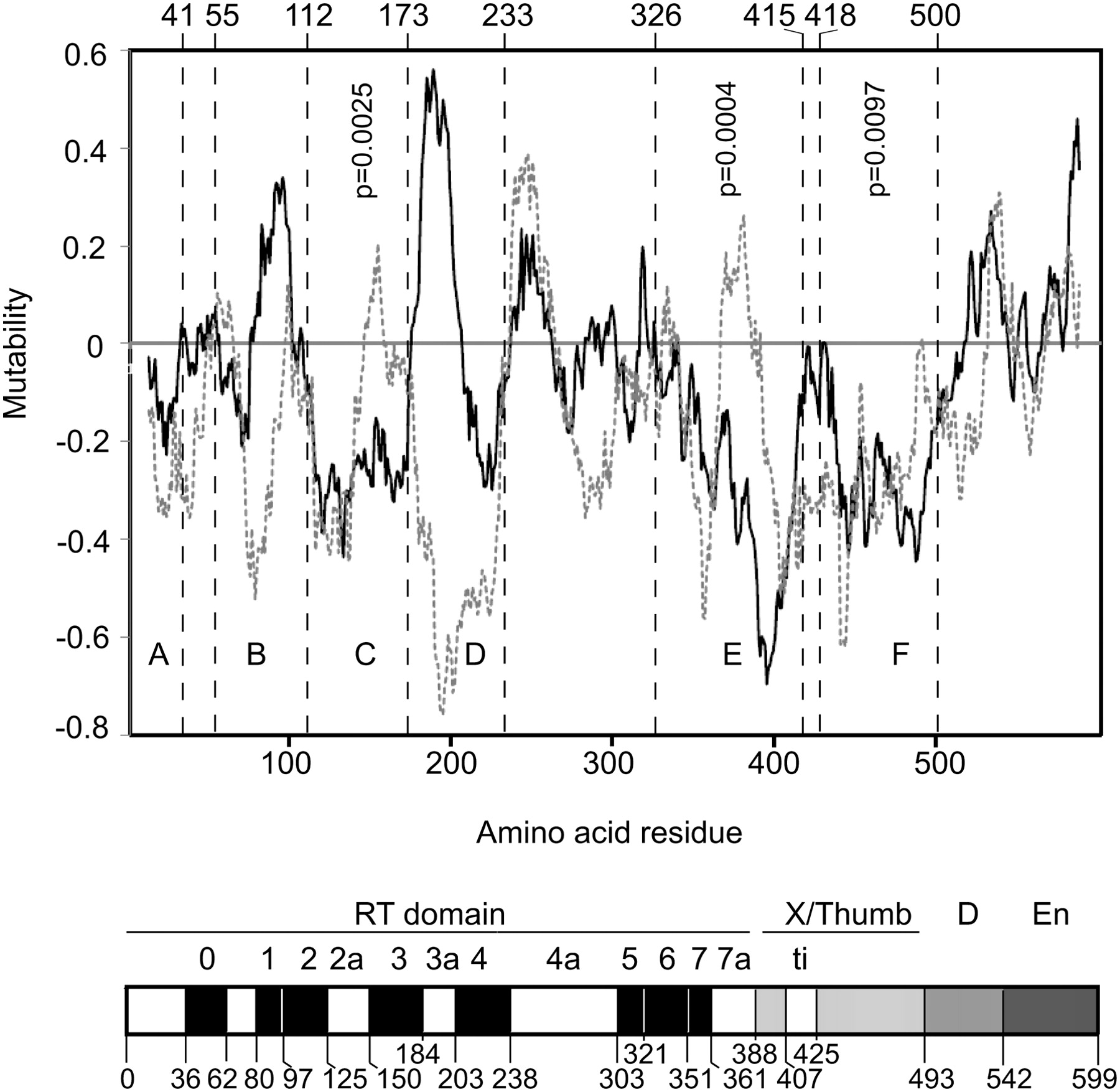
Unigenic evolution analysis of LtrA variants that splice the Ll.LtrB-ΔDIVa intron. E. coli HMS174(DE3) containing a pELG2-ΔDIVa library with random PCR-generated mutations in the LtrA ORF was screened by colony immunoblot assay to identifying functional LtrA variants that promote splicing of the Ll.LtrB-ΔDIVa intron, leading to expression of GFP. Positive colonies were grown up in LB medium, and plasmids were isolated, retransformed into E. coli HMS174(DE3) to confirm splicing activity by RT-PCR for ligated-exons sequences, and sequenced to identify mutations. The plot shows mutability (M) values at different positions in the LtrA protein calculated across a 25-amino acid residue sliding window, as described in the Materials and Methods. The analysis is based on sequences of 170 functional LtrA variants that could promote splicing of the Ll.LtrB-ΔDIVa intron and contained 945 mutations, of which 575 were missense and 370 were silent (summarized in Supplemental Fig. S3). Negative M-values indicate hypomutability, with a minimum value of −1 indicating no missense mutations, and positive M-values indicating hypermutability. P-values for statistically significant hypomutable regions are shown. A plot for LtrA variants that efficiently splice the wild-type Ll.LtrB-ΔORF intron based on the unigenic evolution data in Cui et al. (2004) is shown as a dotted line for comparison (see Supplemental Fig. S4 for details). A schematic of LtrA showing different regions aligned with the mutability plot is shown below.