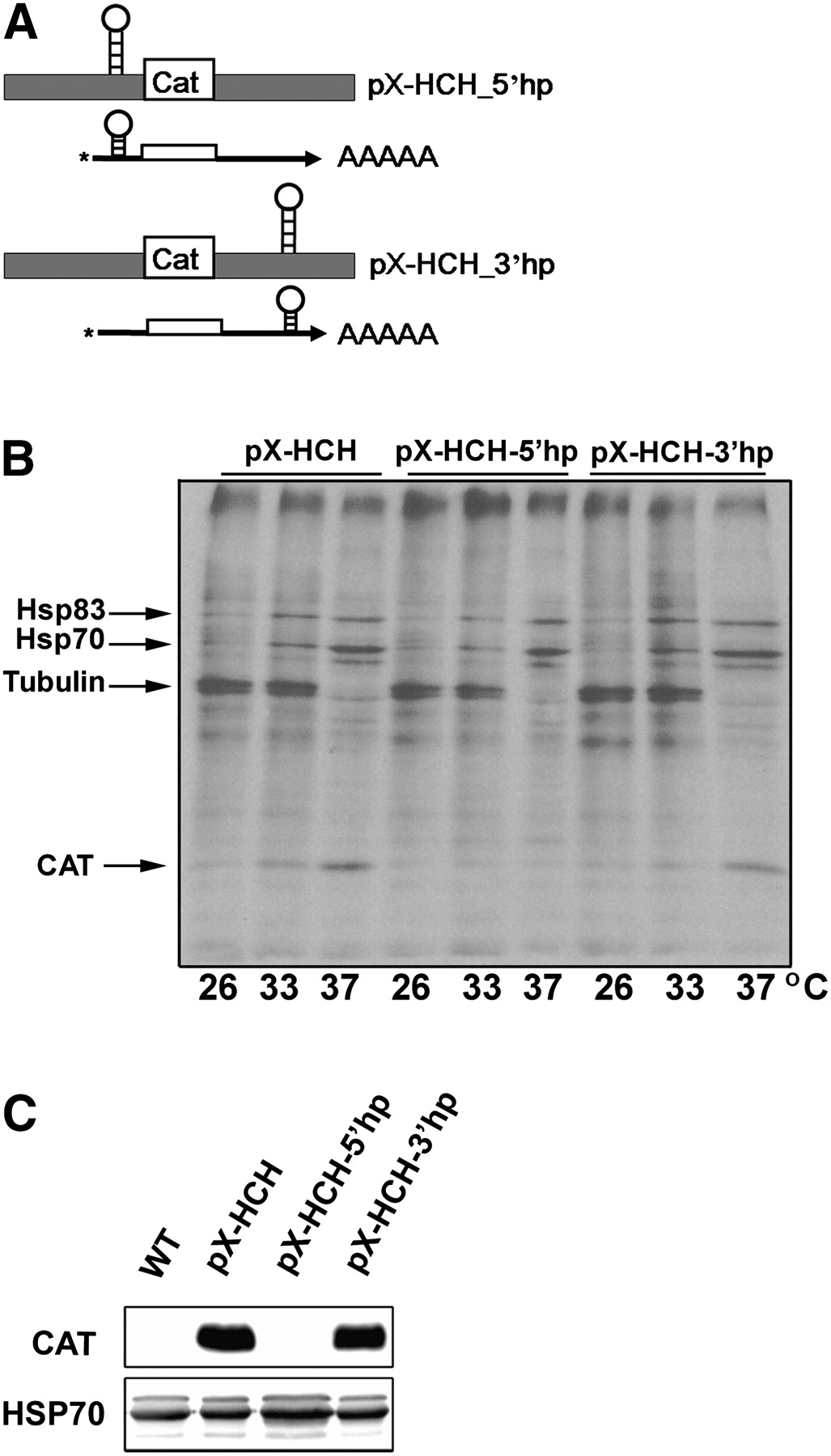
Preferential translation of Hsp83 occurs via scanning of the 5′ UTR. (A) Introduction of a hairpin structure at the Hsp83 5′ and 3′ UTRs. A scheme of plasmids carrying the CAT gene flanked with Hsp83 IRs, with a foreign hairpin structure introduced either to the 5′ or to the 3′ UTRs, is shown. The CAT constructs were cloned into the pX transfection vector and used to generate transgenic Leishmania lines. (B) A hairpin structure introduced in the 5′ UTR has an inhibitory effect on CAT translation at both temperatures. Cells expressing the CAT gene under control of the Hsp83 IRs carrying a hairpin structure either at the 5′ or at the 3′ UTR were incubated for 1 h at different temperatures, 26°C, 33°C, or 37°C, and metabolically labeled with 35[S]-labeled methionine and cystein during 30 min at the corresponding temperatures. Proteins were extracted and separated over 15% SDS-polyacrylamide gels. The migration distances of Hsp83, Hsp70, tubulin, and the CAT reporter gene are marked by arrows. Introduction of a hairpin structure into the 5′ UTR inhibited the de novo translation of the CAT–Hsp83 chimera at all temperatures. (C) Steady-state CAT expression in cells transfected with a CAT–Hsp83 chimera carrying a hairpin structure at the 5′ (pX-HCH-5′hp) and 3′ (pX-HCH-3′hp) UTRs. Cell extracts were separated over 15% SDS-polyacrylamide gels, blotted, and reacted with anti-CAT antibodies. Protein loads were evaluated by control reactions with antibodies against Hsp70.