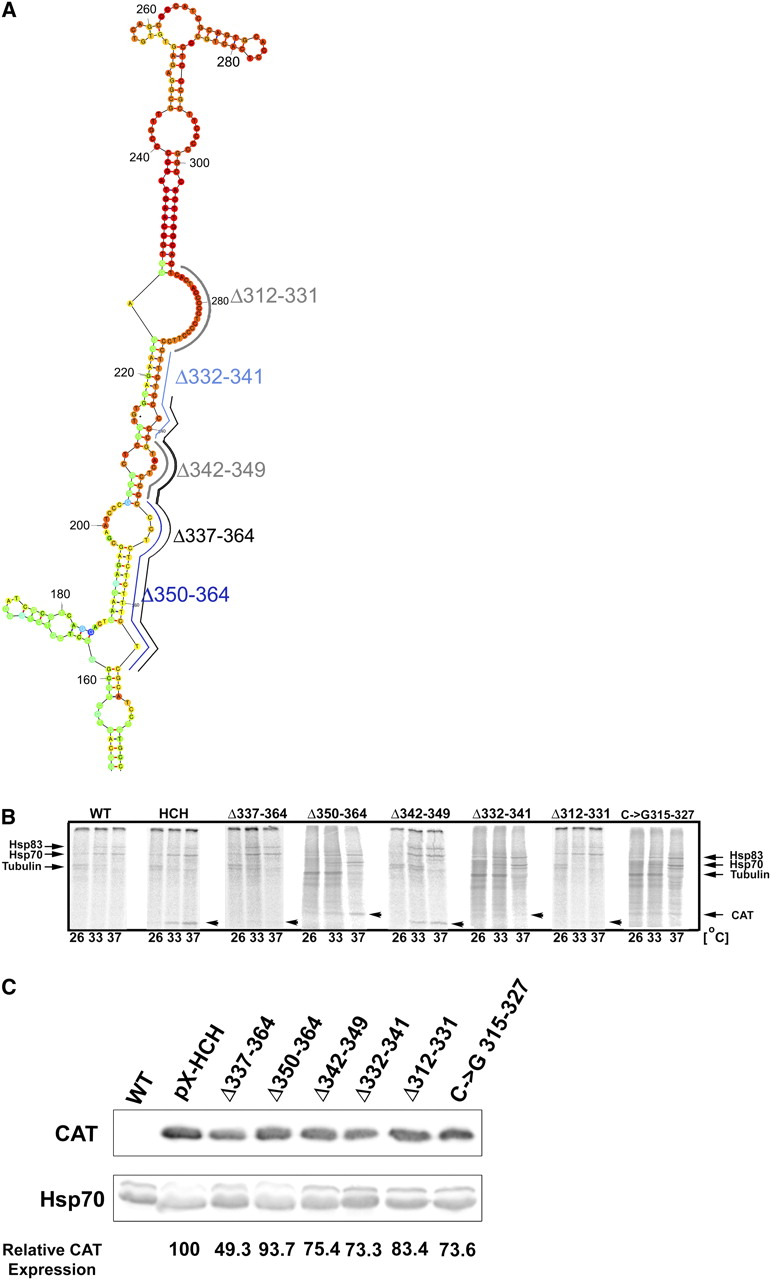
Sequences 312–341 in the Hsp83 3′ UTR are essential for preferential translation during heat shock. (A) A map of mutations within the region 150–364 in the 3′ UTR of Hsp83. The modified IRs were cloned downstream from the CAT gene to generate 3′ UTRs. The upstream Hsp83 IR was not modified. The chimeric CAT–Hsp83 genes were cloned in the pX vector for transfection of Leishmania, and used to generate transgenic parasite cell lines. (B) Functional fine mapping of sequences that are required for preferential translation of the CAT–Hsp83 chimeric gene. Cells expressing the CAT gene under control of the mutated Hsp83 3′ UTR were grown at 26°C, or transferred to 33°C or 37°C for 1 h, and metabolically labeled for 30 min at the corresponding temperatures with 35[S]-labeled amino acids. Proteins were extracted, separated over 15% SDS-polyacrylamide gels, and autoradiogrammed in a PhosphorImager. Migration of Hsp83. Hsp70, the α- and β-tubulins, and CAT are marked with arrowheads. WT represents the nontransfected negative control cells which do not express CAT. pX-HCH represents transgenic cells expressing CAT under control of nonmodified Hsp83 IRs. Deletion mutations Δ312–331, Δ337–364, Δ332–341, and the C → G exchange mutation at positions 315–327 abrogated preferential translation of the CAT transcript. However, deletion mutations Δ350–364 and Δ342–349 did not interfere with the increased CAT translation at elevated temperatures. (C) Steady-state CAT expression at 26°C in cells transfected with the different 3′ UTR deletions. Cell extracts were separated over 15% SDS-polyacrylamide gels, blotted, and reacted with anti-CAT antibodies. Protein loads were evaluated by control reactions with antibodies against Hsp70. The level of CAT expression was quantified with Multigauge V3.0 and normalized against Hsp70. The values shown at the bottom of the figure represent a mean of two independent experiments.