


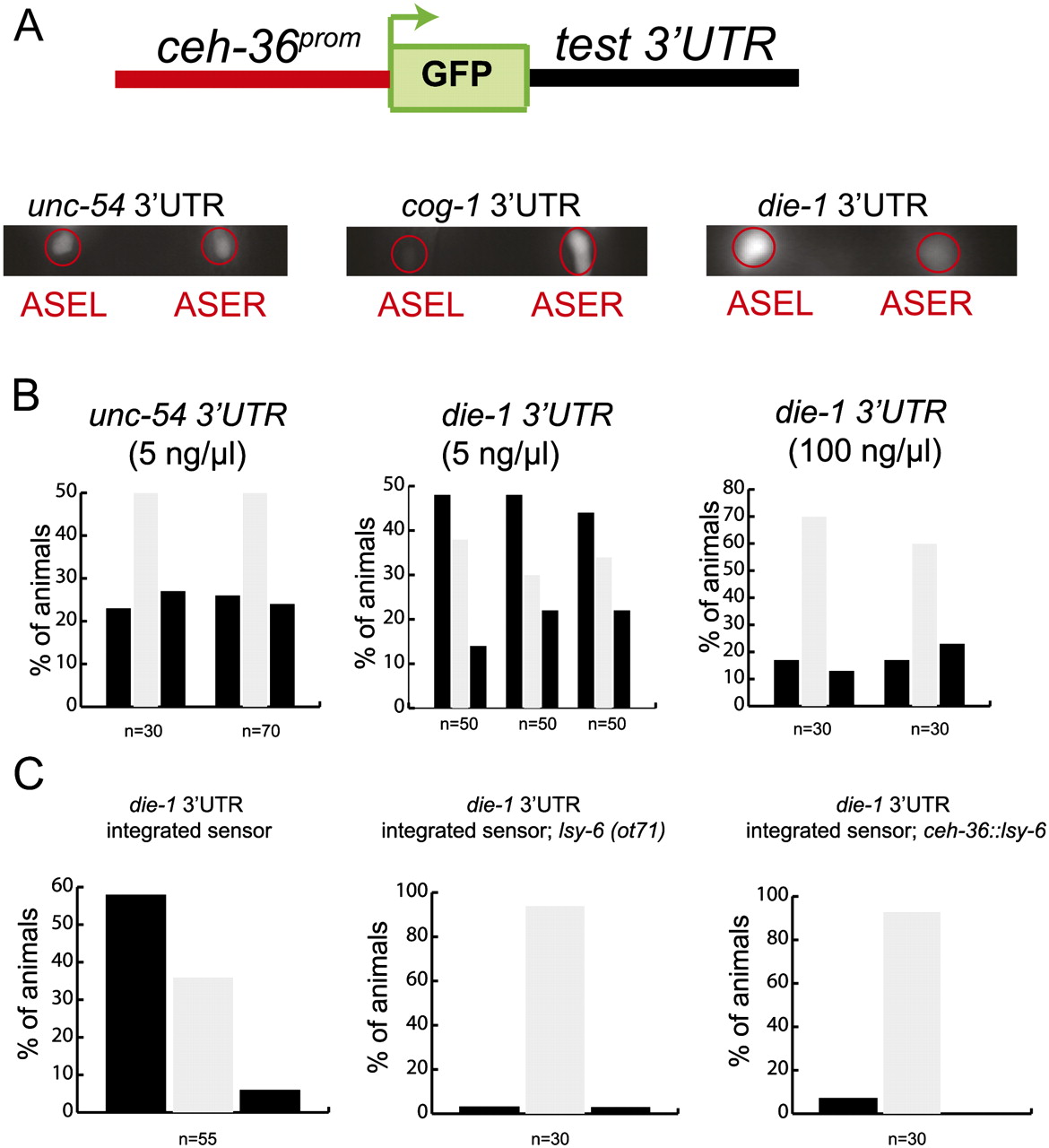
Features of the die-1 3′UTR sensor system. (A) Schematic of the die-1 3′UTR sensor and gfp images that show expression of the sensor in transgenic adult worms (all scoring throughout this article is done in young adults). ASEL and ASER are labeled by red circles. AWC neurons that serve as internal control are out of the plane of view. The data on unc-54 and cog-1 have been described before and are taken from Didiano and Hobert (2006). (B) Quantification of 3′UTR sensor expression. Each set of three bars represents an independent transgenic line. Individual animals are scored and binned into one of three categories: gfp expression in ASEL > ASER (left black bar), ASEL = ASER (middle gray bar) or ASER > ASEL (right black bar). Multiple transgenic lines of the same construct are shown for unc-54 and die-1 3′UTRs. Constructs were injected at 5 ng/μL. Injection of the wild-type die-1 3′UTR sensor construct at high concentrations (100 ng/μL) results in a loss of the observed regulation. The unc-54 data were freshly rescored. (C) die-1 3′UTR regulation is dependent upon ASE asymmetry. An integrated die-1 3′UTR sensor construct (otIs260) displays slightly higher levels of regulation than the extrachromosomal lines shown in panel B. Regulation of the integrated die-1 3′UTR sensor construct is lost in 2-ASER (lsy-6) or 2-ASEL (ceh-36∷lsy-6) mutants. The lsy-6 allele used (ot71) has a 100% 2-ASER phenotype (Johnston and Hobert 2003). The ceh-36∷lsy-6 strain otIs204 expresses lsy-6 bilaterally in ASEL and ASER, causing a near 100% 2-ASEL phenotype, as previously described (Ortiz et al. 2009).




