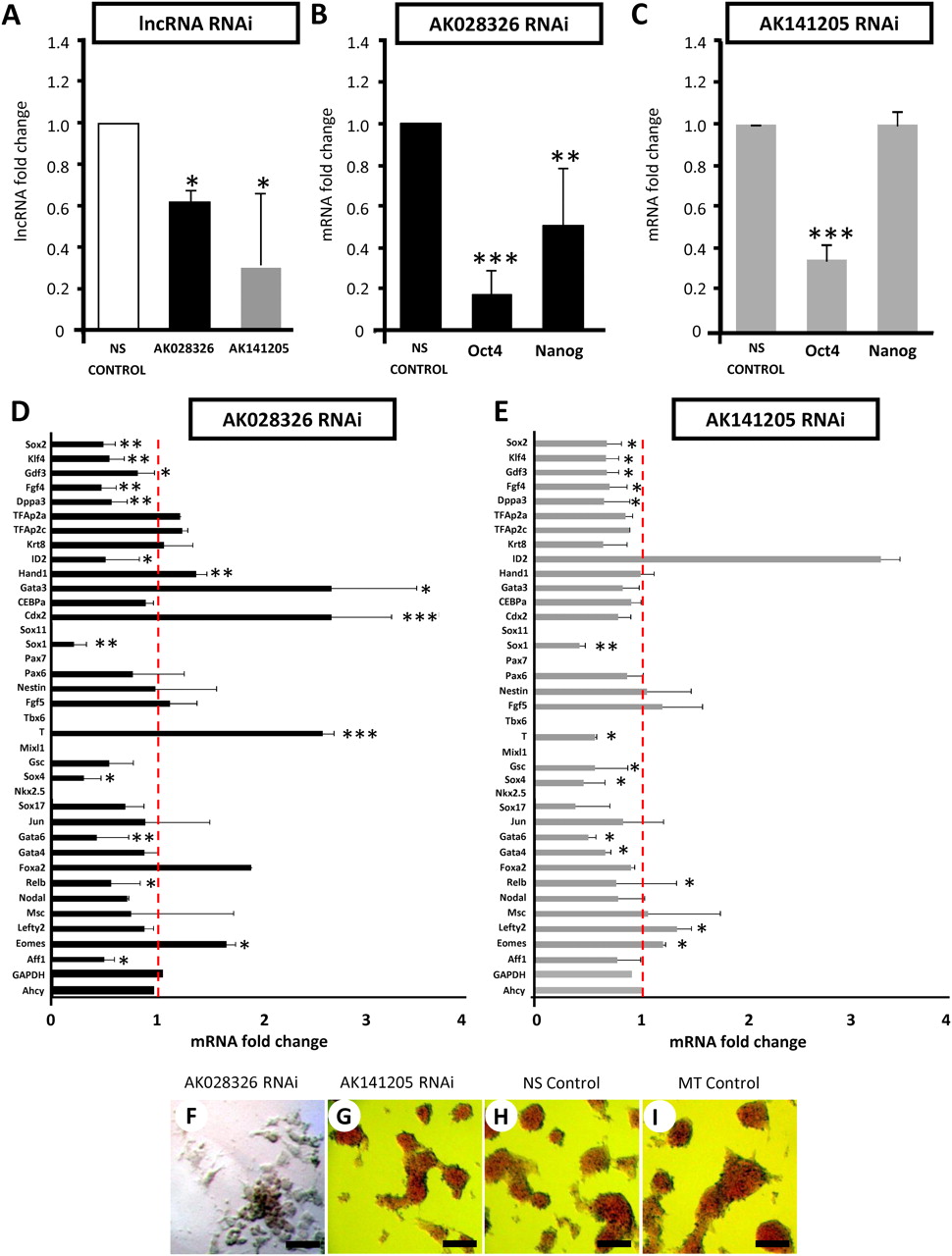
Expression of lncRNAs, pluripotent markers, trophectoderm markers, and epiblast lineage markers in response to lncRNA silencing (RNAi). (A) AK028326 and AK141205 are significantly down-regulated in response to siRNA treatment. (B) AK028326 RNAi was associated with significant down-regulation of both Oct4 and Nanog. (C) AK141205 RNAi was associated with significant down-regulation of Oct4, but Nanog levels remained unchanged. (D) In AK028326 siRNA-treated mESCs, there was a significant enhancement of the mesodermal marker T/Brachyury and the trophectoderm markers Cdx2, Hand1, Gata3, and Eomes; down-regulation of pluripotent markers; and unchanged levels of the housekeeping genes Gapdh and Ahcy. (E) In AK141205 siRNA-treated mESCs, there was general down-regulation of the pluripotent and epiblast lineage markers, up-regulation of the Oct4-repressed marker Id2, and unchanged levels of Gapdh and Ahcy. (F–I) Alkaline phosphatase staining of mESCs treated with siRNAs against AK028326 (F), AK141205 (G), NS control (H), or mock transfection control (MT control) (I). Scale bar, 100 μm. (Asterisks) Significant difference from control samples (*, P < 0.05; **, P < 0.01; ***, P < 0.001) relative to NS control (dotted red line).