


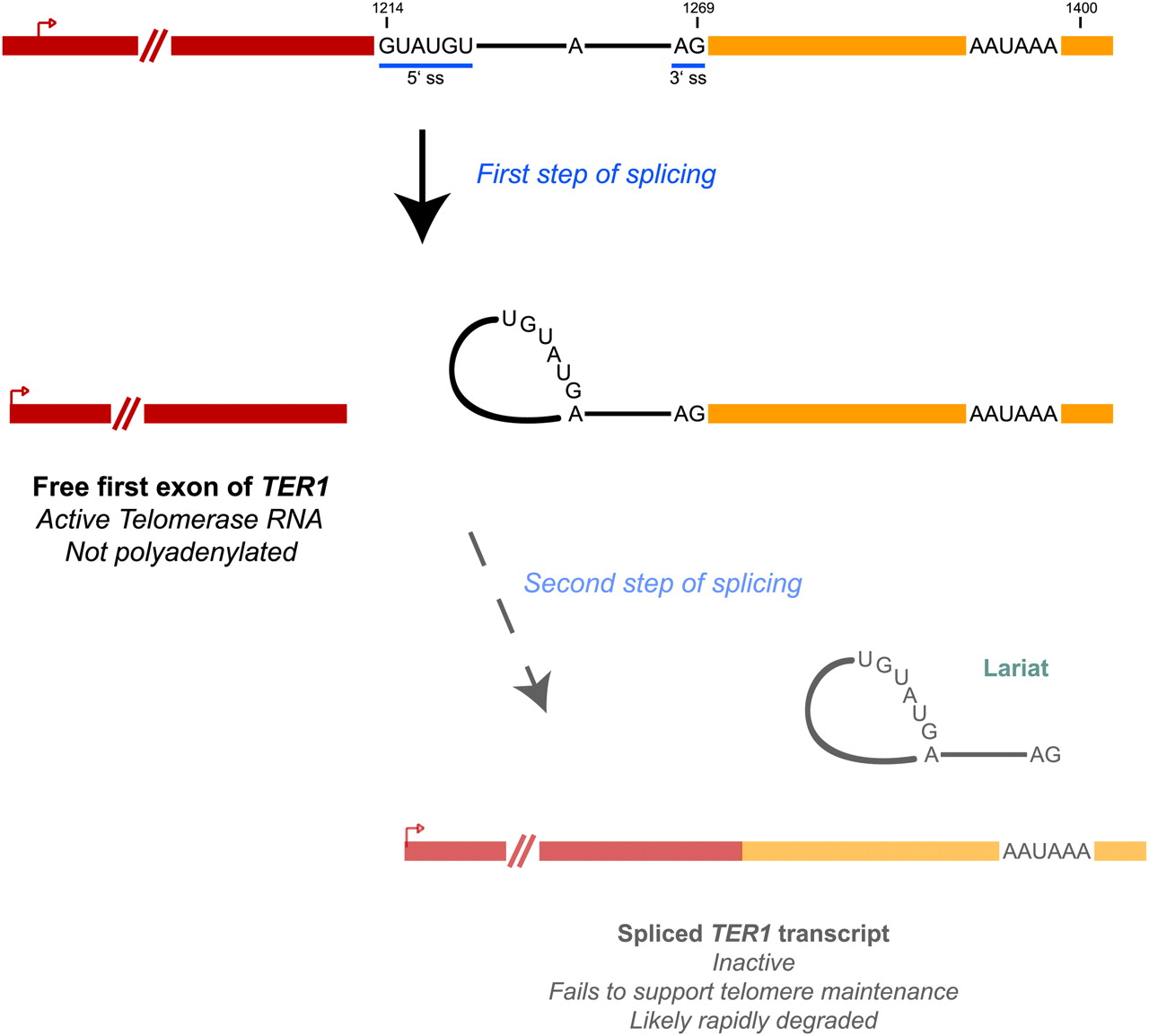
Incomplete splicing generates the functional S. pombe TER1 transcript. A short intron, with canonical 5′ and 3′ splice sites (denoted 5′ ss and 3′ ss, respectively) and branch point sequences, is located upstream of a canonical polyadenylation signal at the 3′ end of the S. pombe TER1 locus. Although the two transesterification steps of splicing are normally tightly coupled, they somehow become uncoupled at the TER1 locus such that only the first step is normally completed. The 5′ exon is released and subsequently functions as the active RNA component of telomerase (Box et al. 2008). If both splicing steps are completed or if the mature 3′ end of TER1 is generated by cleavage/polyadenylation, the resulting TER1 transcripts are inactive and fail to support telomere maintenance.




