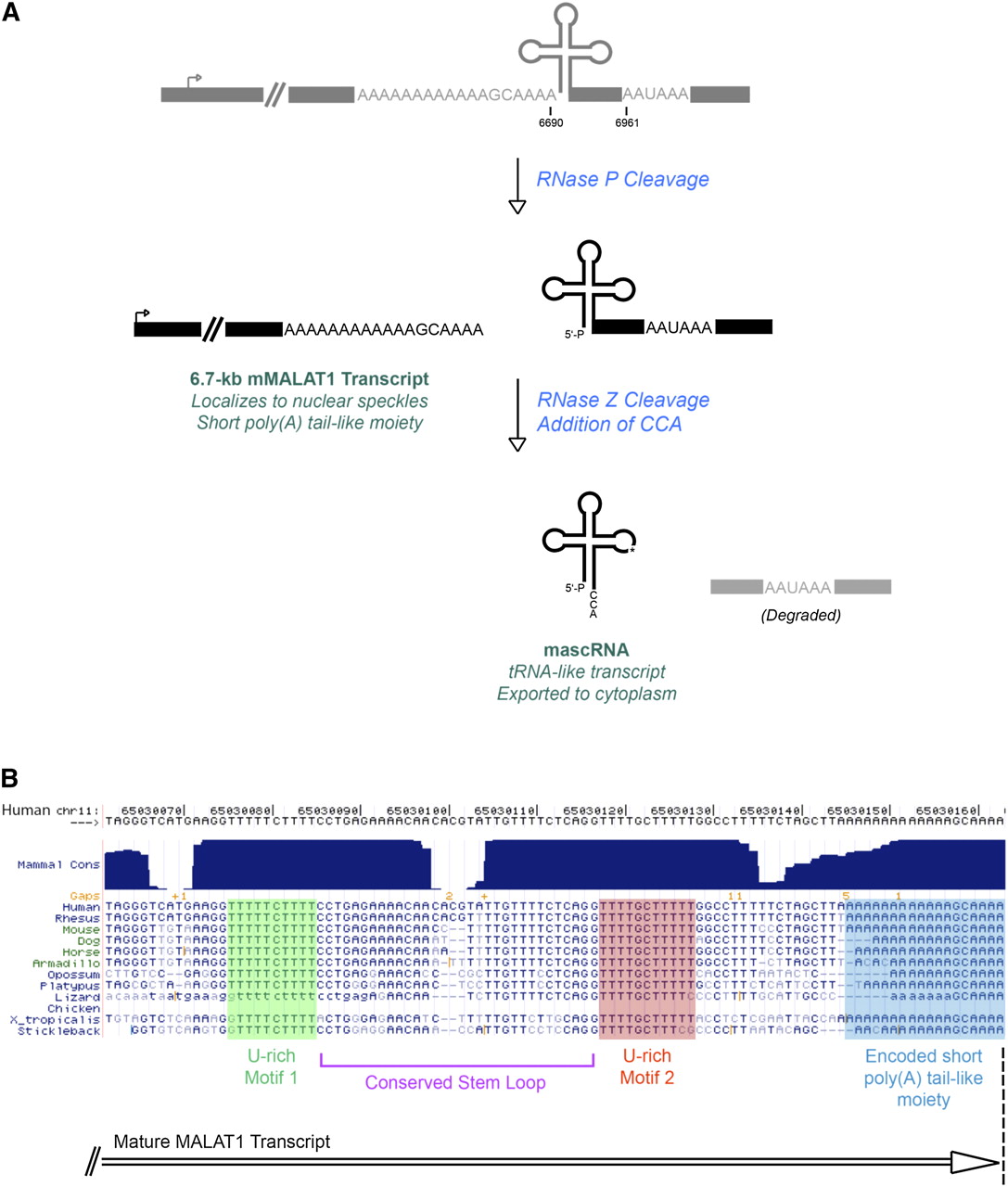
MALAT1 is processed at its 3′ end by the tRNA processing machinery. (A) Although there is a canonical polyadenylation signal at the 3′ end of the mouse MALAT1 locus, MALAT1 is primarily processed via an upstream cleavage mechanism, which yields a mature ∼6.7-kb transcript with a short poly(A) tail-like moiety at its 3′ end (Wilusz et al. 2008). Endonucleolytic cleavage by RNase P simultaneously generates the mature 3′ end of MALAT1 and the 5′ end of mascRNA. The small RNA is subsequently cleaved by RNase Z and subjected to CCA addition to generate the mature 61-nt tRNA-like transcript. (B) The MALAT1 poly(A) tail-like moiety (shaded in blue) is highly conserved and encoded in the genome. Further upstream are two nearly perfectly conserved U-rich motifs (shaded in green and orange) separated by a conserved predicted stem–loop.