


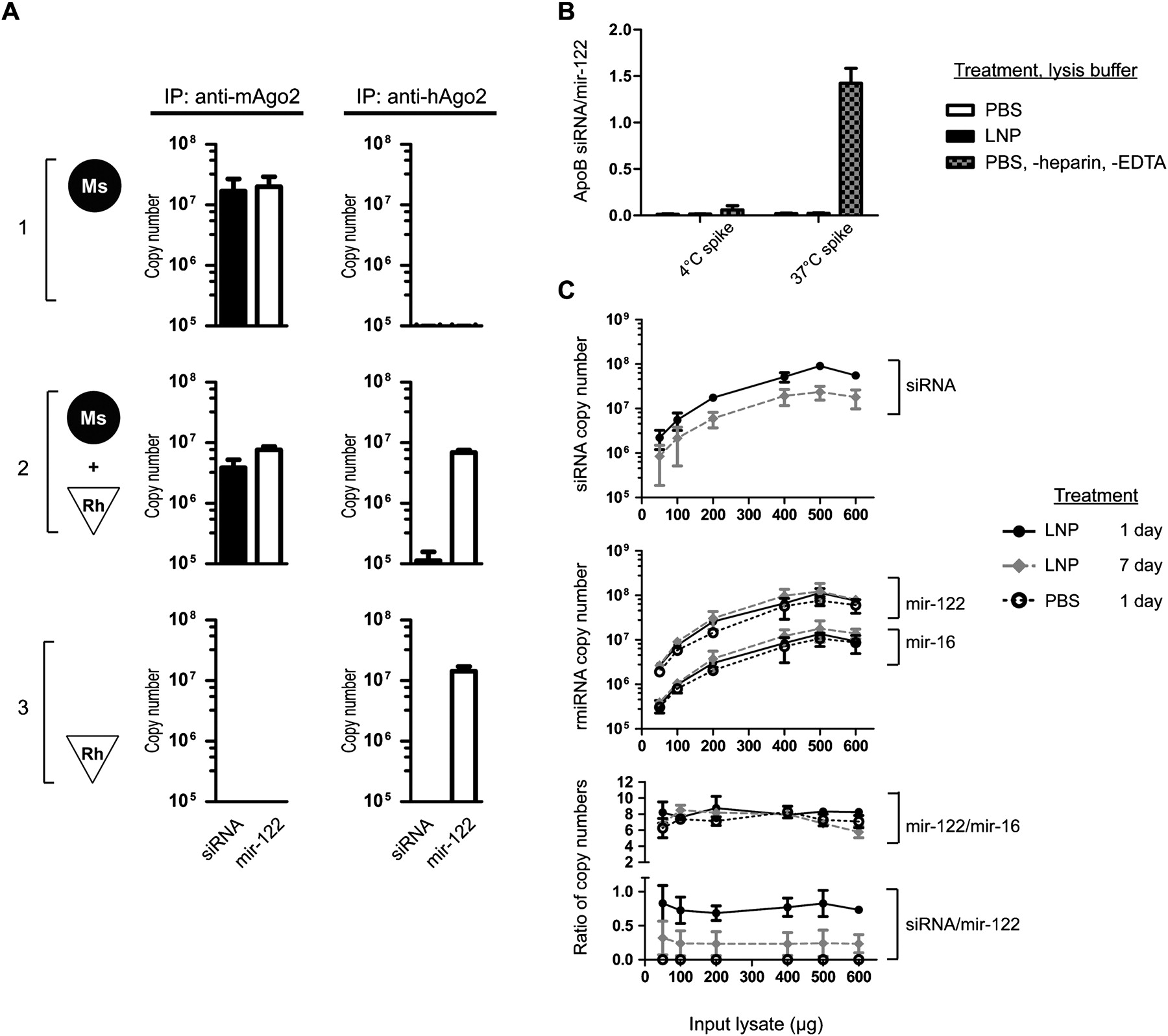
Reliability and robustness of the immunoprecipitation step. (A) siRNA-treated mouse liver harvested at 24 h post-dosing (filled circle, set 1), untreated monkey liver tissue (hollow triangle, set 3), and a mix of the two tissues (set 2) were lysed, and Ago2 from the lysates was immunoprecipitated with either anti-mouse Ago2 or anti-human/monkey Ago2 antibody. After subtracting the background numbers of small RNAs that nonspecifically bind to a control IgG, the copy numbers of Ago2-associated Ssb siRNA and mir-122 from each immunoprecipitates are graphed as mean ± SD (two independent experiments, each performed in duplicate). (B) Synthetic ApoB siRNA duplex was spiked into the indicated liver lysates at a final concentration of 1 μM and incubated at either 4°C or 37°C for 4 h before immunoprecipitation. The ratio of ApoB siRNA guide strand to mir-122 from two independent experiments with duplicates are shown as the mean ± SD. (C) The indicated amounts of liver lysates were prepared from PBS-treated or siRNA-treated animals harvested at 1 d and 7 d after dosing and were then subjected to immunoprecipitation. Copy numbers (not normalized) of Ago2-associated siRNA guide strand, mir-122, and mir-16, as well as the ratios of mir-122/mir-16 and siRNA guide/mir-122 are presented as the mean ± SD (n = 2 per datum).




