


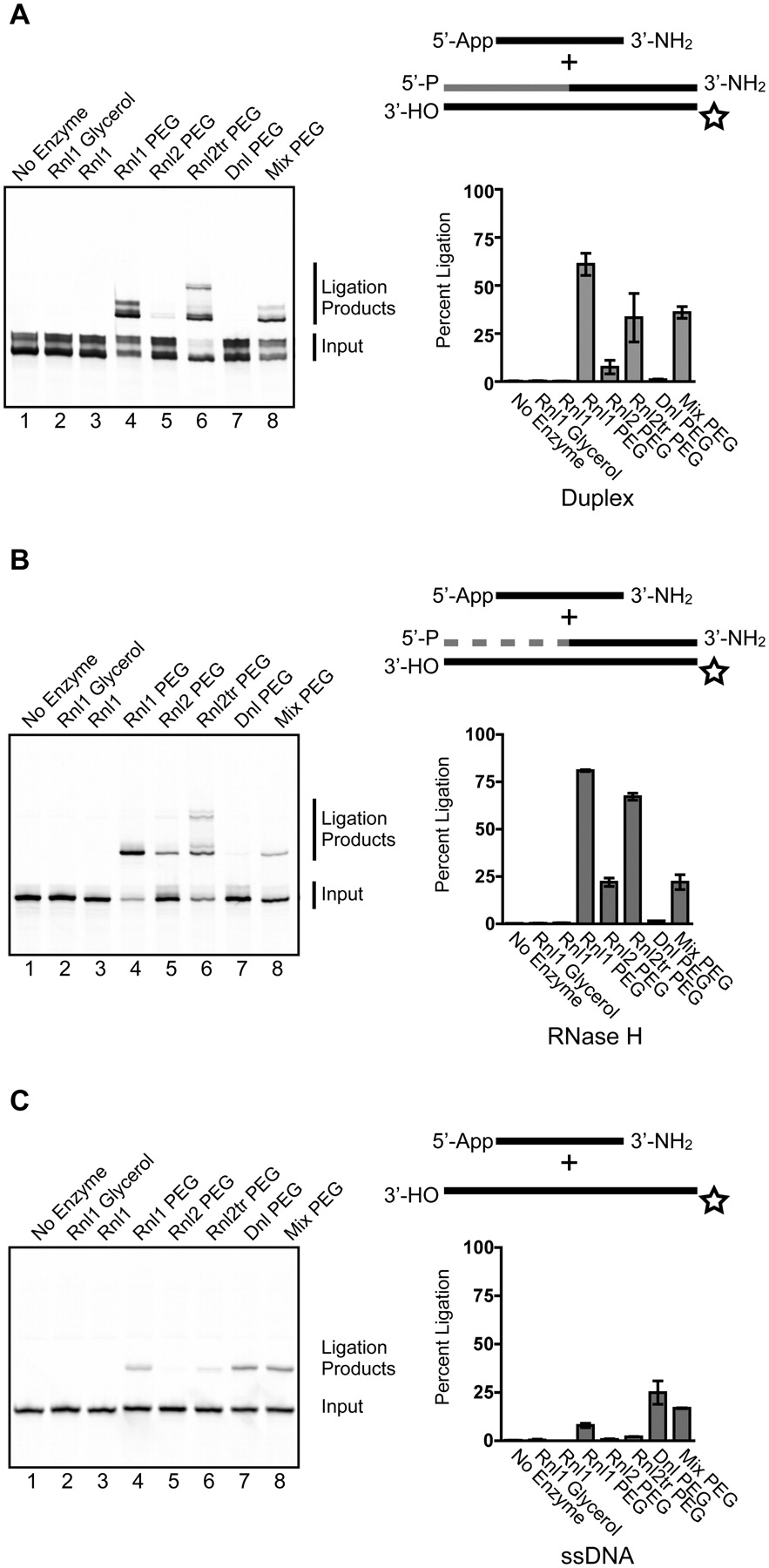
Ligation of adenylated adapters to cDNA 3′-ends. Pre-adenylated DNA oligonucleotides were ligated to synthetic double-stranded, partially double-stranded, or single-stranded oligonucleotides that mimic reaction products from reverse transcription of 3′-end ligated small RNAs. In the schematic representations of ligation inputs shown: (black lines) DNA; (gray lines) RNA; (star) IRDye 700. (A) Ligation of pre-adenylated DNA adapters to double-stranded reverse transcription products. Ligation products were separated by denaturing PAGE and visualized by IR fluorescence scanning. Ligation efficiency was determined as described in the Materials and Methods and is presented as the mean ± SEM of three independent experiments. Incubation and buffer conditions are detailed in the Materials and Methods section. (B) Ligation of pre-adenylated adapters to RNase H-treated reverse transcription products. The efficiency of ligation of pre-adenylated DNA adapters to RNase H-treated substrates is represented graphically as the mean ± SEM of three independent experiments. Ligase, buffer composition, and incubation conditions correspond to those in panel A. (C) Ligation of pre-adenylated adapters to single-stranded DNA oligonucleotides. The efficiency of ligation of pre-adenylated DNA adapters to synthetic single-stranded DNA oligonucleotides is represented graphically as the mean ± SEM of three independent experiments. Ligase, buffer composition, and incubation conditions correspond to those in panel A.




