


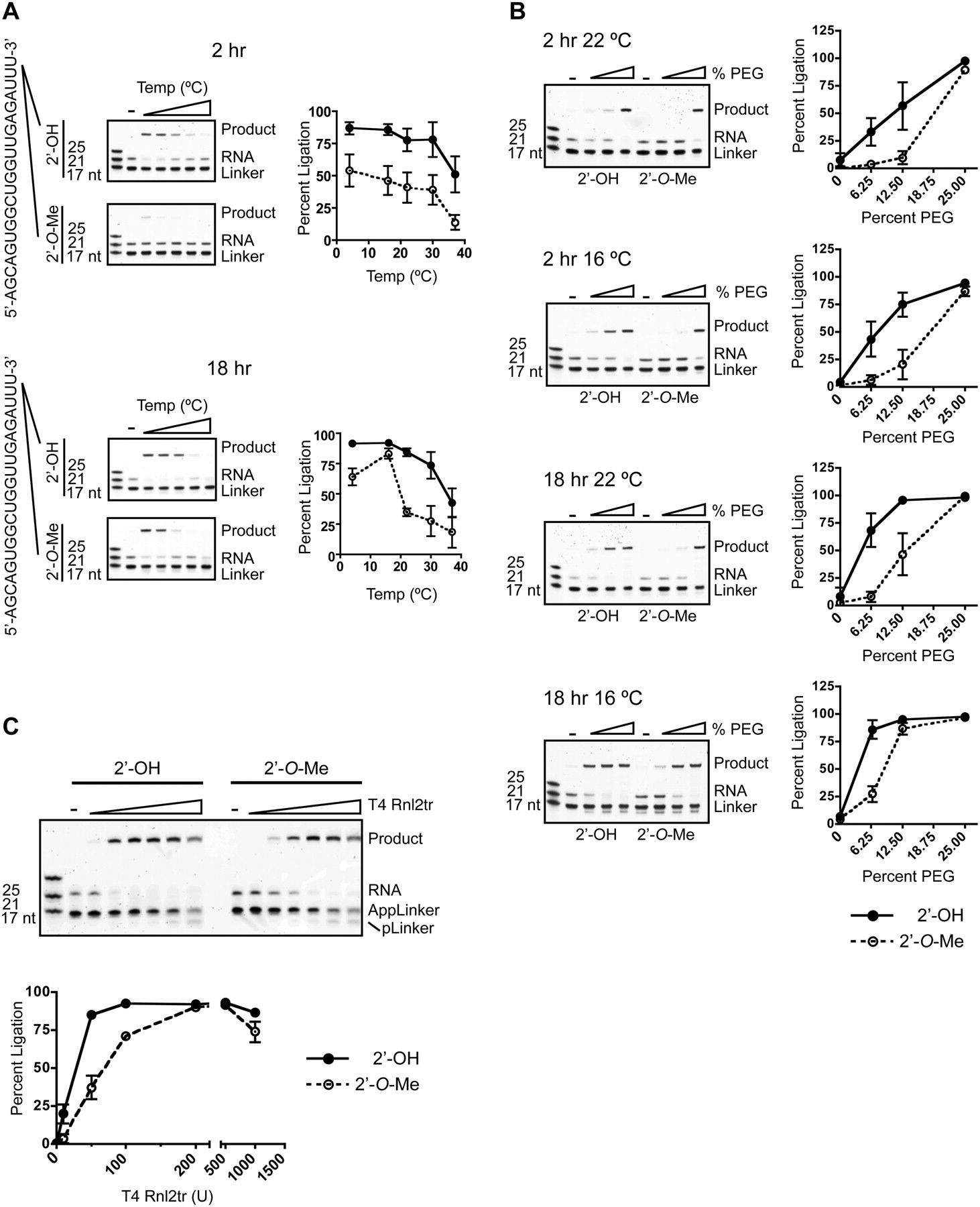
Optimization of RNA 3′-end adapter ligation. (A) Temperature optimization. Synthetic ssRNA oligonucleotides with either 2′-hydroxyl (OH) or 2′-O-methyl (O-Me) 3′-ends were ligated to pre-adenylated DNA adapters (Linker) at different temperatures for either 2 or 18 h with 200 units of T4 Rnl2tr or without enzyme (−; input control). Ligation products were resolved and visualized by SYBR Gold staining. Ligation efficiency at varying temperatures is graphically represented as the mean ± SEM of four independent experiments. (B) Polyethylene glycol (PEG) as a ligation enhancer. Ligations were performed in the presence of varying concentrations of polyethylene glycol 8000 (PEG). Final concentrations in the reaction were 6.25%, 12.5%, and 25% (w/v). Ligation reactions were incubated for either 2 h or 18 h at 22°C or 16°C as indicated using 200 units of T4 Rnl2tr. (−) Indicates the absence of ligase. Ligation efficiency at varying concentrations of PEG 8000 is graphically represented as the mean ± SEM of three independent experiments. (C) Enzyme concentration. Ligations were performed using increasing amounts truncated T4 Rnl2tr (0, 10, 50, 100, 200, 500, 1000 units) in a reaction buffer containing 25% PEG 8000 (w/v) for 2 h at room temperature. Ligation efficiency using increasing amounts of enzyme are graphically represented as the mean ± SEM of three independent experiments.




