


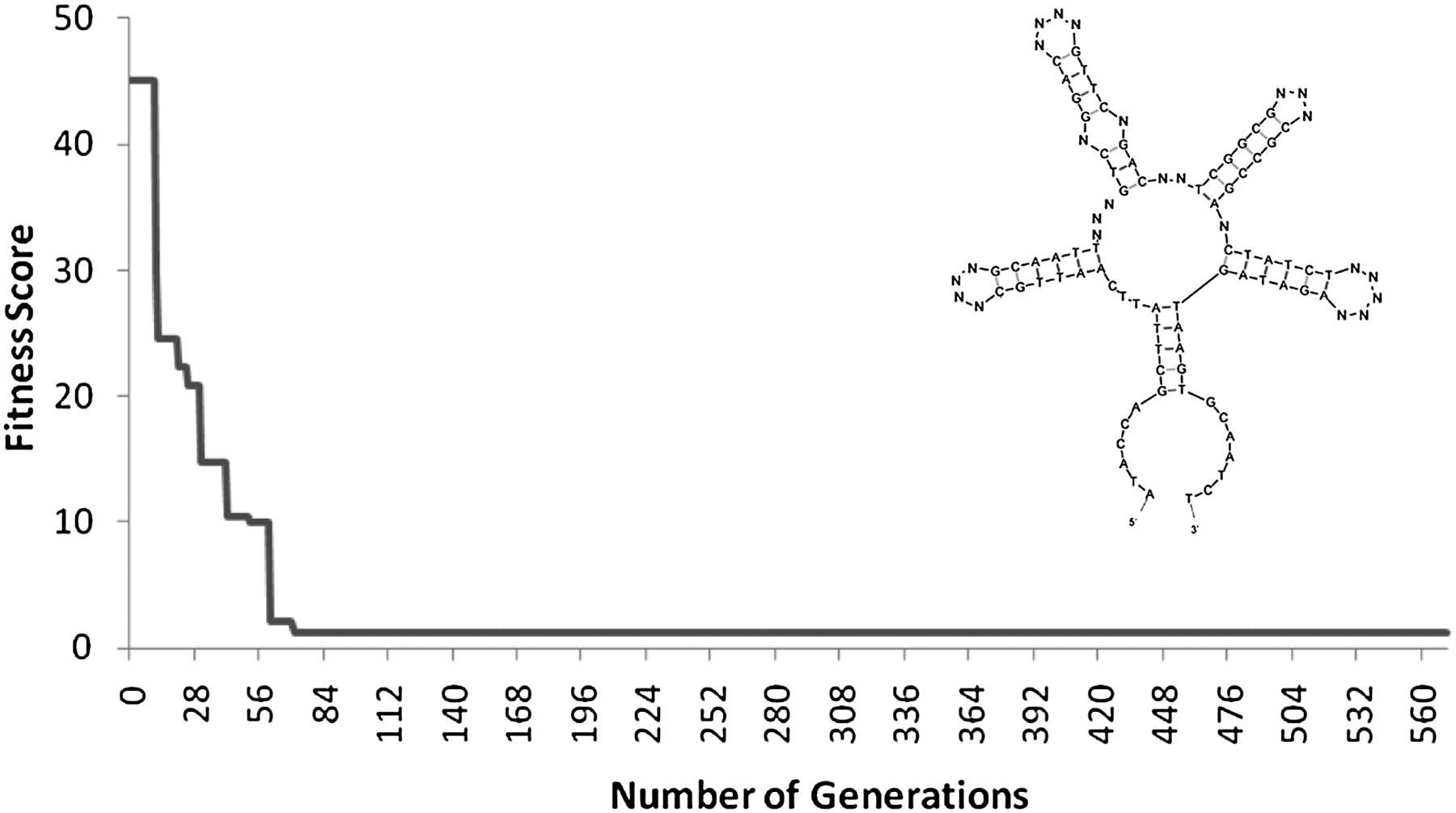
The best fitness value observed so far at each generation of Genetic Filtering (primer sites “ATACCAGCTTATTCAATT” and “AGATAGTAAGTGCAATCT”) Parameters: NG = 10,000 NoChargeCutoff = 500 Pcrossover = 0.0 Pmutation = 0.9 Pposition = 0.0156 Pcopy = 0.1 (see Materials and Methods). The best fitness score (i.e., smallest value), which indicates its closeness to the desired uniform structure distribution, decreases steadily with each generation until it remains steady after ∼500 generations. (Inset) Sample secondary structure of the DNA pool sequence (GFPool1). This 100-nt in-length pool, containing 24 random nucleotide positions, was synthesized and used in selection experiments against ATP. Image generated by Mfold.




