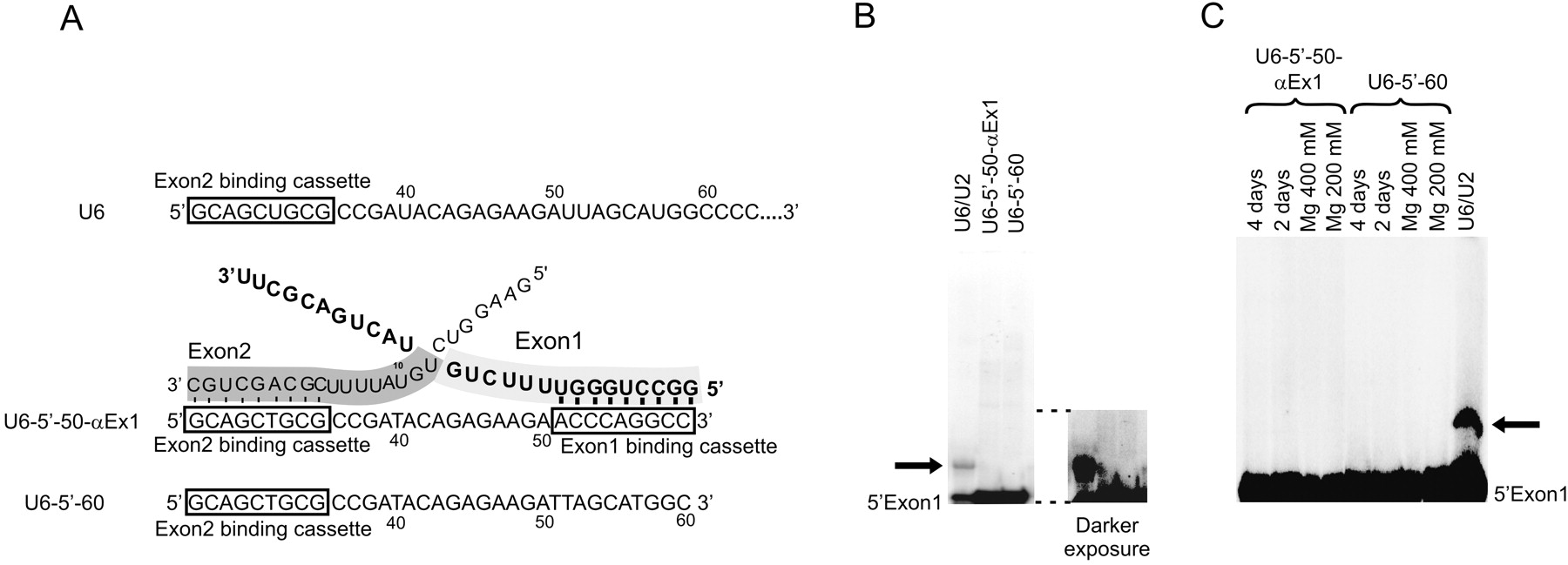
The U6/U2 complex plays a role beyond mere juxtaposition of the substrate during the catalysis of the two-step splicing reaction. (A) The sequence of the U6-mimic oligonucleotides. The sequence of 5′ end of the U6 construct used in the catalytic assays is shown on top. The position of Exon2 binding cassette is indicated. Numbers refer to the human numbering system. The sequence of the two U6-like oligonucleotides is shown below. The Exon2 and Exon1 binding cassettes are shown. The positioning of Exon1 and Exon2 substrates on one of the two oligonucleotides is shown. Exon1 is shown in boldface letters. The gray highlighted regions mark the “exonic” sequences. (B) The U6-like oligonucleotides cannot replace the U6/U2 complex in the reaction. The left panel contains typical reactions in which U6/U2 is replaced by one or the other U6-like oligonucleotides. A darker exposure of the bottom section of the gel is shown in the right panel. Lane marked U6/U2 contains a typical reaction. Arrow points to the product. (C) The reactions with U6-like oligonucleotides are not rescued at high magnesium concentrations or with long incubations. The identity of the U6-like oligonucleotide added and the reaction condition used is shown on top. Lane marked U6/U2 contains a typical reaction. Arrow marks the product. The location of unreacted 5′-labeled Exon1 is shown.