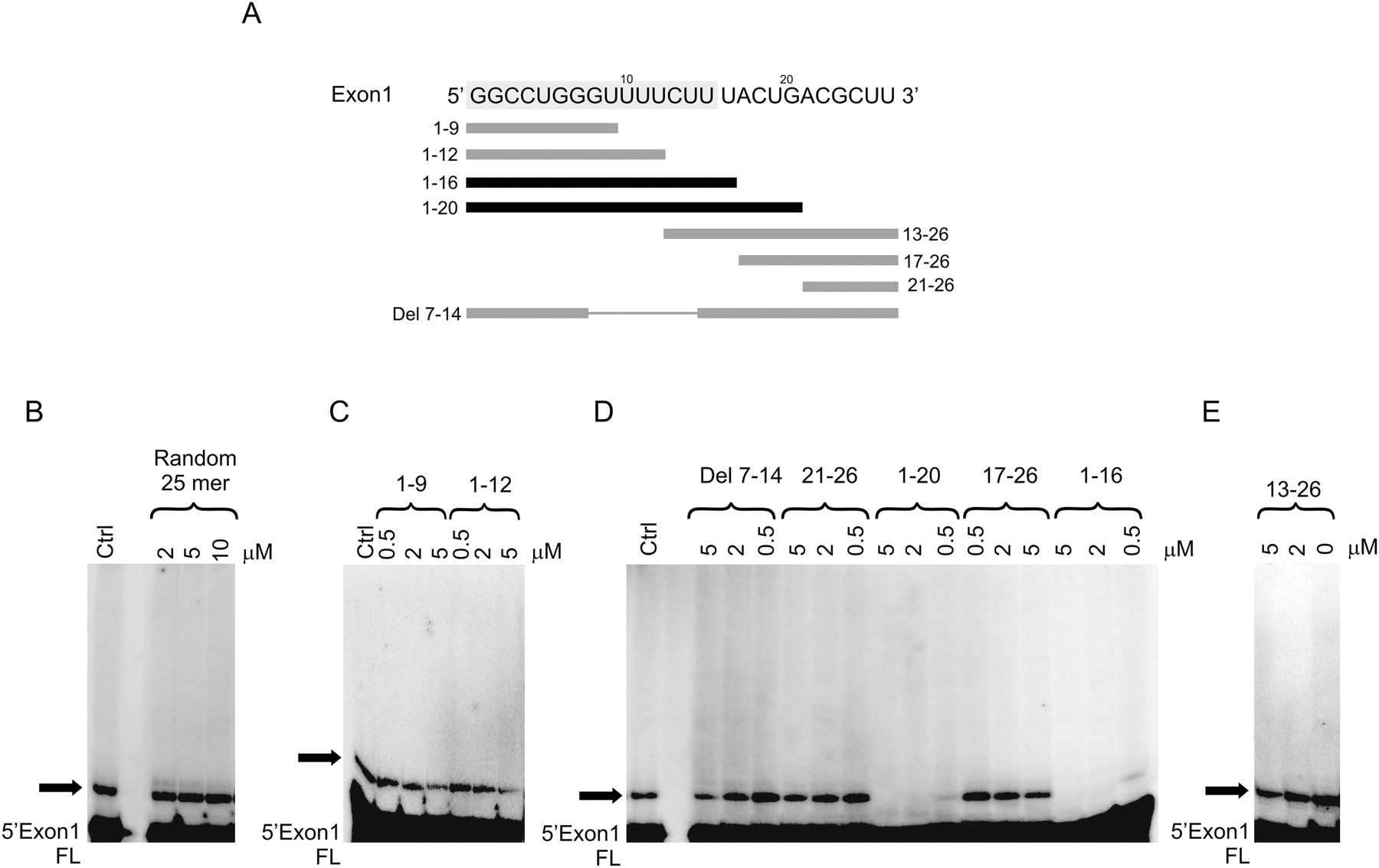
Exon1 binds to U6 via its central region. (A) The sequence of the full-length Exon1 and the fragments used in competition experiments. The sequence of full-length Exon1 is shown on top. Numbers refer to position from the 5′ end. Fragments that could not compete for binding to U6/U2 with Exon1 are shown in light gray, and those that did successfully compete are shown in black. (B–E) Exon1 fragments containing the central region of this substrate can block product formation by competing for binding to U6/U2. The identity and concentration of the competing Exon1 fragment or the random RNA oligonucleotide added as a control are shown on top. Ctrl: typical reactions that do not contain any competing oligonucleotides. Arrows point to the position of the product. The location of radiolabeled full-length Exon1 (5′ Exon1 FL) is shown to the left.