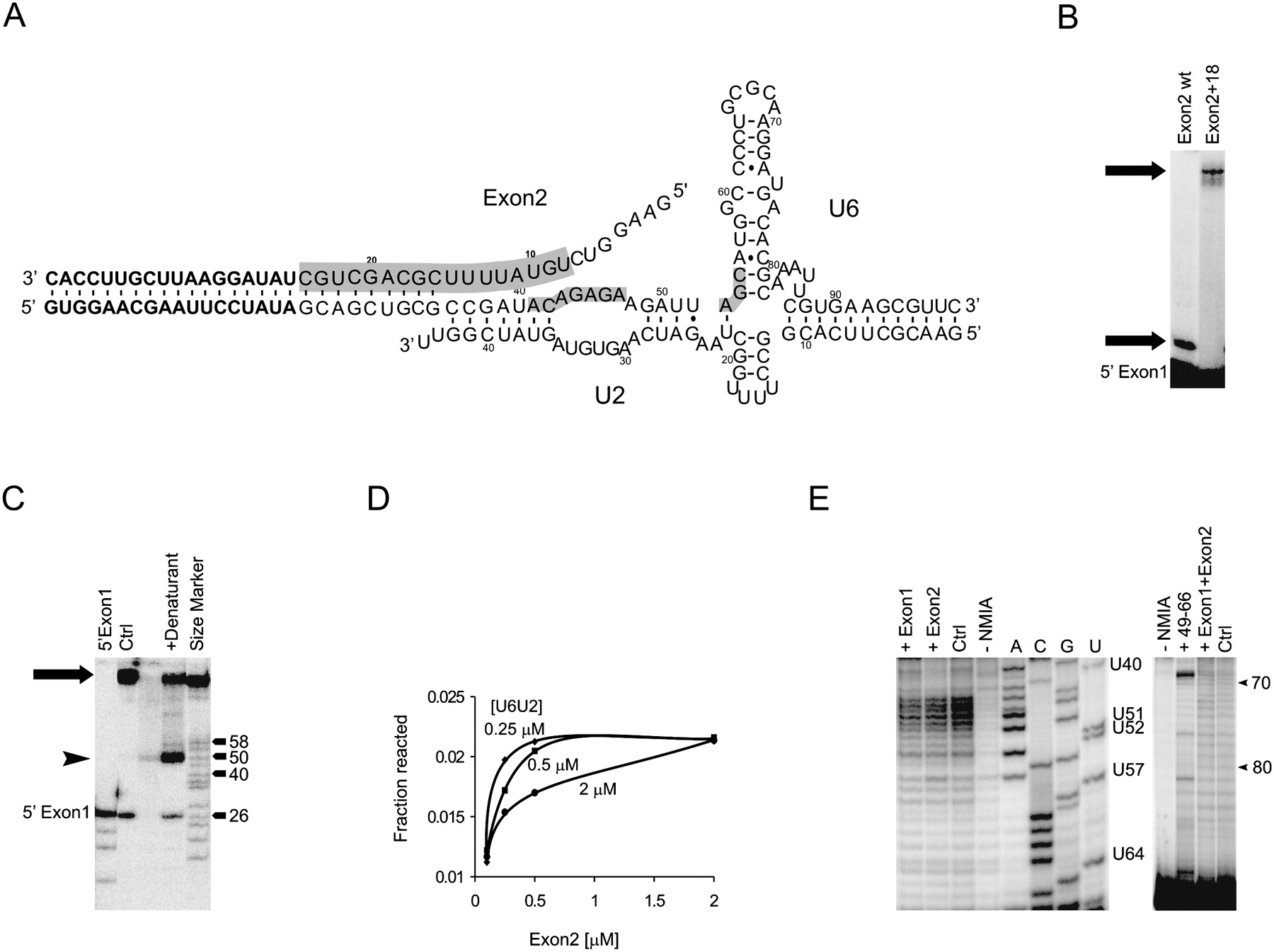
Interaction of Exon2 with the U6/U2 complex. (A) The U6/U2 complex with elongated base-pairing cassette between Exon2 and U6. The base-pairing interactions between Exon2 and U6 are shown. The sequences added for these experiments are shown in boldface. The “exonic” sequences of the original Exon2 substrate are highlighted in gray. Gray highlights in U6 mark the invariant sequences. (B) Exon2 remains associated with the U6/U2 throughout the reaction. Arrows point to the site of products formed with the two different Exon2 species. The location of unreacted Exon1 is shown. (C) Denaturation of the product formed with Exon2 + 18, which remains tightly associated with U6 + 18/U2. Lane marked Ctrl contains purified, untreated product. Lane marked +denaturant contains the purified product subjected to strong denaturing treatment. Location of the purified product is shown by an arrow. Arrowhead points to the site of the product released from the U6 + 18/U2 complex after denaturation. The size of several bands in the size marker lane is shown to the right. (D) Product formation at several U6/U2 and Exon2 concentrations. The Exon2 concentrations are shown at the x-axis of the graph. The U6/U2 concentrations are shown next to each set of data in the graph. (E) NMIA footprinting analyses on U6 before and after the addition of Exon1 and Exon2 substrates. The left panel is probed with a primer binding to the 3′ half of U6 ISL. The right panel contains footprinting data obtained with a primer which binds to the helix II region of the U6/U2 complex through U2 (see Materials and Methods). Lanes marked with letters A, C, G, and U are dideoxynucleotide sequencing lanes. Lane marked -NMIA has not received the modification reagent. Lane marked Ctrl contains the results of NMIA modification on U6 in the absence of substrates. Plus (+) sign indicates the ingredients added compared with the Ctrl lane. Lane labeled +49-66 contains an oligonucleotide complementary to U6 nucleotides 49–66. Position of several nucleotides in U6 is shown to the right.