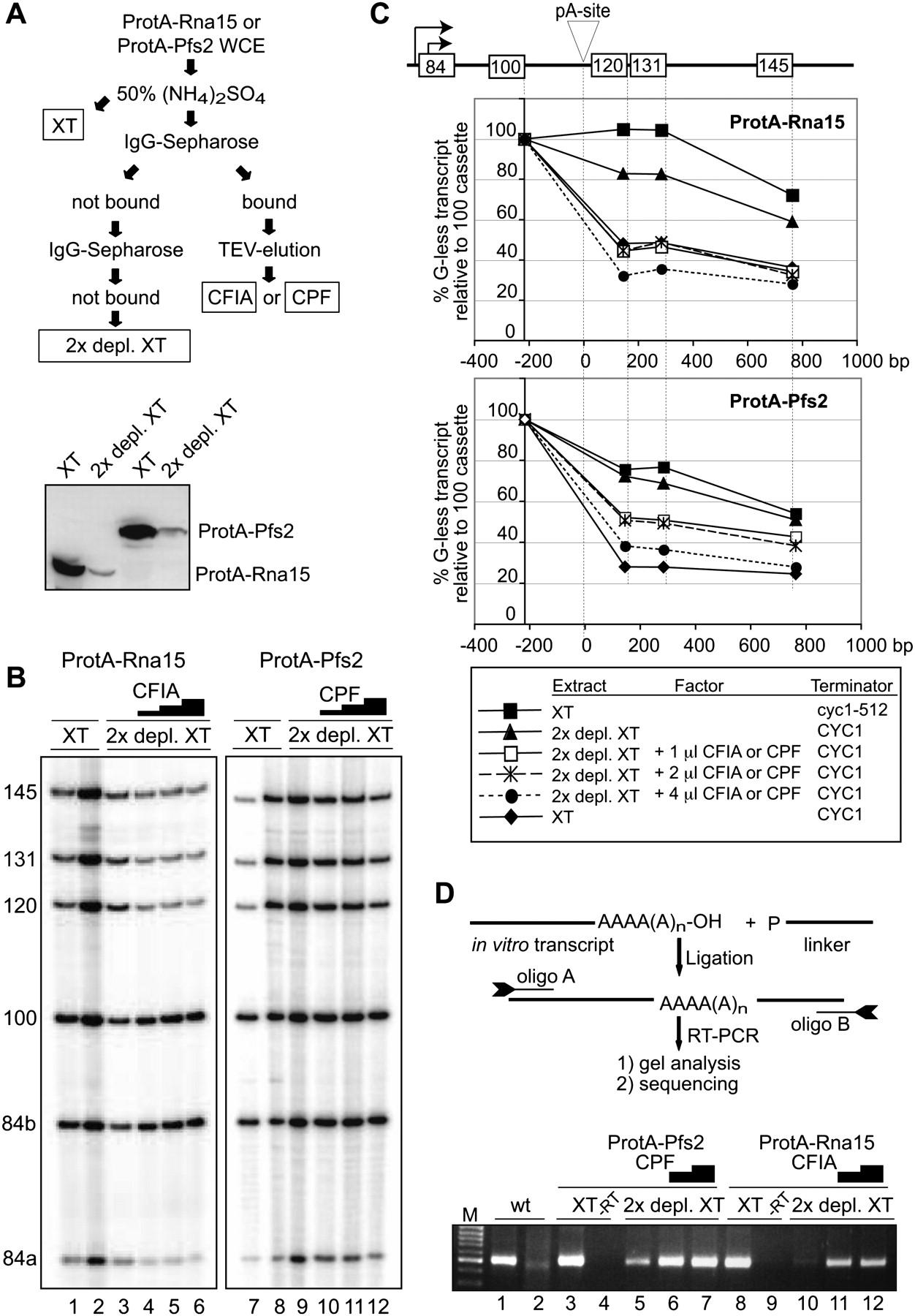
Requirement for 3′ end formation factors for coupled in vitro transcription and processing. (A) Scheme of whole-cell extract (WCE) preparation and factor depletion employed in this work for CF IA–associated ProtA-tagged Rna15 and CPF-associated ProtA-tagged Pfs2, respectively. Also shown is a Western blot of ProtA-tagged Rna15 and ProtA-tagged Pfs2 proteins to control the efficiency of factor depletion. (B) In vitro transcription/processing reactions with constructs carrying the wild-type CYC1 terminator and with extracts before (lanes 1,7) and after (lanes 3–6,9–12) depletion of the indicated ProtA-tagged proteins as described in A. One, two, and four microliters of CF IA and CPF factor, respectively, was added back to depleted extracts (lanes 4–6,10–12). For control, reactions were also done with nondepleted extracts on templates carrying the mutant cyc1-512 terminator (lanes 2,8). (C) Quantification of results obtained in B. (D) Schematic representation of the procedure to analyze 3′ end formation. Nonradioactive in vitro transcription reactions were performed, and the obtained RNAs were used to add a 5′ phosphorylated DNA oligonucleotide linker with T4 RNA ligase. The ligation products were reverse transcribed and amplified by PCR. The employed PCR primers were oligo UP (complementary to region between the 84 and 100 cassette; see Fig. 1A) and oligo B, which is complementary to the DNA linker. The amount of PCR product obtained with this method reflects the efficiency of pre-mRNA 3′ end cleavage. Analyzed were a wild-type extract on the CYC1 terminator (lane 1) and cyc1-512 mutant (lane 2) templates. ProtA-tagged Pfs2 and ProtA-tagged Rna15 extracts were analyzed before (lanes 3,4,8,9) and after (lanes 5–7,10–12) factor depletion. Two and four microliters of CPF and CF IA factor, respectively, was added back to depleted extracts (lanes 6,7,11,12). To ensure that signals were derived from RNA, reverse transcriptase enzyme was omitted from reactions analyzed in lanes 4,9.