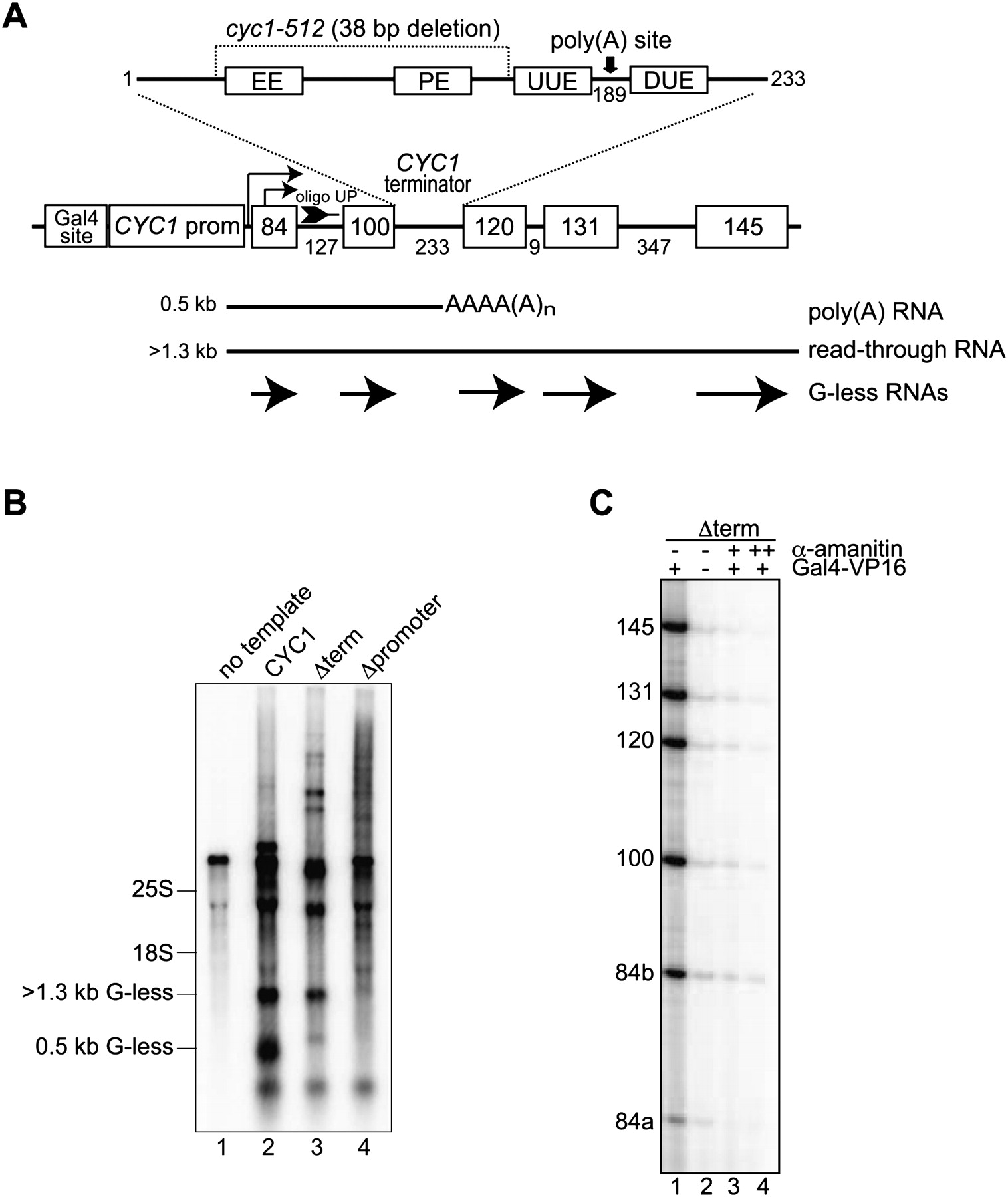
In vitro transcription/processing with yeast whole-cell extracts. (A) Schematic presentation of transcription templates used to study the transcription/processing in vitro. The main features of the construct include Gal4 binding sites, a CYC1 promoter, and five G-less cassettes. Numbers indicate the length of the cassettes and distances separating those, respectively. CYC1 terminator sequences were inserted between the 100 and 120 cassettes; also indicated are specific sequence elements (EE, the efficiency element; PE, positioning element; UUE, upstream U-rich element; DUE, downstream U-rich element; and the poly(A) site). The cyc1-512 mutation encompasses a 38-bp deletion of sequence elements as indicated. The products of in vitro transcription are ∼0.5 kb in length in case of polyadenylated RNA and >1.3 kb in case of read-through transcripts. Between 84 and 100 G-less cassettes, the site of complementarity for oligo UP (arrow tail) is indicated that was used for linker-mediated 3′ end analysis (see Fig. 3D). (B) RNAs obtained from in vitro transcription reactions with wild-type extract and Gal4-VP16 activator were separated on 1.2% denaturing formaldehyde agarose gel, transferred to Hybond N+ membrane, and exposed to a Fujifilm imaging plate. Supercoiled plasmid template carrying reporter construct with the CYC1 terminator (lane 2), no terminator (lane 3), or no GAL4-CYC1 promoter (lane 4) was analyzed; template was omitted in lane 1. (C) In vitro transcription reaction with wild-type extract, Gal4-VP16 activator, and a supercoiled plasmid template carrying the reporter construct without terminator (lane 1). RNase T1 digestion of transcription products released G-less RNAs, which were analyzed by denaturing gel-electrophoresis. The length of the RNAs is indicated on the left. The Gal4-VP16 transcriptional activator was omitted in the reaction shown in lane 2. Reactions analyzed in lanes 3,4 contained 10 and 20 ng/μL α-amanitin, respectively.