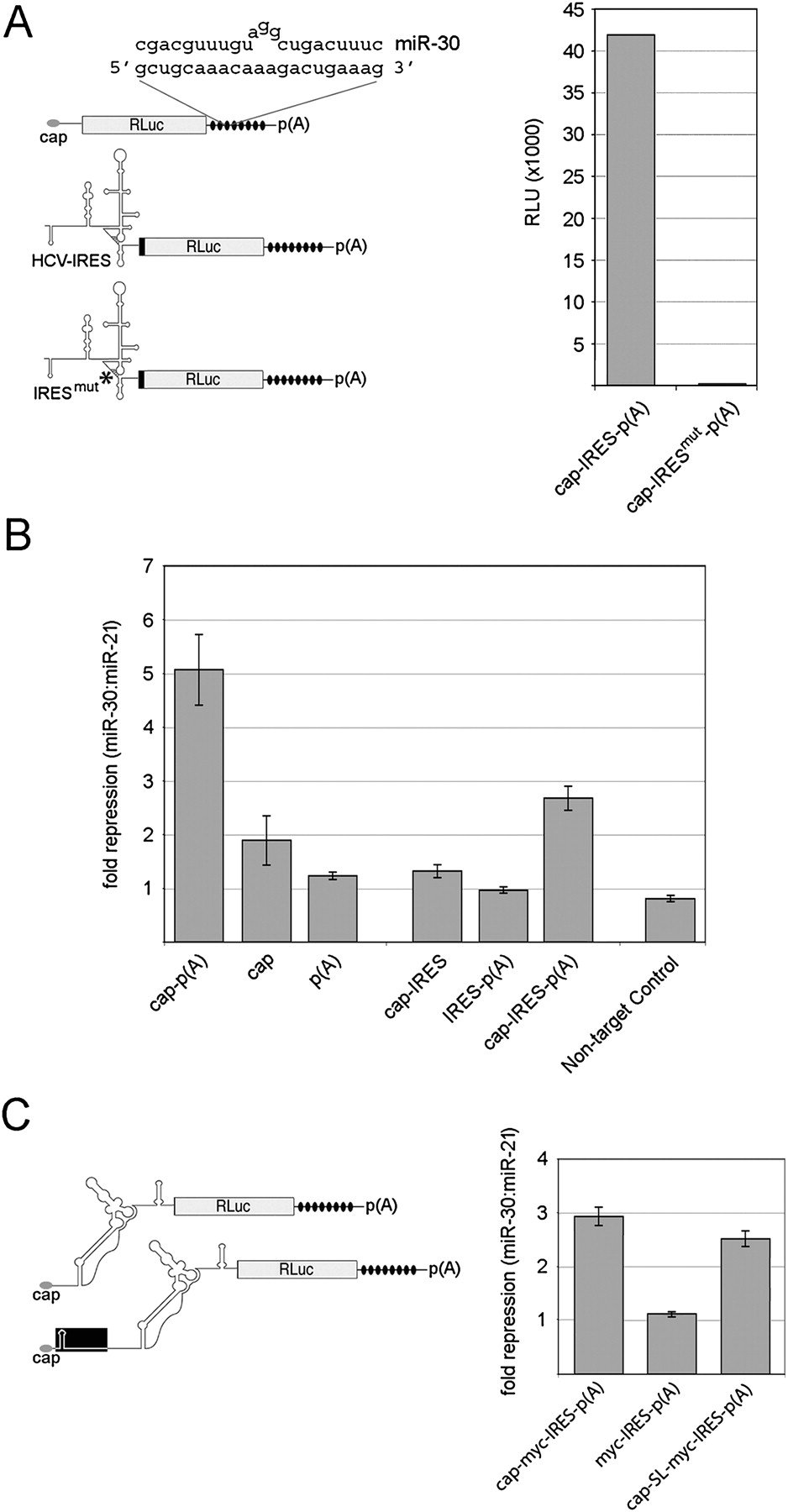
An m7G-cap and poly(A) tail are required for maximum miRNA-mediated repression. (A) (Left panel) Schematic representation of reporter mRNAs utilized. Each reporter contains eight tandem miR-30 target sites (black ovals) in the 3′ UTR and either ∼30 nt of vector-derived sequence, the HCV IRES, or a mutated HCV IRES lacking subdomain IIIf (asterisk; IRESmut) in the 5′ UTR. The predicted base-pairing between miR-30 and a single target site is shown. (Right panel) Raw RLU values for capped and polyadenylated HCV IRES reporter mRNAs after transfection into 293T cells. (B) miR-30 repression levels of transfected mRNA constructs. The indicated mRNAs were co-transfected with either miR-21 (nontargeting) or miR-30 (targeting) duplex RNA, and the repression levels were calculated. The nontarget control construct lacks miR-30 target sites. Error bars represent calculated values for standard deviation. (C) Analysis of c-myc IRES-containing constructs. (Left panel) Schematic depiction of c-myc IRES RLuc mRNAs. A stem–loop (SL) was inserted adjacent to the 5′ end of the cap-SL-myc-IRES-p(A) construct, and ∼200 nt of vector sequence separates the SL and IRES. (Right panel) Repression levels for individual reporters. Transfections were performed in triplicate in three separate experiments.