


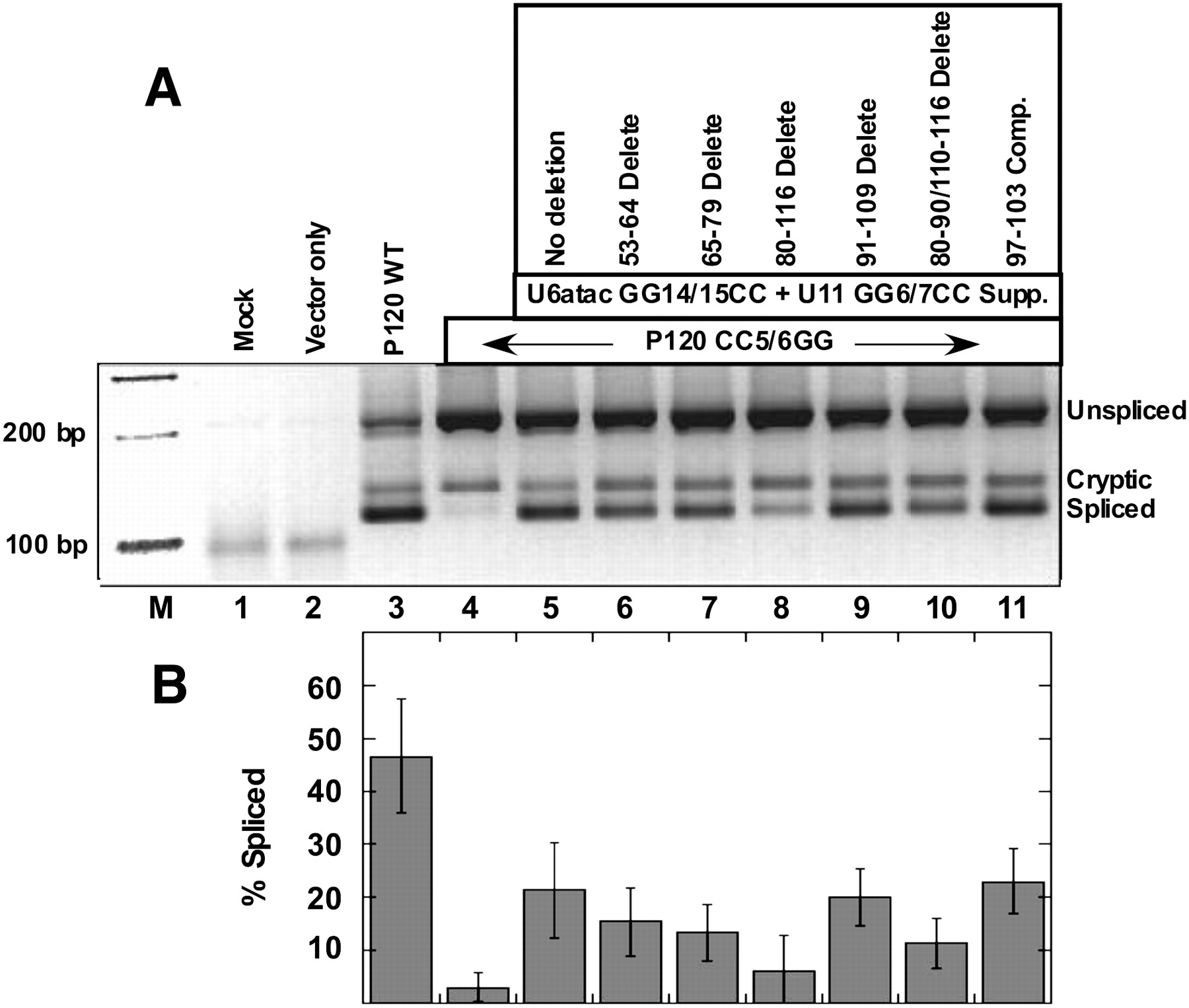
Effects on in vivo splicing of mutations of the U6atac 3′ end domain. (A) RT-PCR analysis of the in vivo splicing of the U12-dependent P120 intron F from the transiently transfected constructs shown. Refer to Figure 2 for details of the assay. (Lane 1) Mock transfection; (lane 2) empty pCB6 expression vector; and (lane 3) wild-type P120 minigene. Lanes 4–11 used the P120 5′ splice site mutant CC5/6GG. Lanes 5–11 included the U11 GG6/7CC mutant. Lanes 5–11 included the U6atac GG14/15CC construct with the following mutations (see Fig. 3A): (lane 5) none; (lane 6), deletion of the 5′ stem–loop element (nucleotides 53–64); (lane 7) deletion of the single stranded region between nucleotides 65 and 79; (lane 8) deletion of the entire 3′ stem–loop element (nucleotides 80–116); (lane 9) deletion of the distal section of the 3′ stem–loop element (nucleotides 91–109); (lane 10) deletion of the proximal section of the 3′ stem–loop element (nucleotides 80–90 and 110–116); and (lane 11) substitution mutation of the terminal loop nucleotides 97–103 with the sequence GAUGAAG. (B) Quantitative analysis of the spliced product in panel A, lanes 3–11, showing the means and standard deviations from three experiments.




