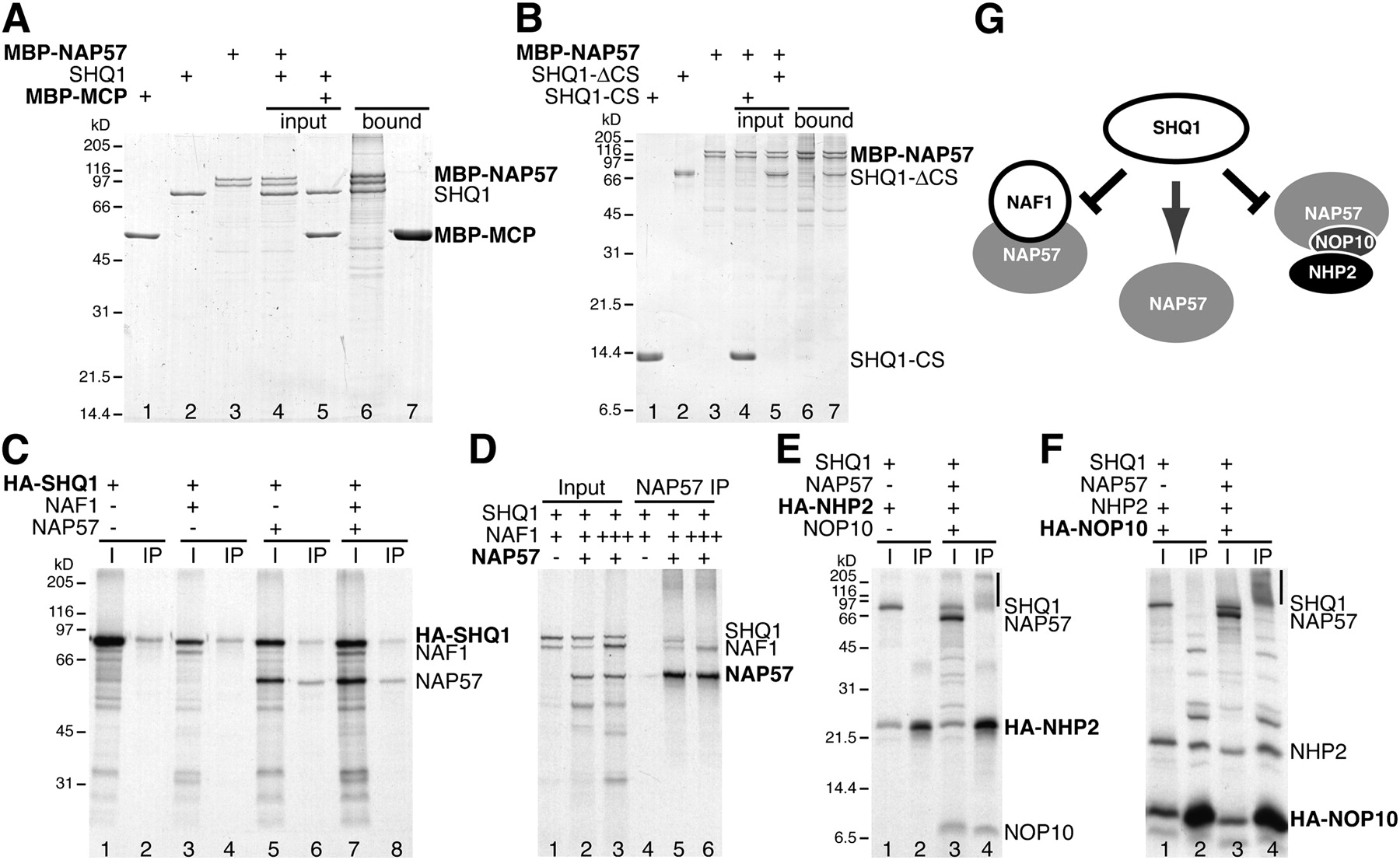
In vitro, SHQ1 only binds NAP57, to the exclusion of other proteins. (A) The bacterially expressed fusion protein of the maltose binding protein (MBP) with NAP57 (lane 3), but not that with the MS2 bacteriophage coat protein (MCP; lane 1) retains recombinant SHQ1 (lane 2) on amylose resin (lanes 6,7, respectively). Ten percent of the inputs were loaded (lanes 4,5) on this Coomassie blue-stained SDS-PAGE, and the proteins used for amylose resin binding are indicated (bold). Note, for unknown reasons, MBP-NAP57 migrates as two mass spectrometrically identical bands (lane 3). (B) In an experiment analogous to A, MBP-NAP57 (lane 3) only retains SHQ1 missing its N-terminal CS domain (SHQ-ΔCS; lane 2), but not its CS domain alone (SHQ1-CS; lane 1) on amylose resin (lanes 7,6, respectively). (C–F) Fluorographs of immunoprecipitations of in vitro translated and 35S-methionine labeled proteins separated by SDS-PAGE. The proteins targeted for precipitation are indicated (bold), and the input lanes (I) contained 10% of the material used for immunoprecipitation (IP). (C) HA-tagged SHQ1 is precipitated by anti-HA antibodies (lane 2) and coprecipitates NAP57 (lane 6) but not NAF1 (lane 4). When both NAP57 and NAF1 are present, HA-SHQ1 only precipitates NAP57 (lane 8). (D) NAP57 antibodies only precipitate SHQ1 and NAF1 in the presence of NAP57 (lanes 2,5) but not in its absence (lanes 1,4). If specifically the amount of NAF1 is increased in the input (cf. lanes 2 and 3), NAP57 only precipitates NAF1 (lane 6), suggesting a competition between SHQ1 and NAF1 for NAP57 binding. (E) HA-NHP2 fails to coprecipitate SHQ1 alone (lanes 1,2) or in the presence of the core trimer (lanes 3,4) although precipitating NAP57 and NOP10. (F) HA-NOP10 fails to coprecipitate SHQ1 in the presence of NHP2 (lanes 1,2) and in addition of NAP57 (lanes 3,4) although precipitating NAP57 and NHP2. For unknown reasons and as noted before (Wang and Meier 2004; Darzacq et al. 2006), precipitated NAP57 occasionally migrated anomalously (vertical bar in E and F). (G) Schematic summarizing the results that SHQ1 only binds NAP57 alone but not when associated with NAF1 or the core trimer (and not with NAF1, NOP10, or NHP2 alone).