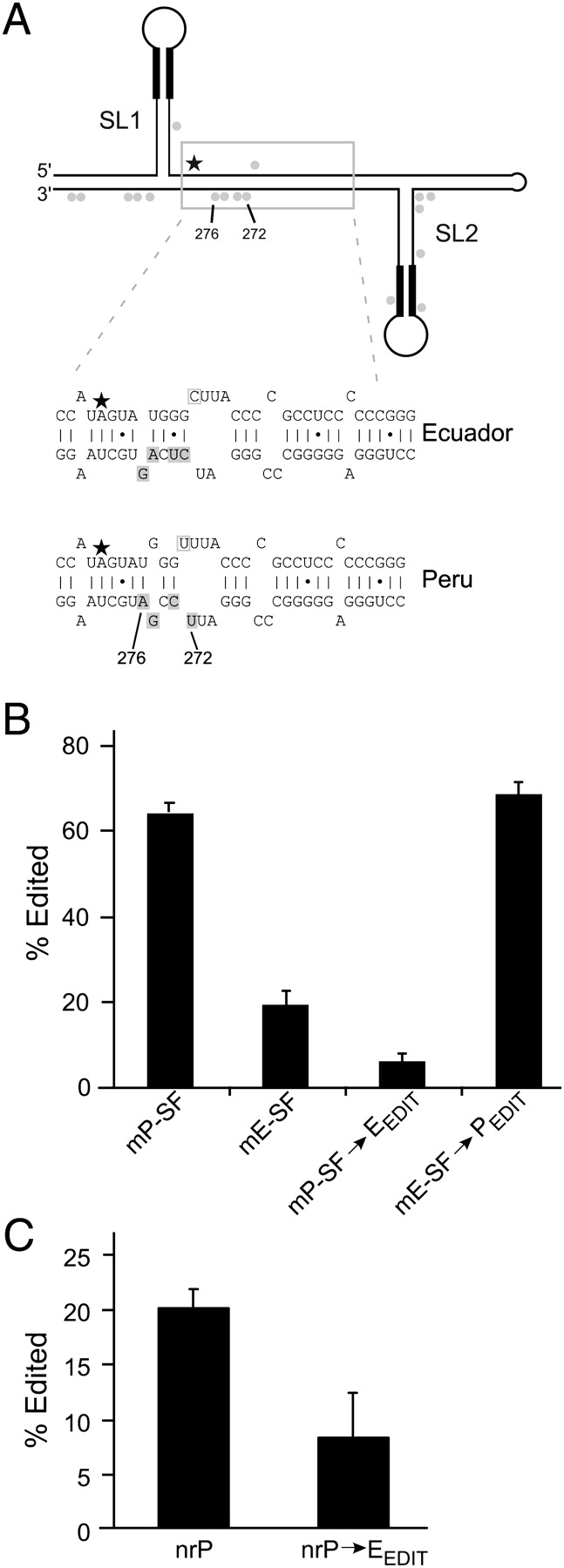
HDV RNAs from Peruvian and Ecuadorian isolates are edited with different efficiencies. (A) Schematic diagram of the branched RNA secondary structure formed by miniaturized RNAs mE-SF and mP-SF derived from the Ecuadorian and Peruvian HDV-3 isolates, respectively. The star denotes the amber/W editing site. Heavy lines indicate the location of the stem–flip (SF) mutations that stabilize stem–loops SL1 and SL2 in this branched structure. The 17 nt positions that differ between the Peruvian and Ecuadorian miniaturized RNAs are indicated by gray circles. The region around the editing site is enlarged, showing the sequence and predicted secondary structure of the Ecuadorian and Peruvian isolate RNAs. Watson–Crick base pairs are indicated by vertical lines, G–U wobble pairs by black dots. The sequence differences between the two RNAs are shaded or outlined in gray. (B) Editing in vitro by ADAR1 of miniaturized branched Peruvian and Ecuadorian RNAs. RNAs were incubated with nuclear extracts containing ADAR1; percent editing of the RNA at the amber/W site was determined by restriction digestion of RT/PCR products, as described (Linnstaedt et al. 2006). Values shown are the average of four independent experiments. The four variant positions between 272 and 276 (shaded gray in A) were exchanged between mP-SF and mE-SF to generate mP-SF → EEDIT and mE-SF → PEDIT. (C) Editing of nonreplicating RNAs in transfected cells. Huh-7 cells were transfected with expression constructs for nonreplicating RNAs Pnr and Pnr → EEDIT (described in the text). The former contains Peruvian HDV sequences, the latter contains the four sequences of the Ecuadorian variant between positions 272 and 276. RNAs were harvested 2 d post-transfection and analyzed for amber/W site editing, as described previously (Cheng et al. 2003).