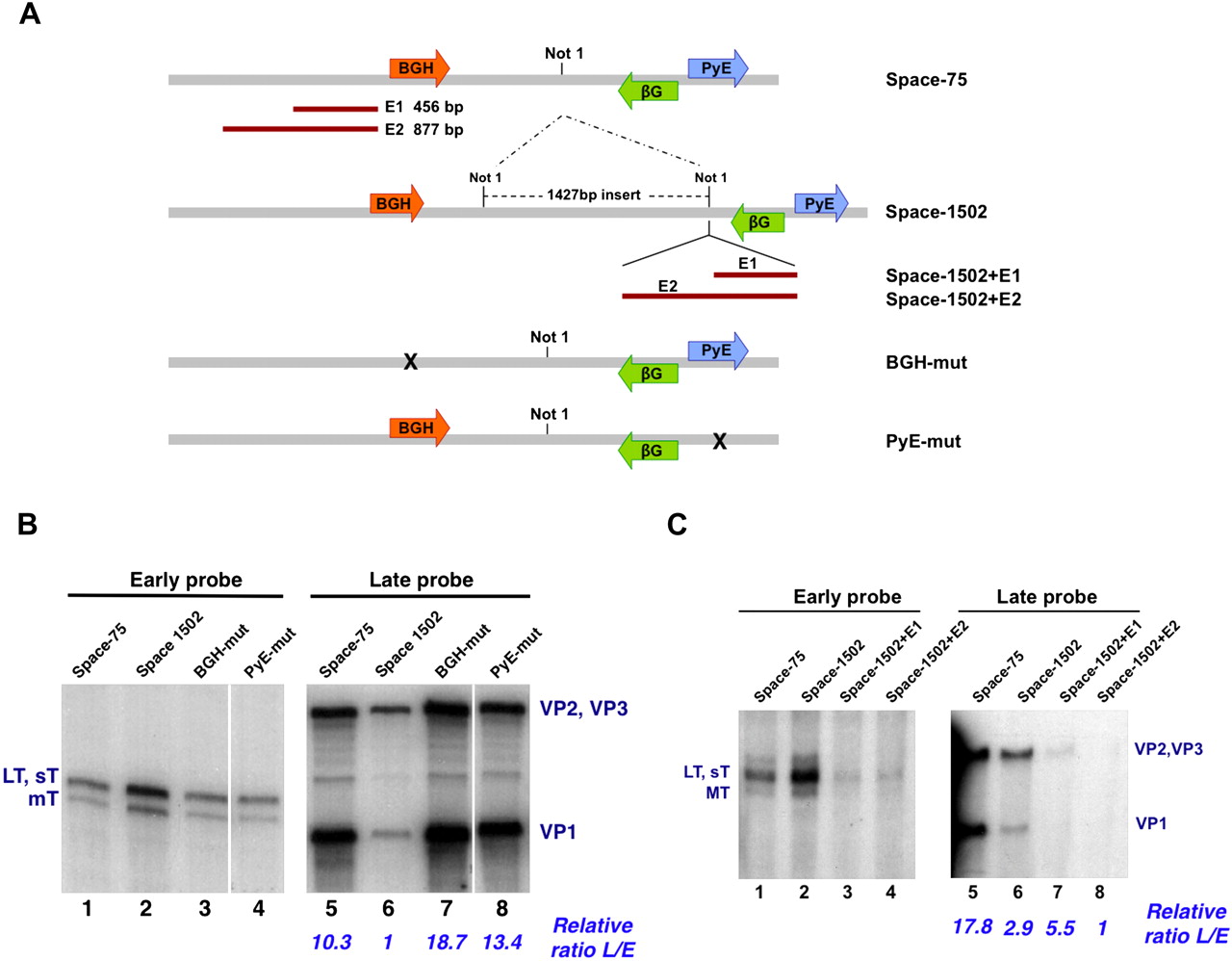
(A) Schematic of additional constructs. While the results shown in Figure 6 show that increasing the spacing between polyadenylation signals alters the E/L switch, it remained possible that the essential spacing was not between poly(A) signals themselves, but between elements flanking them. To rule this out, sequences in the early region that lie just downstream from the wild-type late poly(A) signal (E1 and E2) were inserted into construct Space-1502, as shown. To examine the contribution of tandem poly(A) signals that exist on the early strand of construct Space-75, either the bovine growth hormone (BGH) (AAUAAA to AGGAAA) or the polyoma early poly(A) signals (AAUAAA to AGUAGA) were individually mutated. (B) RNase protection assays and quantitations as in Figure 6. Note that the BGH-mut and PyE-mut constructs have a normal early-to-late switch. (C) RNase protection assays and quantitations as in B, showing that sequences downstream from the late poly(A) signal cannot rescue the early-to-late switch defect of construct Space-1502.