


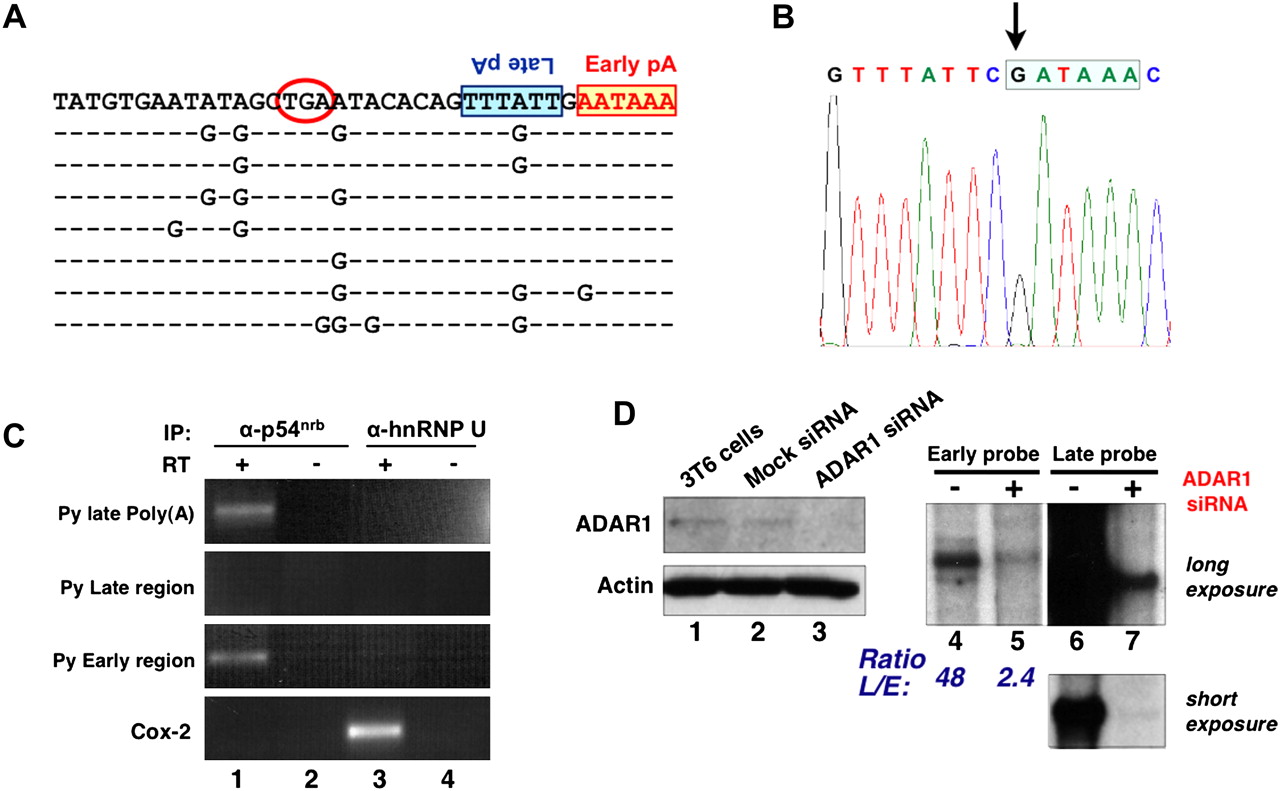
(A) Demonstration that the region of overlap between early and late polyadenylation signals leads to A-to-I editing. Nuclear RNA was isolated 60 h after virus infection of NIH3T6 cells. One microgram was used for RT-PCR amplification using primers that spanned the early and late polyadenylation signals. Following TOPO-TA cloning, individual clones were picked and sequenced. Seven of 44 randomly selected clones showed evidence of editing in this region. The early and late poly(A) signals are indicated by the yellow and blue boxes, respectively, and the stop codon for large T antigen is circled. (Top) The sequence of the early coding region; (below) sequences are identical except for the bases noted. Note that since editing requires duplex formation with the antisense strand, editing of early RNAs also indicates that the complementary late transcript must also have been edited in this region. (B) Editing of the late poly(A) signal. NdeI-resistant RT-PCR products generated as in Figure 3B were cloned and subjected to DNA sequence analysis. In the sequence shown here, there is an A-to-G transition (arrow) at the first position of the late polyadenylation AAUAAA hexanucleotide element (boxed), indicative of editing at this position. (C) Nuclear extracts were prepared 48 h after infection. Immunoprecipitation was carried out with anti-p54nrb or anti-hnRNP U antibodies, followed by RT-PCR for specific viral sequences (for p54nrb) or for a known target of hnRNP U in the Cox-2 3′-UTR (Cok et al. 2003). Note that p54nrb associates with the late poly(A) region and the early region, consistent with editing, but not with the viral late region, which is not edited. (D, lanes 1–3) ADAR1 siRNA was used to reduce ADAR1 expression in NIH3T3 cells. Western blotting showed about a fourfold reduction in protein levels. (Lanes 4–7) Cells treated with mock siRNA or with ADAR1 siRNA were infected with wild-type polyomavirus. Forty-eight hours later, RNase protection assays showed a 20-fold difference in late/early RNA levels.




