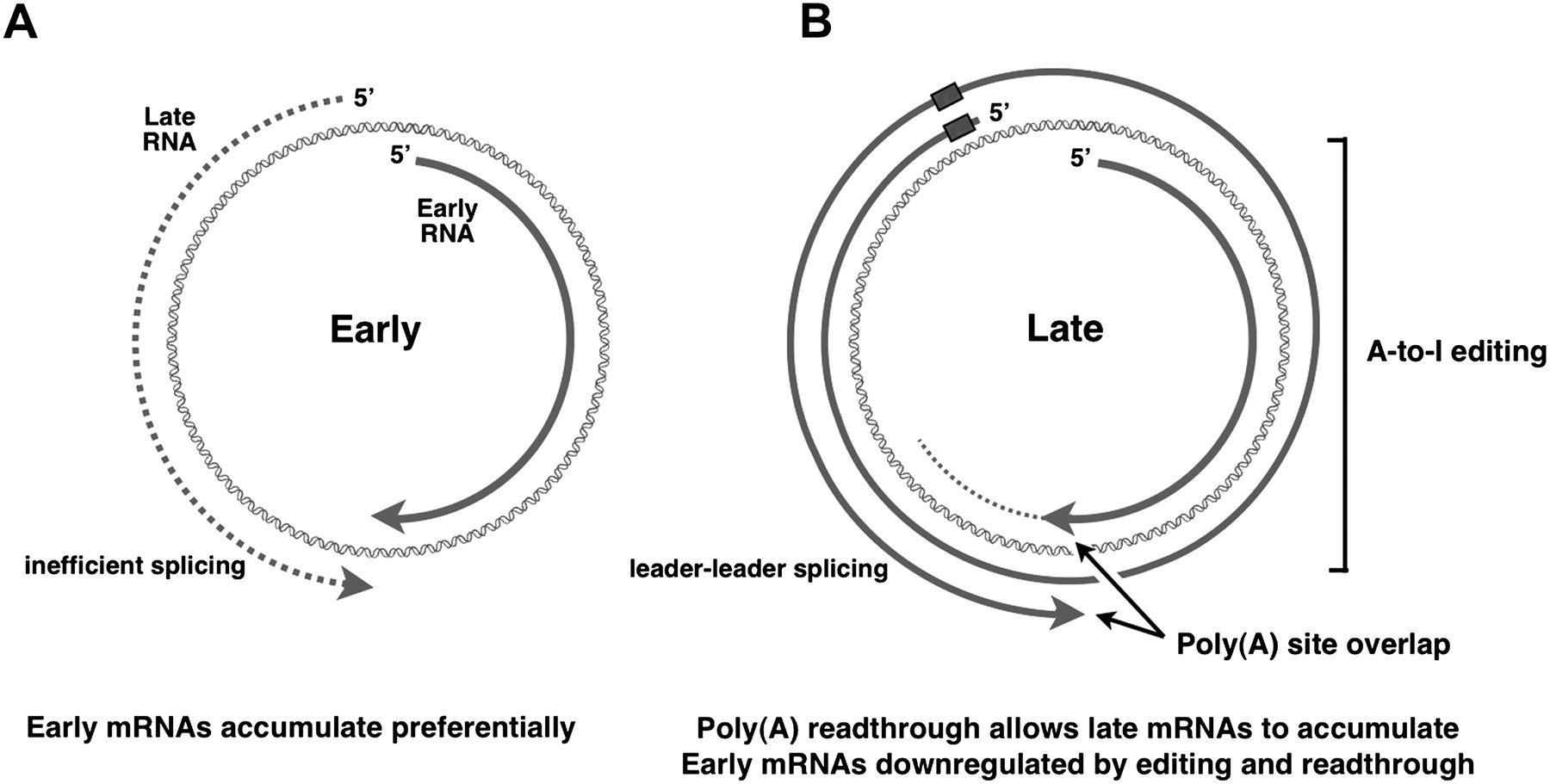
(A) Model for the early-to-late switch, in which poly(A) site editing plays a key role. At early times in infection, early mRNAs preferentially accumulate, because late pre-mRNAs are inefficiently spliced. Little dsRNA is formed at this time. (B) At late times, overlapping transcripts become edited in the polyadenylation region, and this is associated with a failure of the 3′-processing machinery to recognize the signals. If dsRNA is formed or the late poly(A) signal is edited, transcription proceeds around the genome, with leader–leader splicing removing the large edited intron and resulting in accumulation of late mRNAs. Productive polyadenylation is thus in competition with dsRNA or editing. Some early-strand transcripts become edited as a result of antisense from the late-strand read-through. At the same time, some early poly(A) signals may also become edited. In this case, however, there is no splicing event that can remove the edited sequences.