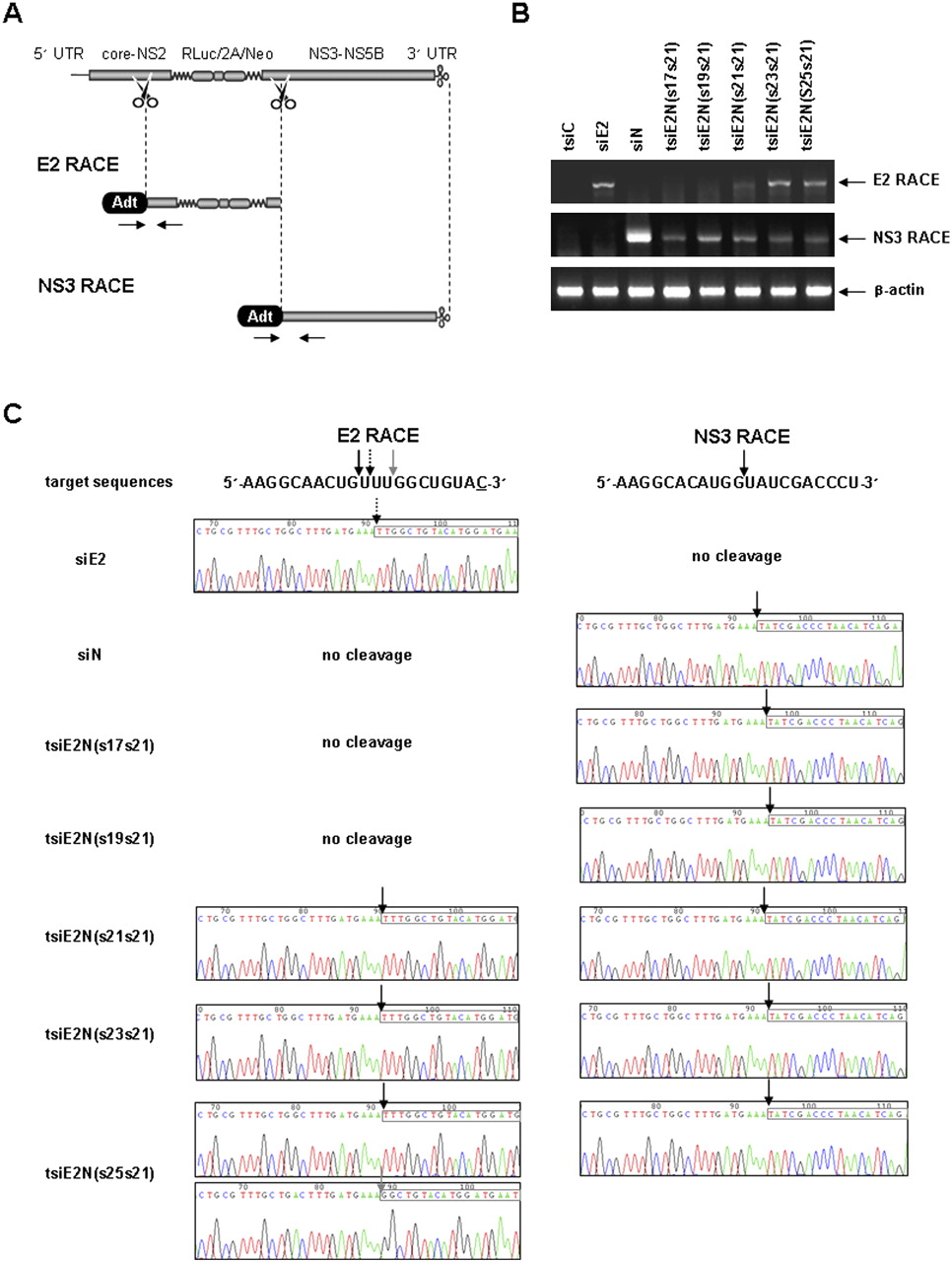
Identification of the 5′-end cleavage sites of tsiRNA using 5′ rapid amplification of cDNA ends (RACE) technology. (A) Schematic illustration of the RACE strategy. An adaptor RNA (Adt) was ligated to total RNA from FK/R2AN cells transfected with siRNA- or tsiRNA-encoding constructs. The RNA pool was reverse-transcribed with random oligomers and then amplified with adaptor-specific primers and either E2-specific (for E2 RACE) or NS3-specific (for NS3 RACE) primers. (Arrows) Primer binding sites used for PCR amplification. (B) RT-PCR amplification showing the (top) E2-specific and (middle) NS3-specific RACE products from FK/R2AN cells transfected with indicated siRNA- or tsiRNA-expression vectors. (Bottom) Amplification of β-actin was used as an internal loading control. Each product is marked with an arrow on the right of agarose gels stained with ethidium bromide. (C) Sequence analysis of (left) E2 and (right) NS3 RACE products. The HCV sequences of the 22-nt siE2 and 21-nt siN target sites are represented above. (Arrows) Predicted cleavage points within the viral RNA by (solid arrows) 21-nt and (dotted arrows) 22-nt siRNA. (Underlined) The extra sequence on 22-nt siE2, which is also identical with viral RNA sequence, for efficient transcription. (White boxes and both solid and dotted arrows on the sequences) The 5′-termini of correctly cleaved viral RNAs. (Gray arrow) The 3-nt-shifted cleavage position on the HCV E2 coding region by tsiE2N(s25s21).