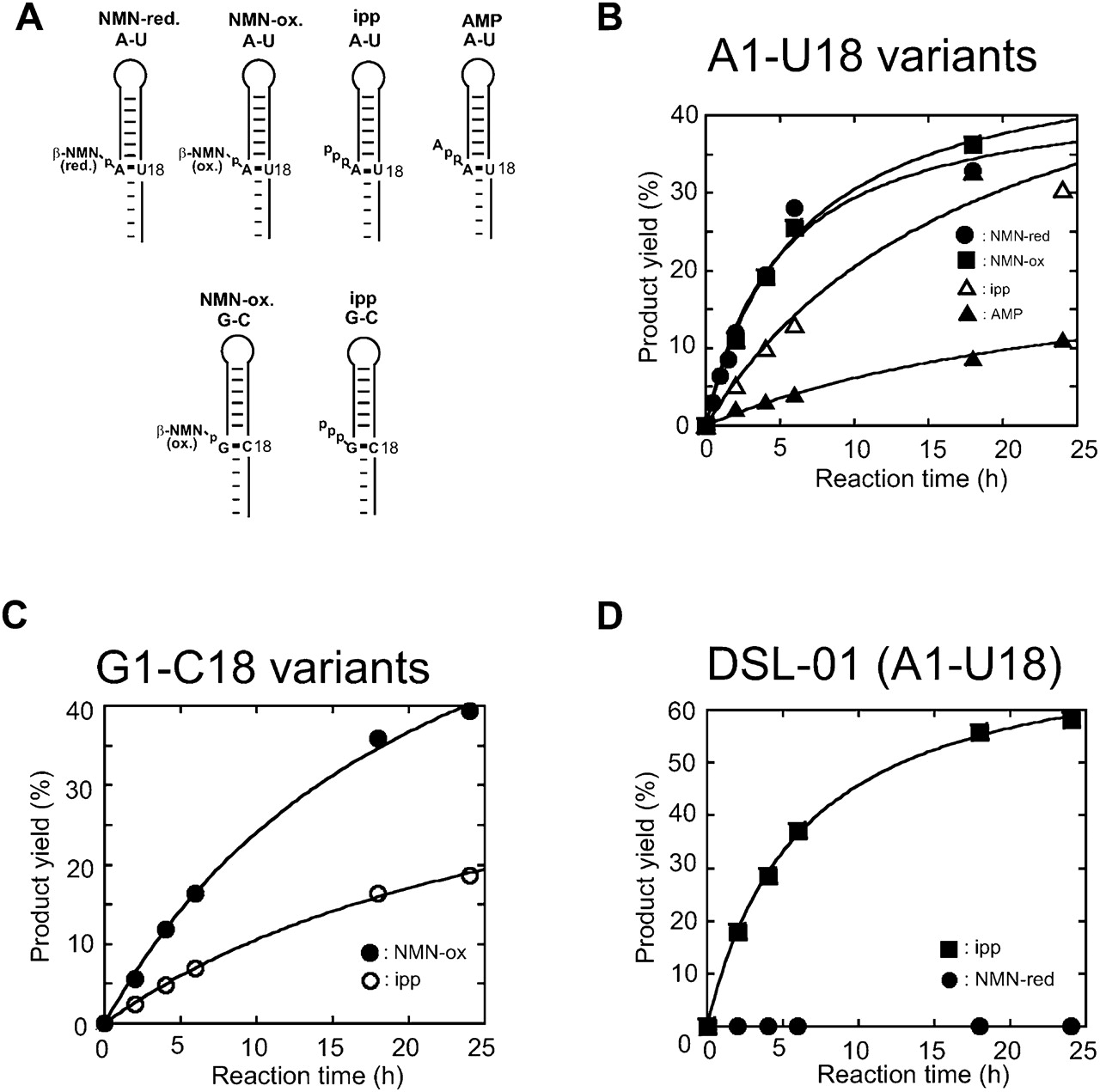
Effects of helical contexts in the P1 region and leaving groups on the reaction of the YFL-1 ribozyme. (A) Structures and sequences of the 5′-end of the (upper left) parental YFL-1 and mutants. These P1s possess either (upper) the original A1–U18 pair or (lower) the G1–C18 pair. (B) Activities of the YFL-1 variants with the A1–U18 pair and different leaving groups: (filled circles) reduced form of β-NMN, (filled squares) oxidized form of β-NMN, (triangles) inorganic pyrophosphate, and (filled triangles) AMP. (C) Activities of the YFL-1 variants with the G1–C18 pair and different leaving groups: (filled circles) oxidized form of β-NMN and (open circles) inorganic pyrophosphate. (D) Activities of the DSL ribozyme with different leaving groups: (filled circles) inorganic pyrophosphate and (filled squares) the reduced form of β-NMN.