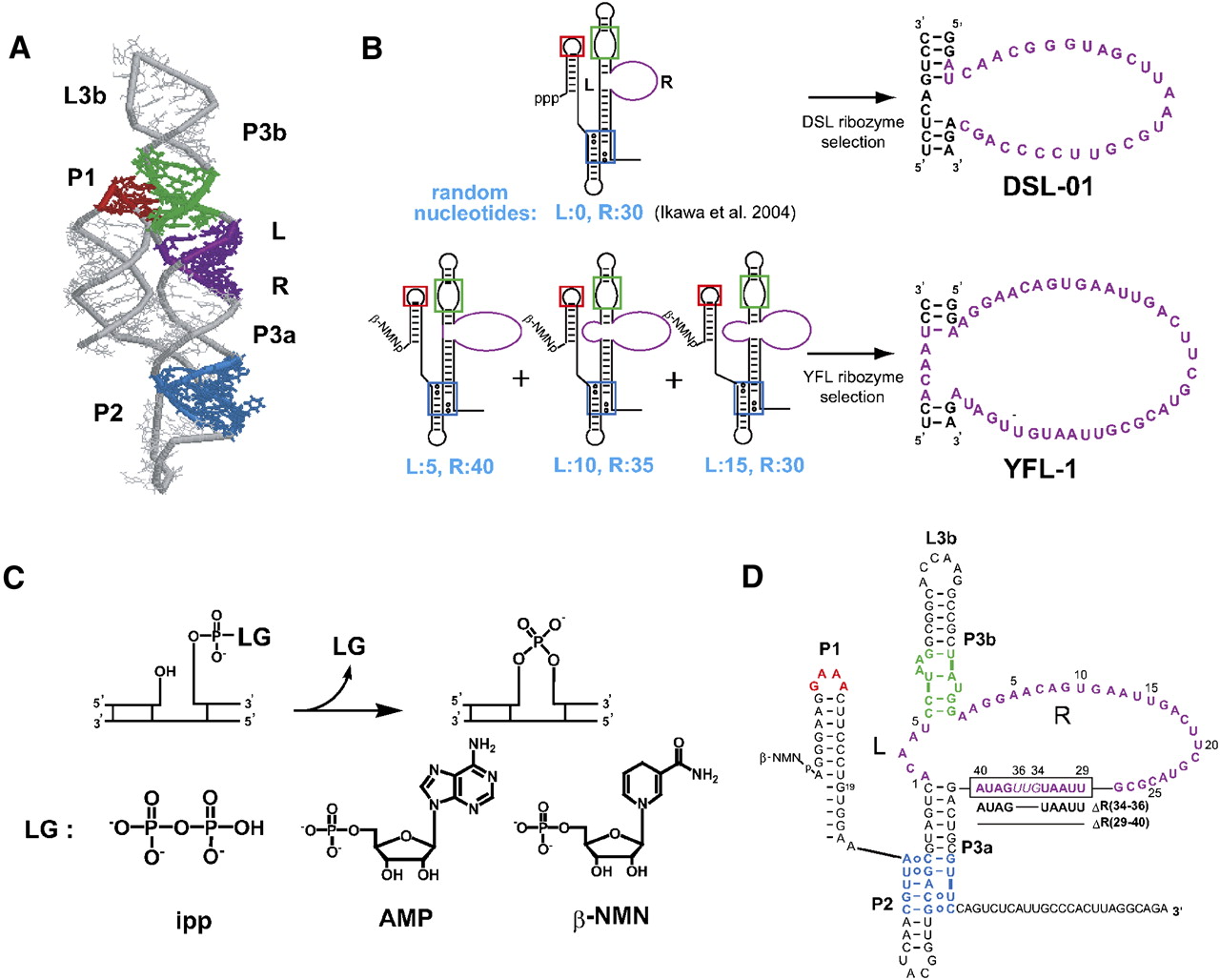
Construction scheme, structure, and reaction of the class YFL and related ribozymes. (A) 3D structure of the scaffold RNA. Colored regions correspond to those in the secondary structures shown in B and D. (B) Secondary structures of the RNA libraries and isolated sequences. For construction of the three sublibraries for YFL ribozyme selection, 5, 10, or 15 and 40, 35, or 30 random nucleotides were introduced into the L and R regions, respectively, which originally form five base pairs. (C) Leaving groups of the ligation reaction by ligase ribozymes. (Left) Inorganic pyrophosphate (ipp) used by several ligase ribozymes including the DSL. (Middle) Adenosine monophosphate (AMP) used by three ligase ribozymes isolated by Hager and Szostak (1997). (Right) β-Nicotinamide mononucleotide (β-NMN) used by the YFL-1 ribozyme. (D) Secondary structure of the YFL-1 ribozyme. Colored regions indicate structural motifs, (red) GAAA loop, (green) receptor motif for GAAA loop, and (blue) triple-helical scaffold, used in the molecular design of the scaffold. ΔR(35–37) and ΔR(29–40) indicate truncated sequences in analysis of the catalytic unit.