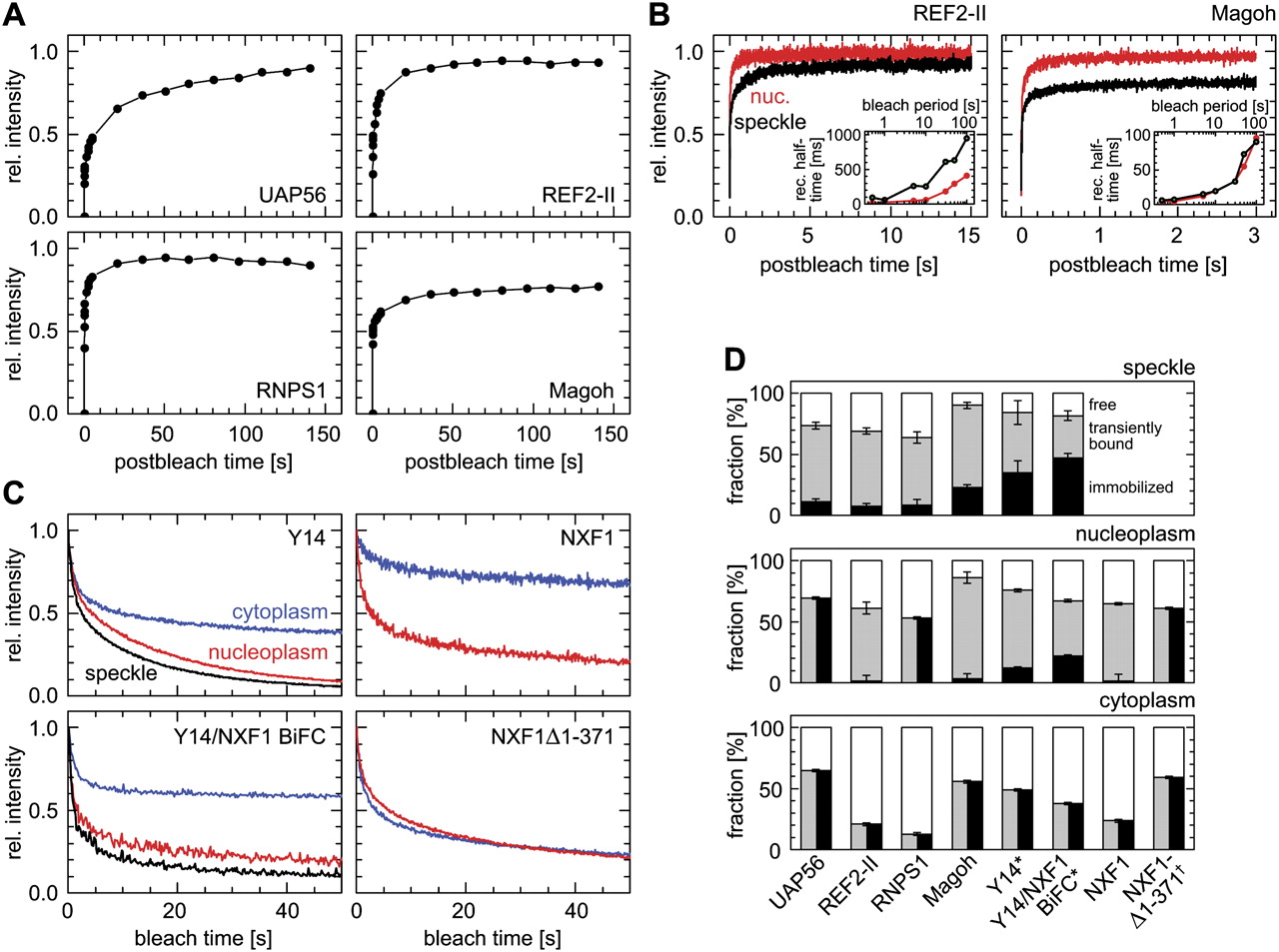
Determination of half-times of recovery, free and bound fractions of EJC proteins and Y14/NXF1 BiFC complexes at different cellular locations with imaging FRAP, point FRAP, and CP. (A) Imaging-based FRAP of GFP-tagged UAP56, REF2-II, RNPS1, and Magoh in speckles. The curves represent the average of 12–21 single FRAP experiments. (B) Point FRAP of GFP-tagged REF2-II and Magoh performed in speckles (black) and nucleoplasm (red). Half-times of recovery increased with increasing bleaching periods, indicating that effective diffusion contributed to the redistribution (inset). (C) CP of GFP-tagged Y14, NXF1, NXF1Δ1-371, and YFP-tagged Y14/NXF1–BiFC complexes. The example plots are averages of 5–10 independent CP experiments and show differences in the degree of immobilized/transiently bound and free molecules between cytoplasm (blue), speckles (black), and nucleoplasm (red). (D) Plots of free, transiently bound/slowly mobile and immobilized fractions of UAP56, REF2-II, RNPS1, Magoh, Y14, Y14/NXF1–BiFC complexes, NXF1, and NXF1Δ1-371 in speckles, nucleoplasm, and cytoplasm obtained from the integrated FRAP and CP approach. The allocated transiently bound fractions for the cytoplasm, as well as of nucleoplasmic UAP56 and RNPS1 may still contain immobilized molecules (indicated by vertically splitting the bars) as FRAP data were not available. Immobilized fractions obtained with FRAP were taken from (*) Schmidt et al. (2006) and (†) Calapez et al. (2002).