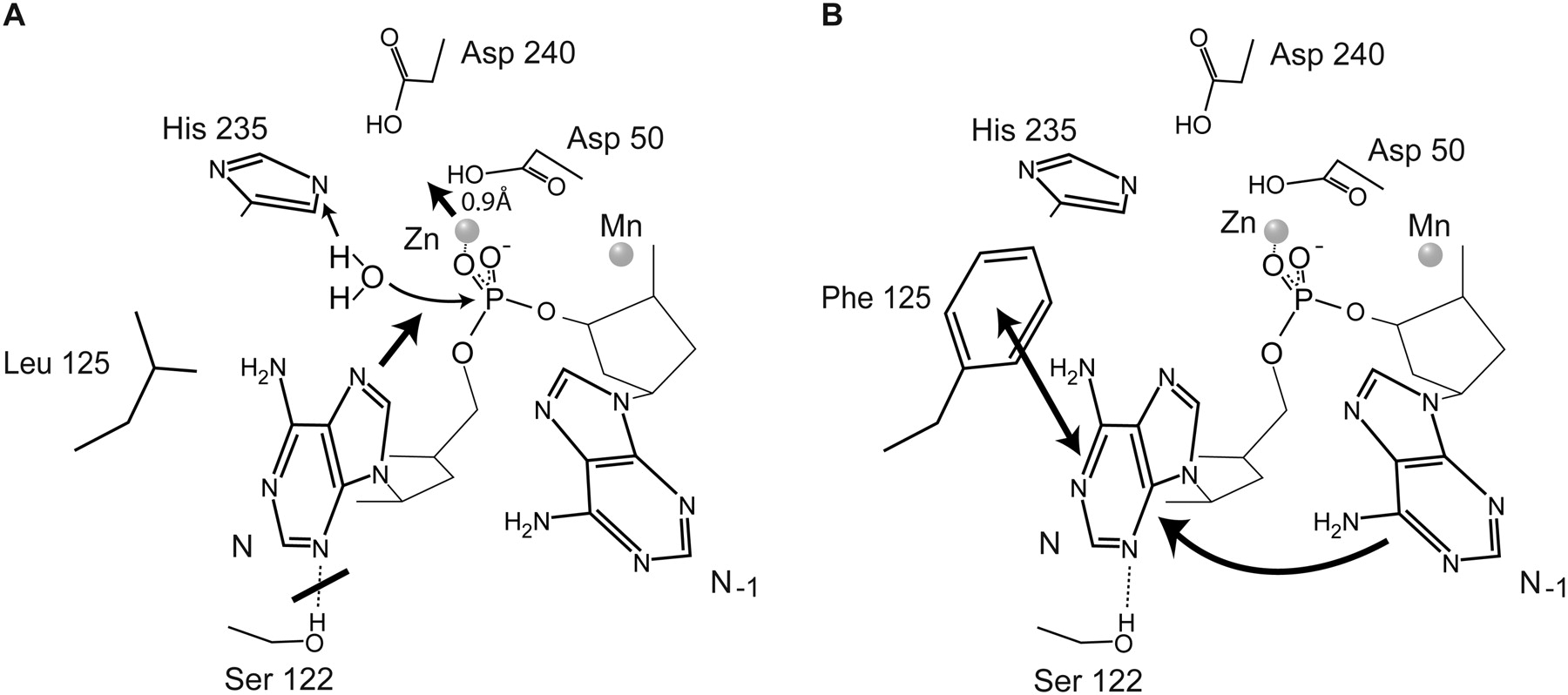
Mechanistic model for RNA selectivity and processivity in Pop2p. (A) The hydrolysis reaction involves activation of a water molecule by His235 for nucleophilic attack on the last phosphodiester bond (thin arrows). The last adenosine residue (N) is possibly recognized at the N3 position by Ser122. Exchange of the Mg2+ ion in the A site for Zn2+ causes a shift of the ion and concomitantly the phosphate and the last nucleotide toward Asp50 of 0.9 Å (thick arrows), potentially resulting in a slower rate of product (AMP) release. The movement would also weaken the interaction with Ser122 and therefore reduce the preference for adenosine. (B) Mutation of Leu125 to phenylalanine increases the stacking interaction with the last base (N) and reduces the importance of the Ser122 interaction. Upon hydrolysis and release of AMP in the context of the L125F mutation, the nucleotide at the new 3′ end (N−1) has higher affinity for the position occupied by the leaving nucleotide than in the wt case, accounting for the observed increase in processive behavior.