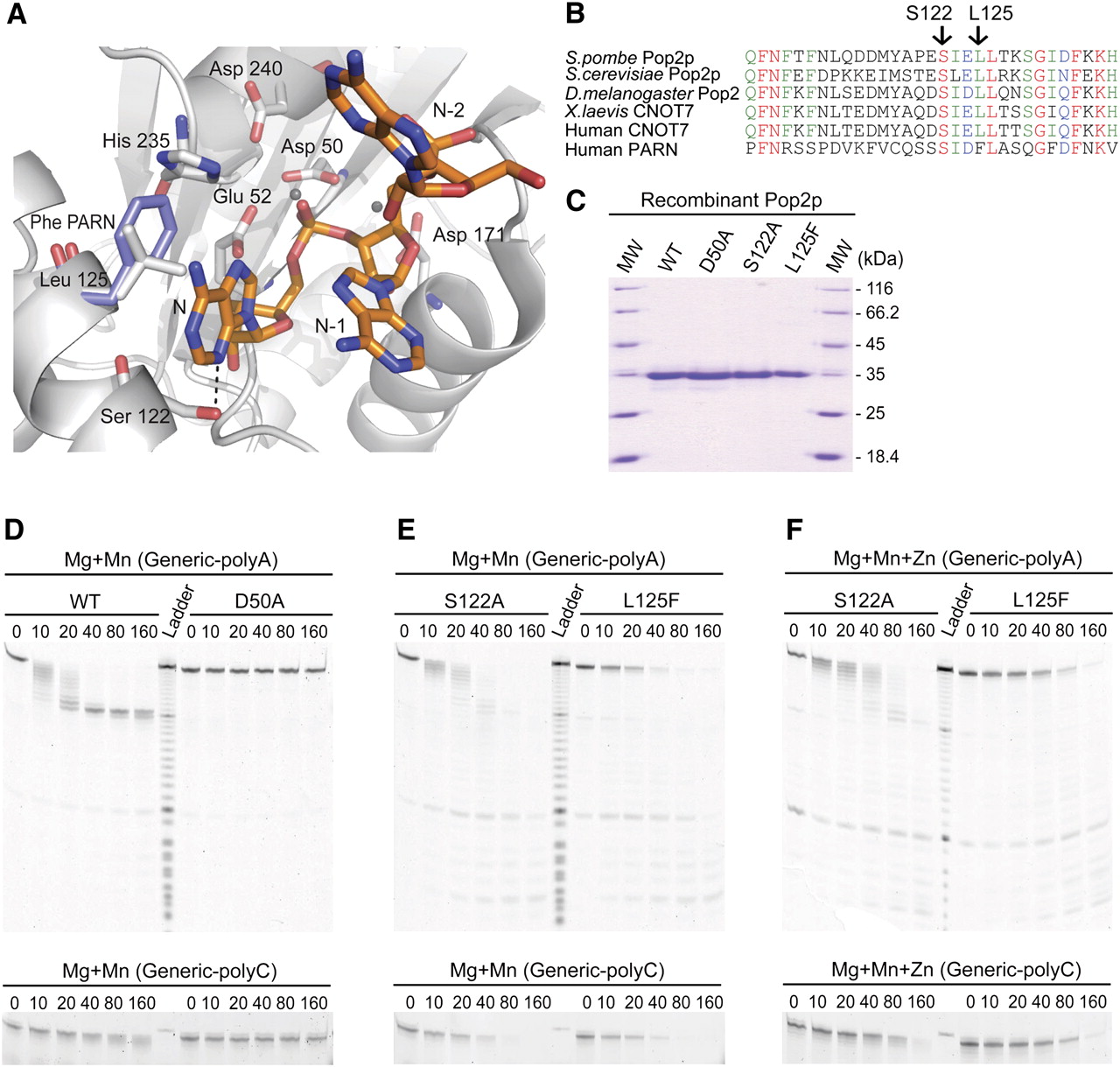
Effects of active site mutations on kinetics and selectivity. (A) The RNA-bound form of Pop2p modeled by superposition of poly-A RNA from the structure of the human PARN (PDB ID 2A1R) (Wu et al. 2005), shown along with the active site residues and ions involved in catalysis or base recognition. The phenylalanine found in the human PARN structure corresponding to Leu125 in Pop2p is shown in blue stacking with the 3′ adenine base. (B) Alignment of the sequence region of interest around Ser122 and Leu125 in Pop2p homologs. Shown are S. pombe Pop2p (this study), S. cerevisiae Pop2p, Drosophila melanogaster Pop2, Xenopus laevis CNOT7, and human CNOT7 along with the corresponding region in human PARN. (C) Coomassie-blue stained SDS-PAGE gel showing the recombinant, purified wt, D50A, S122A, and L125F Pop2p proteins used for in vitro RNA degradation assays. (D–F) Time course competition deadenylation experiments using wt Pop2p, D50A, S1222A, or L125F and a 1:1 molar ratio of Generic-polyA (top) and Generic-polyC RNA substrates (bottom, showing full-length band only) in the presence of either Mg2+ and Mn2+ or all thee ions, Mg2+, Mn2+, and Zn2+, at physiological concentrations.