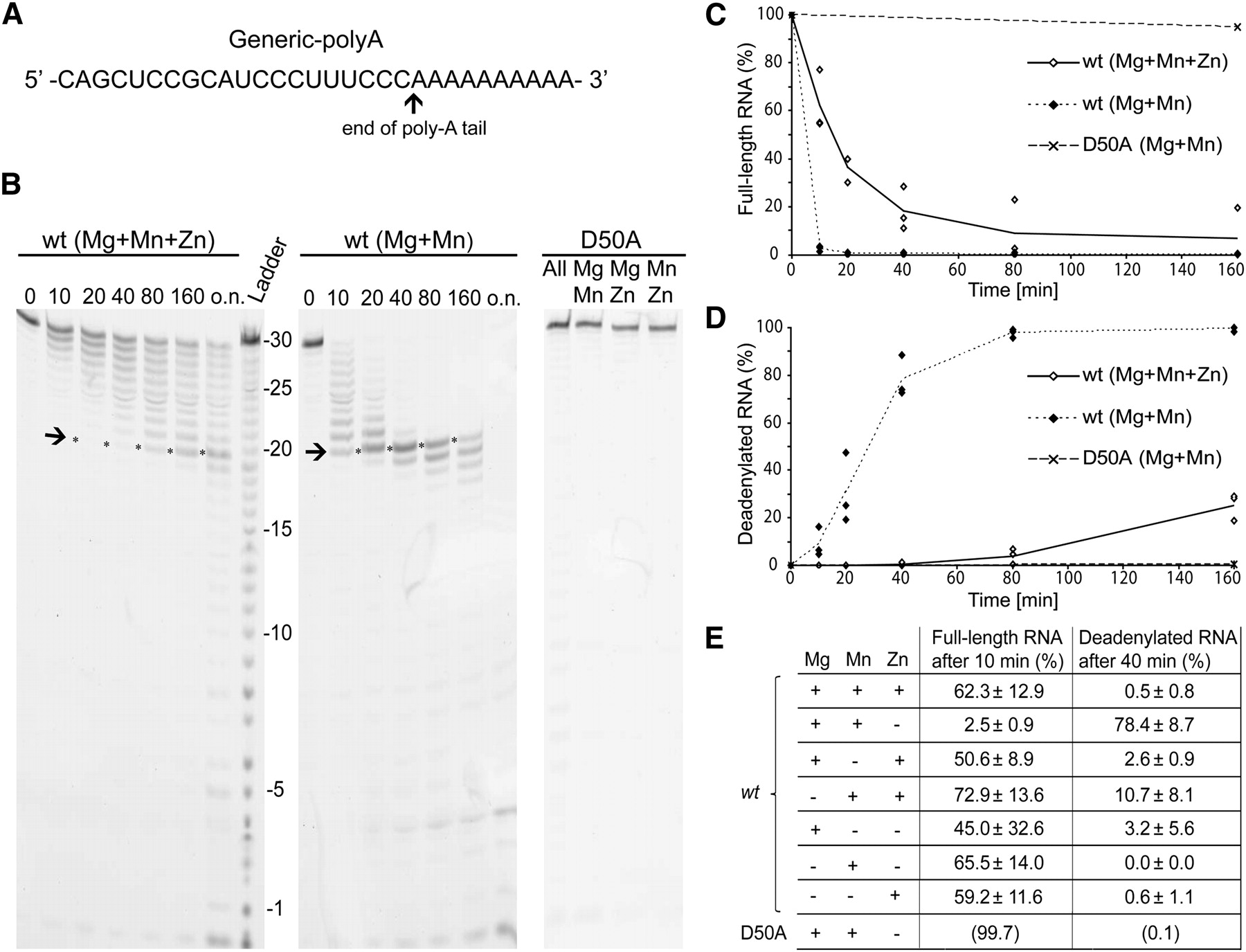
In vitro deadenylation activity of S. pombe Pop2p. (A) Sequence of the “Generic-polyA” RNA substrate. ↑ indicates the end of the poly-A tail after 20 nt. The RNA contains a 5′ fluorescein modification (not shown). (B) Time course deadenylation experiments at the indicated combinations of 7.1 mM Mg2+, 75 μM Mn2+, and 220 μM Zn2+. The ladder shows individual base steps with → indicating the fully deadenylated product (20 nt). “D50A” shows equivalent experiments carried out with the D50A active site mutant as negative control. (C) Quantification of the Pop2p-mediated degradation showing the decay of full-length substrate and (D) build-up of the completely deadenylated RNA with time. Percentages are calculated as the integrated density of either the intact RNA band or the 20 nt intermediate product + smaller bands, normalized by the total lane density. The lines represent averages of three independent experiments with individual experiments shown with markers. (E) The relative activity of Pop2p in either initiating degradation [“Full-length RNA after 10 min (%)”] or completing deadenylation [“Deadenylated RNA after 40 min (%)”] at various conditions. The numbers for the D50A mutant are approximated based on the 160-min end point. Except for the D50A control, all numbers represent the average of three independent experiments ± standard deviation.