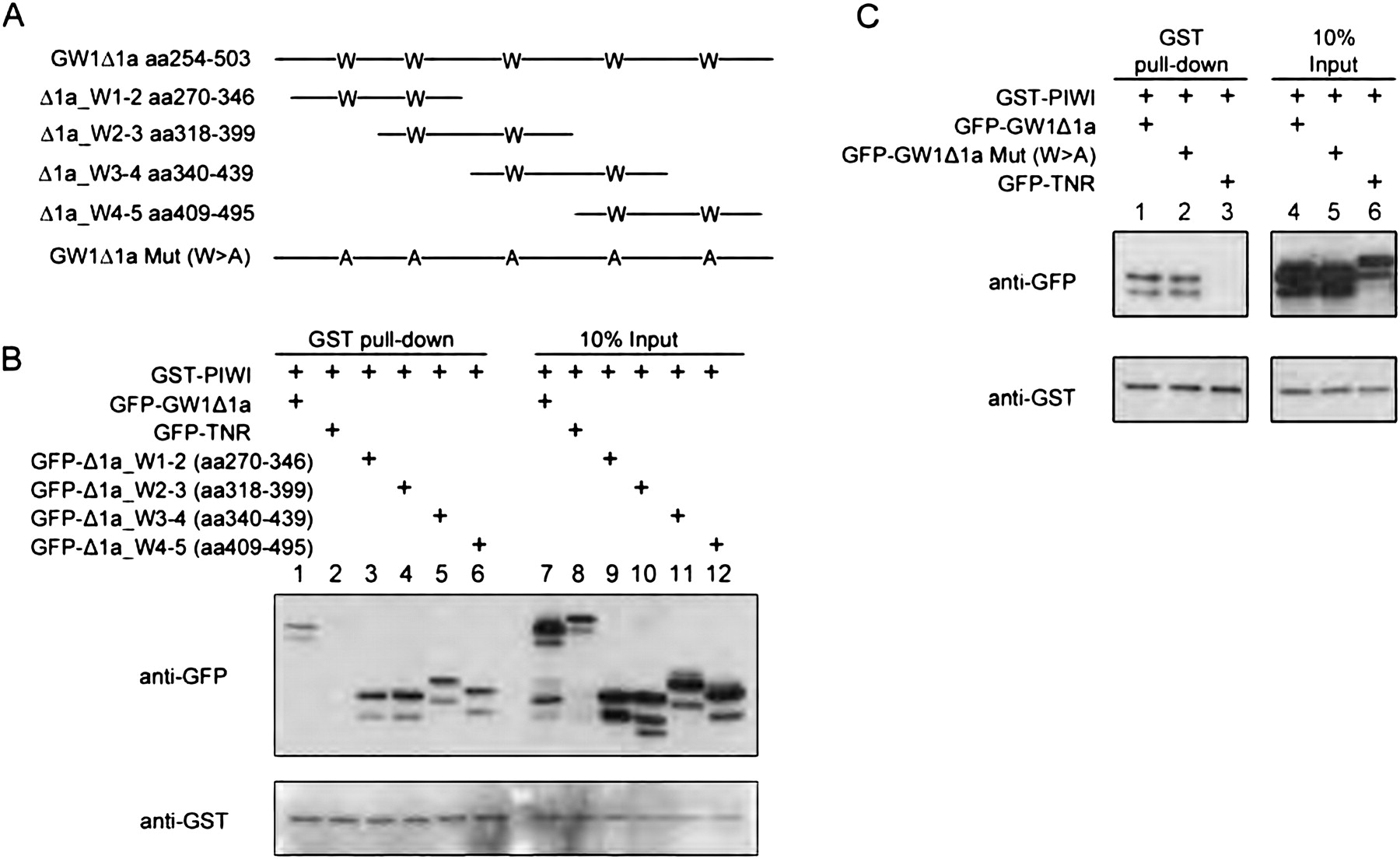
Four subregions of GW1Δ1a were capable of binding Ago2, and the interaction between GW1Δ1a and PIWI was not dependent on the five tryptophan residues. (A) Schematics of the four overlapping fragments of GW1Δ1a each containing two tryptophan residues and the mutant designed with all five tryptophans substituted with alanine. (B) Truncated constructs of GW1Δ1a containing any two continuous tryptophans were able to coprecipitate with PIWI. GST-PIWI was transfected with GFP-tagged TNR, GW1Δ1a, and its truncated constructs: Δ1a_W1-2 (“aa270-346,” contains the first and second tryptophans of GW1Δ1a), W2-3 (“aa318-339,” contains the second and third trytophans), W3-4 (“aa340-439,” contains the third and fourth tryptophan), and W4-5 (“aa409-495,” contains the fourth and fifth tryptophans). Compared with GFP-TNR (lane 2), all truncated constructs of GW1Δ1a (lanes 3–6) coprecipitated with GST-PIWI as full-length GW1Δ1a did (lane 1). (C) GW1Δ1a mutant without tryptophan still coprecipitated with PIWI. A GW1Δ1a mutant with all tryptophan (W) mutated to alanine (A) (GW1Δ1a Mut (W > A), lane 2) was cotransfected with GST-PIWI into HeLa cells. Compared with wild-type GW1Δ1a (lane 1), GW1Δ1a mutant was coprecipitated with PIWI at the comparable level. GFP-TNR (lane 3) served as a negative control in the GST pull-down assay.