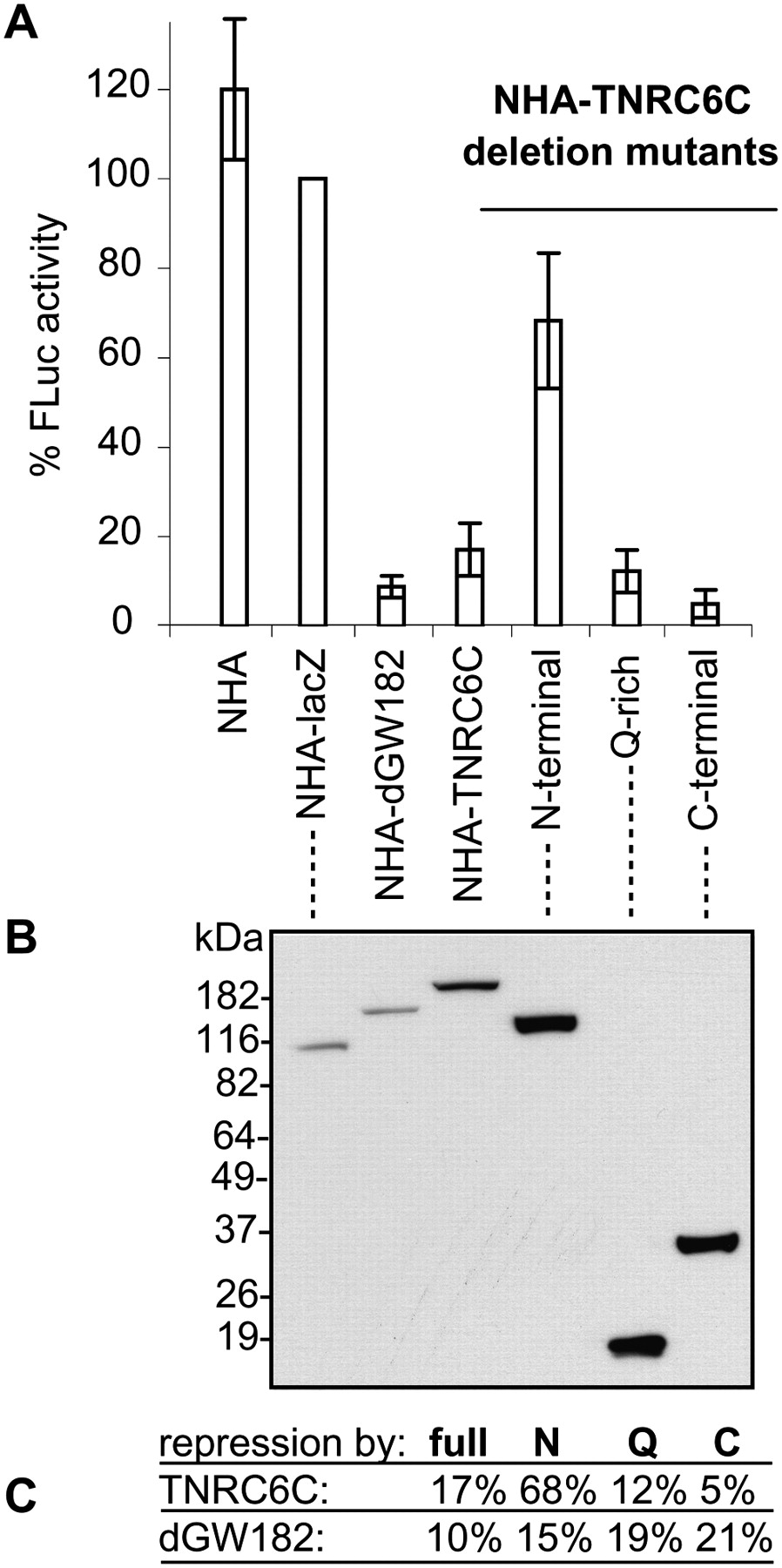
Human homolog of dGW182, TNRC6C, and its Q-rich and DUF-RRM regions are able to repress tethered mRNA in Drosophila S2 cells. (A) The tethering assay was performed essentially as in Figure 1C, with human protein TNRC6C and its deletion mutants tethered instead of dGW182. The N-terminal tethered fragment of TNRC6C (amino acids 1–1035) includes GW-rich repeats; the middle portion (amino acids 1080–1245) covers the Q-rich region; the C-terminal part (amino acids 1370–1690) comprises conserved DUF and RRM. Full-length NHA-dGW182 was tethered as a positive control, NHA and NHA-lacZ as negative controls. (B) Expression levels of NHA-fusion proteins were estimated by Western blotting with anti-HA antibody. (C) Summary of the repressive effects by TNRC6C, dGW182, and their deletions. The numbers show the percent translation in the presence of tethered full-length proteins, N-terminal, Q-rich, and C-terminal (DUF-RRM) fragments, accordingly.