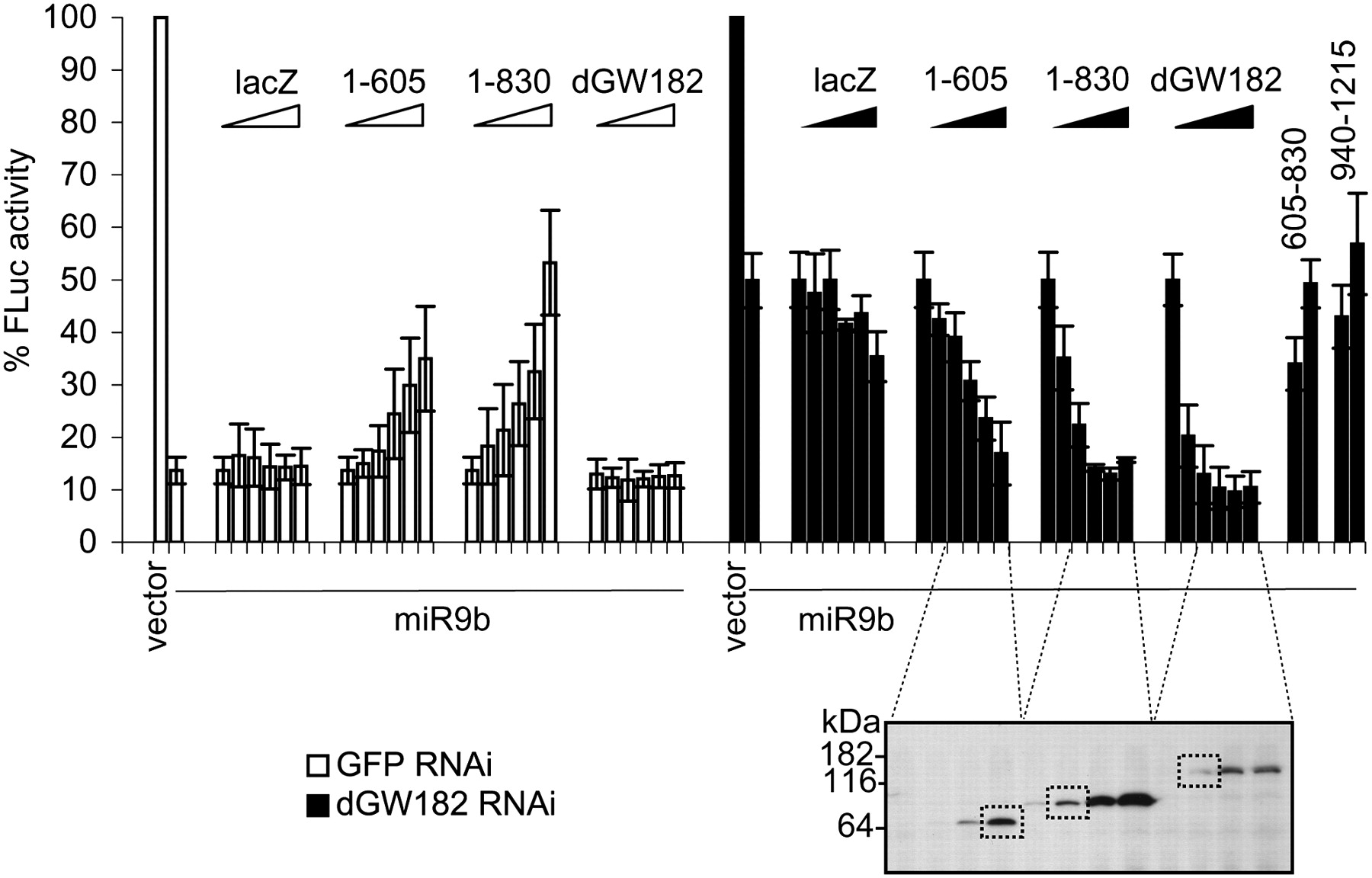
Overexpression of dGW182 and its N-terminal fragments rescues RNAi knockdown of endogenous dGW182. (Black bars) Endogenous dGW182 was depleted in Drosophila S2 cells with dsRNA as described in Figure 4; (open bars) a batch of cells was treated with GFP-specific dsRNA, as a negative control. Cells were transfected with firefly luciferase reporter containing miRNA-9b target sites (FLuc-nerfin) and with either miRNA-9b-encoding plasmid or the empty vector. As in all transfection experiments, RLuc was coexpressed as a transfection control; expression levels of firefly luciferase were normalized to Renilla luciferase activity and expressed as a percentage of the firefly luciferase activity in the presence of the empty vector. To rescue the knockdown of endogenous dGW182, increasing amounts (from 0 to 100 ng per well, in a 96-well plate) of plasmids encoding NHA-dGW182 or its deletion mutants were co-transfected: 1–605 construct, encoding N-terminal GW-repeats, and 1–830 construct, encoding GW-repeats together with the Q-rich region. Expression of NHA-dGW182 and its deletions was estimated by Western blotting with anti-HA antibody; the squared bands correspond to the minimal expression levels sufficient to rescue miRNA-9b-mediated repression to the level observed in GFP dsRNA-treated cells. Increasing amounts of NHA-lacZ were co-transfected for a negative control. To test the dependence of rescue on the N-terminal region of dGW182 required for dGW182–Ago1 interaction, we also co-transfected increasing amounts of NHA-605-830 and NHA-940-1215 plasmids encoding for Q-rich and DUF-RRM regions, accordingly (30 and 100 ng/well).