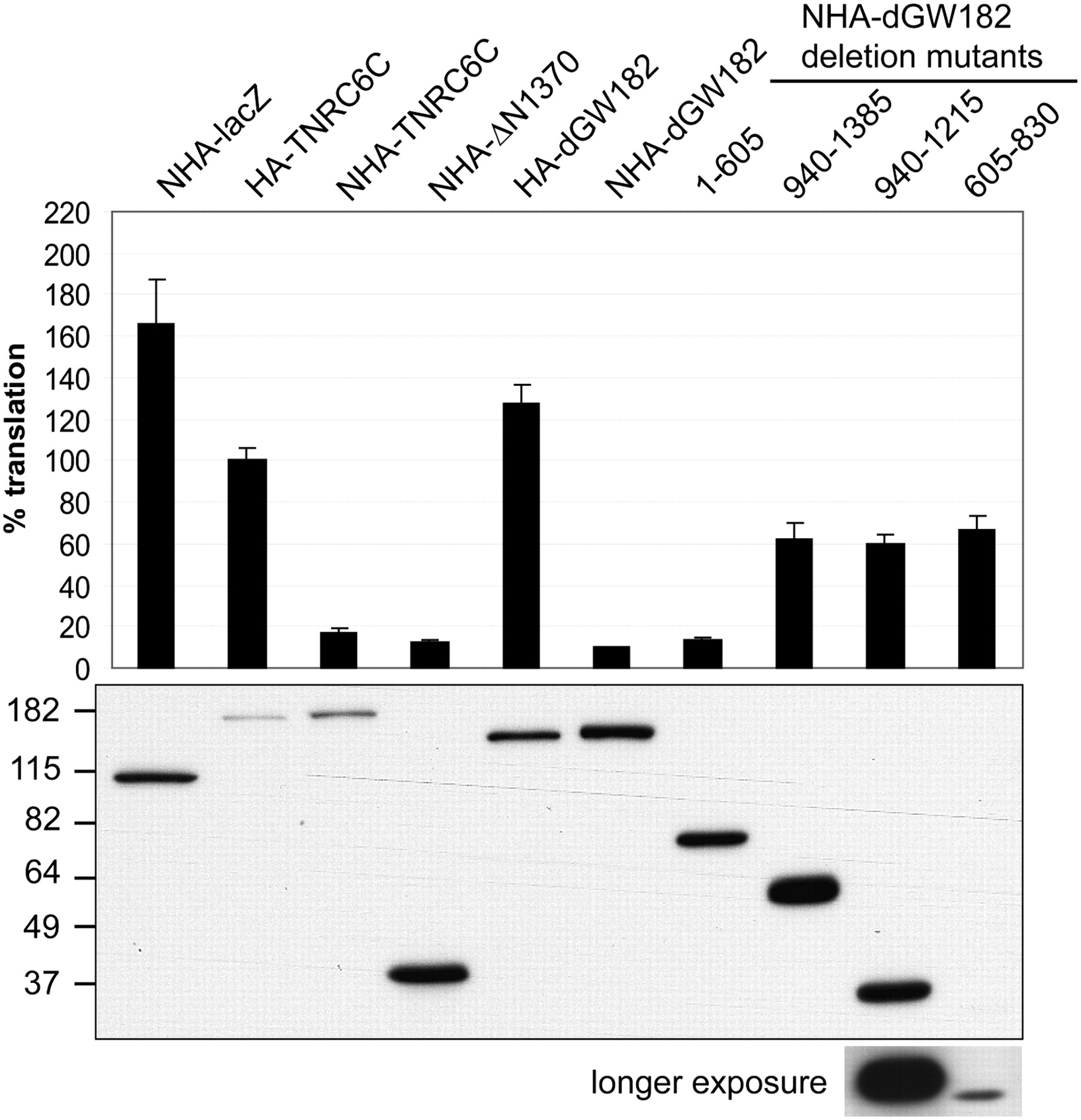
Effect of tethering of dGW182 and its deletion mutants on activity of RL-5BoxB reporter in human cells. (Upper panel) Tethering of dGW182 and its deletion mutants represses activity of RL-5boxB reporter in HEK293 cells. Indicated plasmids expressing human TNRC6C or Drosophila dGW182, or their mutants, were transfected to cells together with RL-5boxB and FL-Con. Normalized RL activity is indicated as the percentage of activity in cells expressing HA-TNRC6C set as 100%. (Lower panel) Expression of fusion proteins analyzed by Western blotting using anti-HA Ab. (Inset at the bottom) Shows stronger exposure of the two lanes at far right, indicating that the Q-rich domain (mutant 605-830) is expressed at a much lower level than the remaining proteins. However, this low level of NHA-605-830 appears to be sufficient to achieve maximal repression since transfection of higher amounts of the plasmid encoding NHA-605-830 did not result in stronger repression (data not shown). The data represent means from three independent experiments. We note that transfection of control NHA-lacZ plasmid occasionally results in RL expression that is stronger (although not significantly) than that of another control reporter, HA-TNRC6C. The data were always normalized to RL expression in the presence of HA-TNRC6C, which we consider as a more appropriate control than NHA-lacZ.