


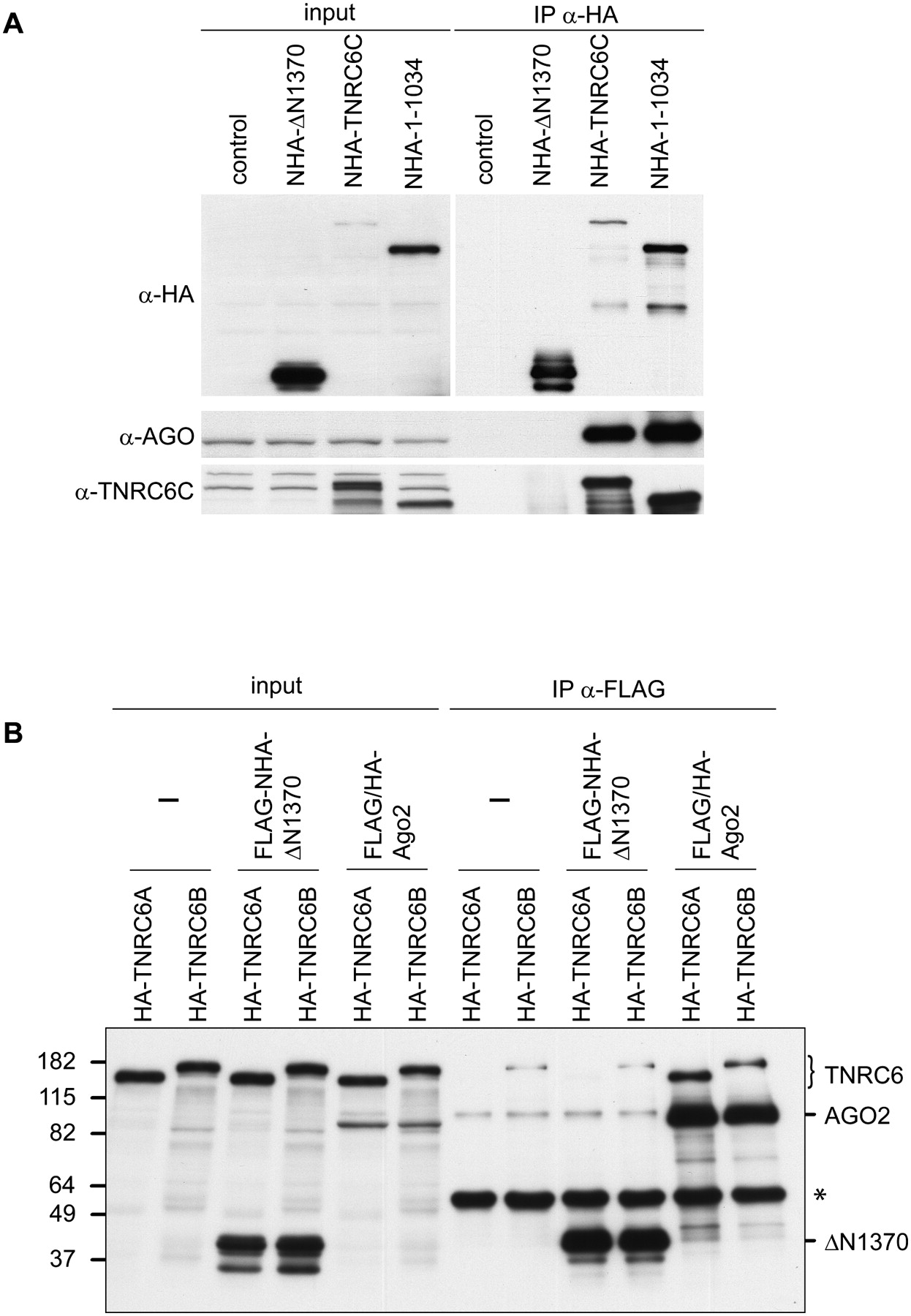
ΔN1370 does not interact with endogenous Ago and TNRC6C proteins. Cell extracts of HEK293 cells transiently expressing the indicated fusion proteins were incubated with anti-HA Affinity Matrix (Roche), and immunoprecipitated proteins (45% of the total immunoprecipitate) were analyzed by Western blotting using the indicated Abs. Note that anti-AGO mAb 2A8 recognizes all human AGO proteins (Nelson et al. 2007). Inputs represent 1% (detection of Ago) and 5% (detection of TNRC6C) of the cell extract used for IP. Nontransfected cells served as a control. (B) ΔN1370 does not interact with TNRC6A and TNRC6B proteins. Cell extracts of HEK293 cells transiently expressing indicated epitope-tagged proteins were incubated with anti-Flag M2-Agarose Affinity Gel (Sigma), and immunoprecipitated proteins (45% of the total immunoprecipitate) were analyzed by Western blotting using anti-HA 3F10 mAb. Inputs represent 2% of the cell extract used for IP. Note that HA-TNRC6B unspecifically binds to α-Flag beads and traces of it are present in IPs from both ΔN1370-expressing and control cells. (*) The band most probably represents the IgG heavy chain.




