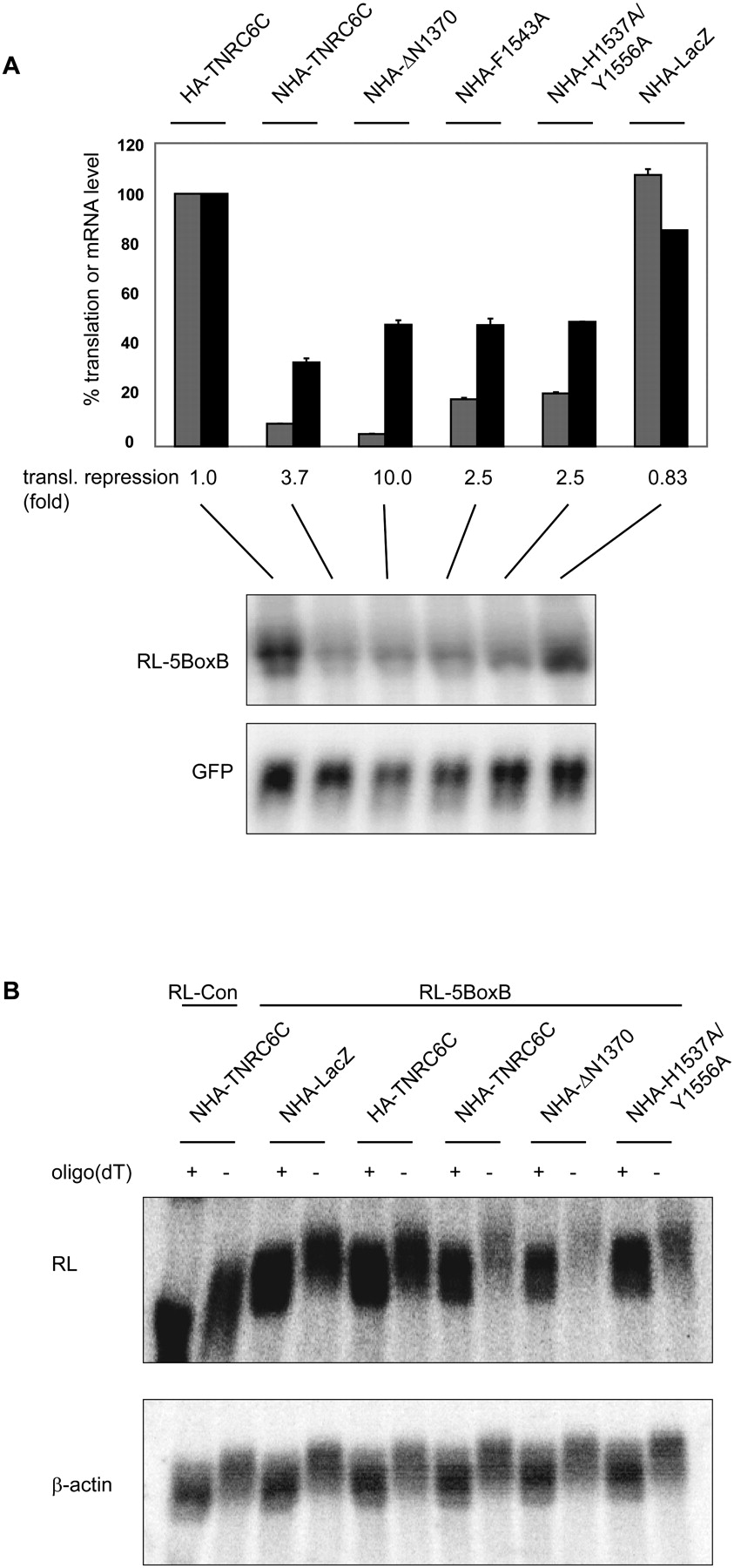
The ΔN1370 fragment acts mainly as a translational repressor. (A) Tethering of ΔN1370 causes strong repression of translation that is partially relieved by mutations in the RRM domain. Indicated proteins were coexpressed with reporter plasmids in HEK293 cells, and their effect on RL activity and RL-5BoxB mRNA stability was analyzed using extracts originating from the same transfections. (Upper panel) Effect of tethering on RL activity ([gray bars] normalized to FL) and RL-5BoxB mRNA level ([black bars] normalized to GFP mRNA). Values for transfection of HA-TNRC6C were set to 100%. Calculated net repressive effects on translation are shown below the bars (n = 3, with the exception of Northern analysis for NHA-H1537A/Y1566A and NHA-LacZ performed only twice and once, respectively). (Lower panels) Representative Northern analyses. (B) Treatment with RNase H in the presence of oligo(dT) results in faster mobility of both control mRNAs and mRNAs repressed by tethering. RL-Con and RL-5BoxB mRNAs were coexpressed in HEK293 cells with proteins indicated above the panels. RNA isolated from transfected cells was incubated with RNase H in the absence or presence of oligo(dT) and analyzed by Northern blotting. The same blot was consecutively hybridized with probes specific for RL and β-actin mRNAs. Note that RL-Con mRNA is 220 nt shorter than RL-5BoxB. Hybridization signals (as measured by PhosphorImaging) in lanes representing incubations without oligo(dT) were found to be reproducibly weaker than those in the lanes with oligo(dT). This is more pronounced for RL mRNAs than β-actin mRNA, and in the case of RL mRNAs, it applies to the same extent to mRNAs that do and do not undergo repression.