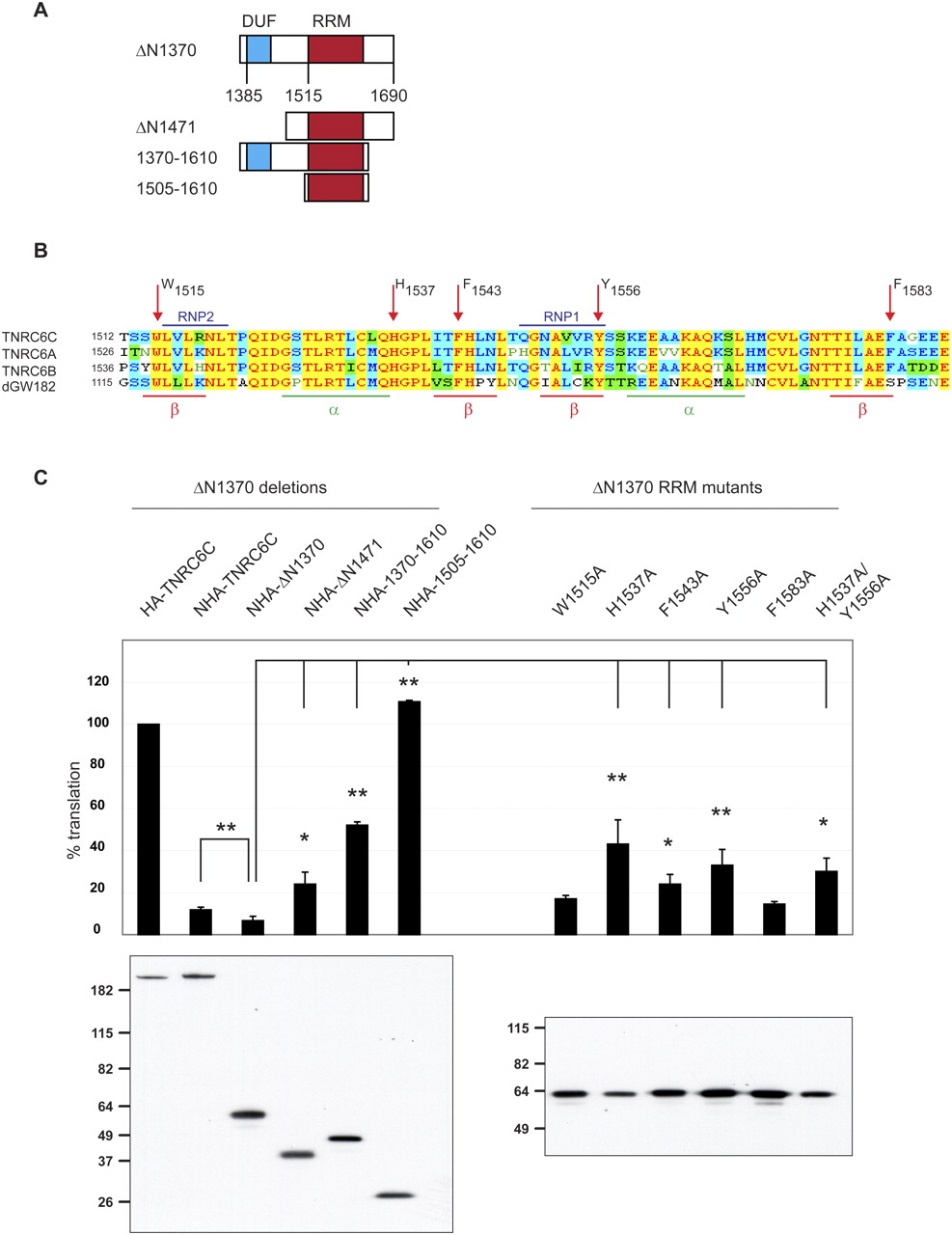
Detailed characterization of the C-terminal ΔN1370 fragment of TNRC6C. (A) Schematic representation of deletion mutants of the C-terminal ΔN1370 fragment of TNRC6C. (B) Sequence alignment of RRM domains of selected GW182 proteins. Aromatic amino acids mutated to alanines, either singly or in combination (mutant H1537/Y1556), are indicated. RNP1 and RNP2 motifs are overlined. Positions of α-helices and β-sheets predicted for the TNRC6C RRM using Phyre (http://www.sbg.bio.ic.ac.uk/phyre/) are shown below the alignment. (C, upper panel) Repressive activity of mutants of the ΔN1370 fragment shown in panel A. Cells were co-transfected with plasmids expressing NHA fusions of TNRC6C or the ΔN1370 fragment and its mutants, and the reporter plasmids. Values represent the percent of translation as measured by normalized RL activity, with translation in the presence of HA-TNRC6C taken as 100%. Error bars show standard error (n = 3–12). Statistical significance (NHA-TNRC6C versus NHA-ΔN1370 and NHA-ΔN1370 versus other deletion and RRM amino acid mutants) was calculated using the nonparametric Mann–Whitney–Wilcoxon test (NHA-TNRC6C versus NHA-ΔN1370) or paired two-tailed Student's t-test (all other comparisons); (*) P < 0.05; (**) P < 0.01. (Lower panels) Expression levels of HA-TNRC6C, NHA-TNRC6C, and the C-terminal ΔN1370 fragment and its mutants as assessed by Western blotting using anti-HA Ab.