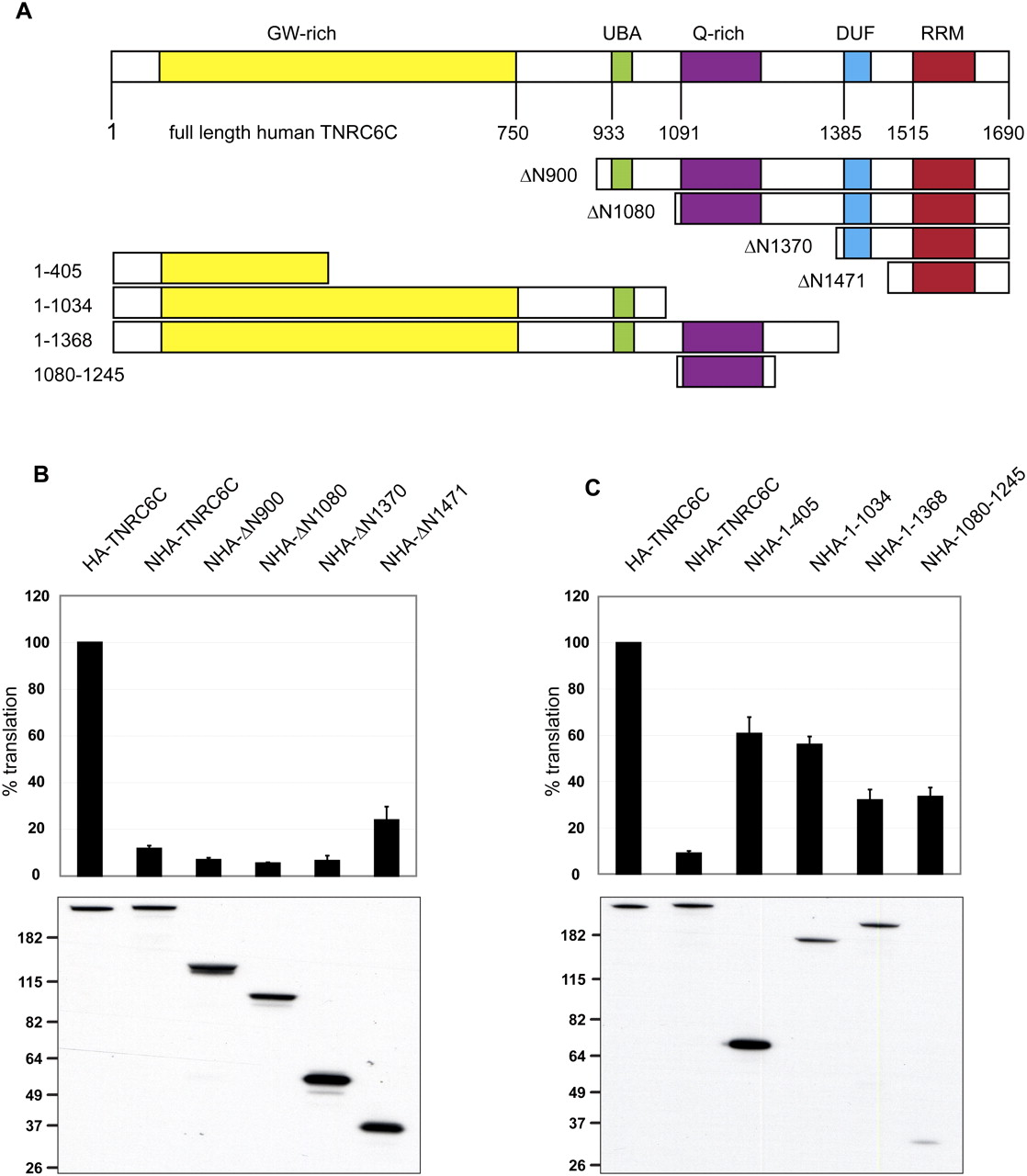
Characterization of the TNRC6C deletion mutants. (A) Schematic representation of TNRC6C and its deletion mutants. Mutants with progressive deletions from the (upper part of scheme) N terminus and (lower part of scheme) C terminus. Numbers correspond to amino acid positions. (B) The C-terminal domain of TNRC6C is sufficient to effectively repress protein synthesis when tethered to mRNA. (Upper panel) Repressive activity of TNRC6C and its N-terminal deletion mutants. HEK293 cells were co-transfected with plasmids expressing N-HA fusions of TNRC6C or its fragments and plasmids encoding RL-5BoxB and FL reporters. HA-TNRC6C served as a negative control. Activity of RL was normalized for expression of FL. Values represent relative RL activities normalized to FL, with translation in the presence of HA-TNRC6C set as 100%. (Lower panel) Expression levels of HA-TNRC6C and NHA-TNRC6C and its mutants as assessed by Western blotting using anti-HA Ab. Positions of protein size markers are indicated. (C) Analysis of progressive deletion mutants from the C terminus and the 1080–1245 mutant reveals only moderate repressive activity of GW- and Q-rich domains. Details of experiments are identical to those given in the legend to Figure 4B. The values in B and C are means (±SEM) from four to 12 independent experiments. Expression of the Q-rich domain was reproducibly weaker than of other domains.