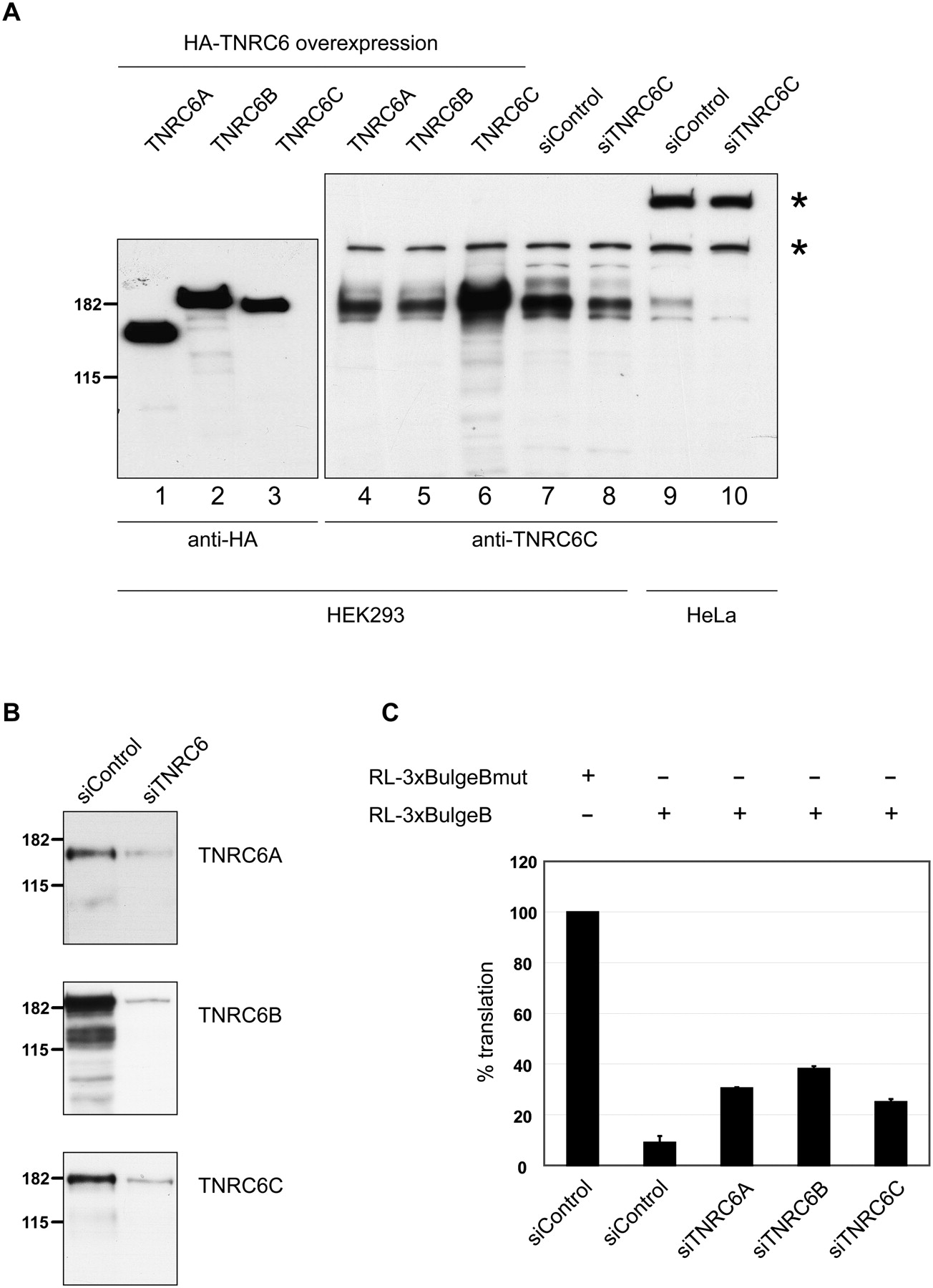
Expression of TNRC6C protein in HEK293 and HeLa cells and its importance for effective miRNA-mediated repression. (A) Anti-TNRC6C Abs specifically recognize endogenous TNRC6C in HEK293 and HeLa cell extracts and do not cross-react with overexpressed TNRC6A and TNRC6B proteins. (Lanes 1–6) Extracts prepared from HEK293 cells overexpressing indicated HA-TNRC6 proteins; (lanes 7–10) extracts of HEK293 or HeLa cells transfected with either control or anti-TNRC6 siRNAs. Abs used for Western analysis and positions of protein size markers are indicated. (*) Non-specific proteins cross-reacting with anti-TNRC6C Ab. Note that overexpression of TNRC6A or TNRC6B proteins slightly decreases the level of endogenous HTNRC6C (cf. lanes 4,5 and lane 7). (B) Knockdown of individual TNRC6 proteins by specific siRNAs. Cells were cotransfected with constructs expressing indicated NHA-tagged TNRC6 proteins and either gene-specific or control siRNAs. One siRNA was used in the case of TNRC6A, and mixtures of two in the case of TNRC6B and TNRC6C (Materials and Methods). Anti-HA Ab was used for Western blot analysis. (C) TNRC6C, similarly to TNRC6A and TNRC6B, is required for efficient repression of RL-3xBulgeB reporter by endogenous let-7 in HeLa cells. Down-regulation of each protein partially rescues repression of RL-3xBulgeB. RL-3xBulgeBmut, containing mutations in the seed sequence of the let-7 binding that prevent the repression (Pillai et al. 2005; Schmitter et al. 2006), was used as a control reporter. SiRNAs used for knockdowns are indicated. The data represent means from three independent experiments.