


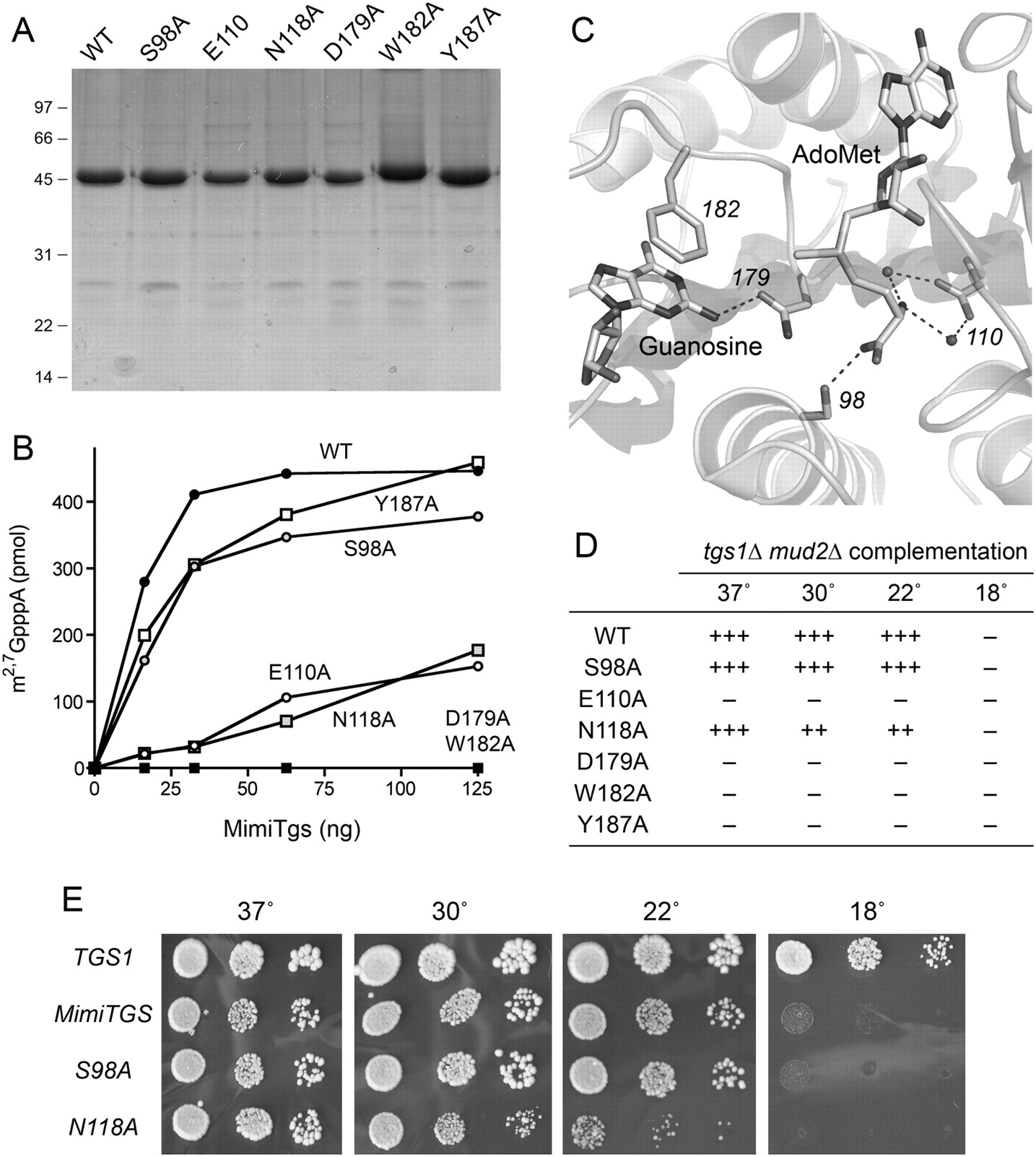
Effects of alanine mutations on MimiTgs activity. (A) Aliquots (5 μg) of the nickel-agarose preparations of wild-type His10Smt3-MimiTgs and the indicated alanine mutants were analyzed by SDS-PAGE. Polypeptides were visualized by staining with Coomassie Blue dye. The positions and sizes (in kDa) of marker proteins are indicated on the left. (B) Reaction mixtures (10 μL) containing 50 mM Tris-acetate (pH 6.0), 5 mM DTT, 50 μM [3H-CH3]AdoMet, 1 mM m7GpppA, and proteins as specified were incubated for 15 min at 37°C. The extents of methyl transfer are plotted as a function of input enzyme. (C) Active site of Thermus thermophilus RNA guanine-N2 methyltransferase RsmC in complex with AdoMet and guanosine (from PDB 3DMH). Highlighted are the RsmC side chains that contact the methyl donor and acceptor and that have putative counterparts among the MimiTgs residues that were subjected to alanine scanning. Hydrogen bonding interactions are denoted by dashed lines. The residue numbers refer to the homologous positions in MimiTgs. (D,E) The ability of 2μ LEU2 plasmids bearing wild-type MimiTGS and the indicated alanine mutants to complement growth of a yeast tgs1Δ mud2Δ strain was tested by plasmid shuffle as described by Hausmann et al. (2008). Lethal mutations of MimiTGS were those that failed to support growth on medium containing 0.75 mg/mL 5-fluoroorotic acid (FOA) at any of the temperatures tested (scored as –). The tgs1Δ mud2Δ MimiTGS strains that grew on FOA at 30°C were tested for growth on rich medium by spotting serial 10-fold dilutions of liquid cultures (grown in SD-Leu medium) on YPD agar plates, which were then incubated at 18, 22, 30, or 37°C. Yeast tgs1Δ mud2Δ p(CEN LEU2 TGS1) cells were processed in parallel as a positive control. Photographs of the plates are shown in E. Growth of the viable MimiTGS-Ala strains was scored in D as follows: (+++) colony size indistinguishable from a strain bearing wild-type MimiTGS; (++) reduced colony size; (–) no growth.




