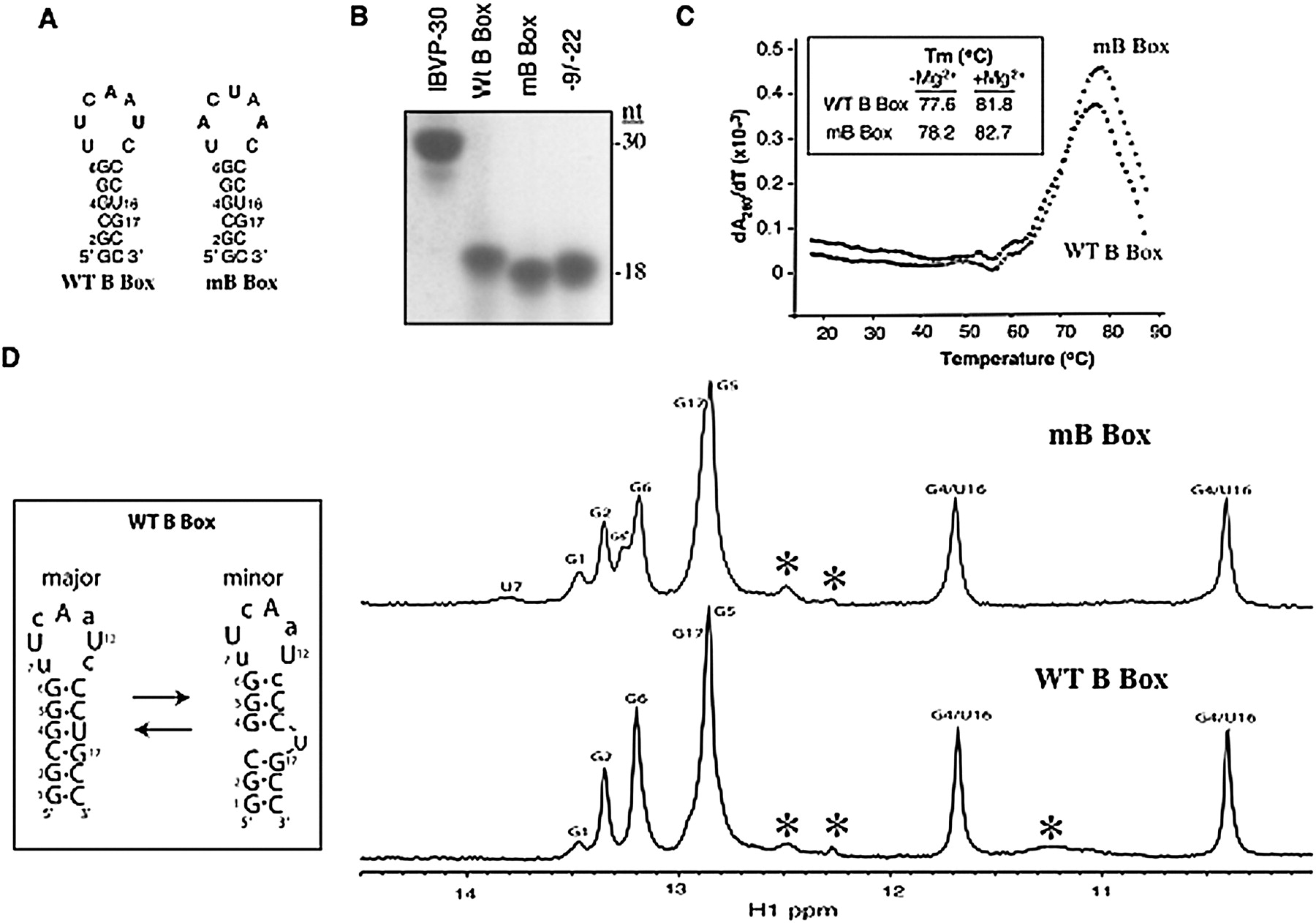
Analysis of the B Box RNA structure. (A) Sequences of the B Box RNA motif and a mutant, mB Box, used in the analysis. (B) Mobilities of the WT and mutant B box RNAs in a 15% native gel. Two RNAs served as markers for RNA conformations: IBVP-30mer (a 30-nt RNA with an 8-nt RNA loop and an 11 base-pair [bp] stem) and −9/−22 (an 18-nt RNA with a 6-nt loop with a 6-bp stem). (C) The UV denaturation profiles of the WT and mutant B Box RNA motifs. The first temperature derivatives of the absorbance at 260 nm (dA260/dT) were plotted against different temperatures. The maximum point of each plots represents the melting temperature (Tm) of each RNA motif. All RNAs were in a phosphate buffer (pH 6.5) containing 100 mM NaCl. The inset summarizes the Tm of the WT and mutant B Box RNAs and also the Tm in the same buffer amended with 1 mM MgCl2. (D) 1D NMR analysis of the WT and a mutant version of the B Box RNA. The imino proton spectra of WT B Box and mBBox at 10°C are shown. The spectra were taken at pH 5.7 using a 500-MHz Varian VNMRS spectrometer. The peaks identified as * represent the minor conformation. G6* in the mBbox spectrum is suspected to be G6 in another conformation in which U7 also forms a UA base pair. The inset represents our interpretation of the major and minor conformations of the B Box RNA. While the predicted ΔG values for the major and minor conformations are comparable, NMR analysis showed that the alternative conformation is extremely flexible, which may exist in a minor conformation. This might be due to the destabilizing presence of the internal U bulge in the middle of the stem.