


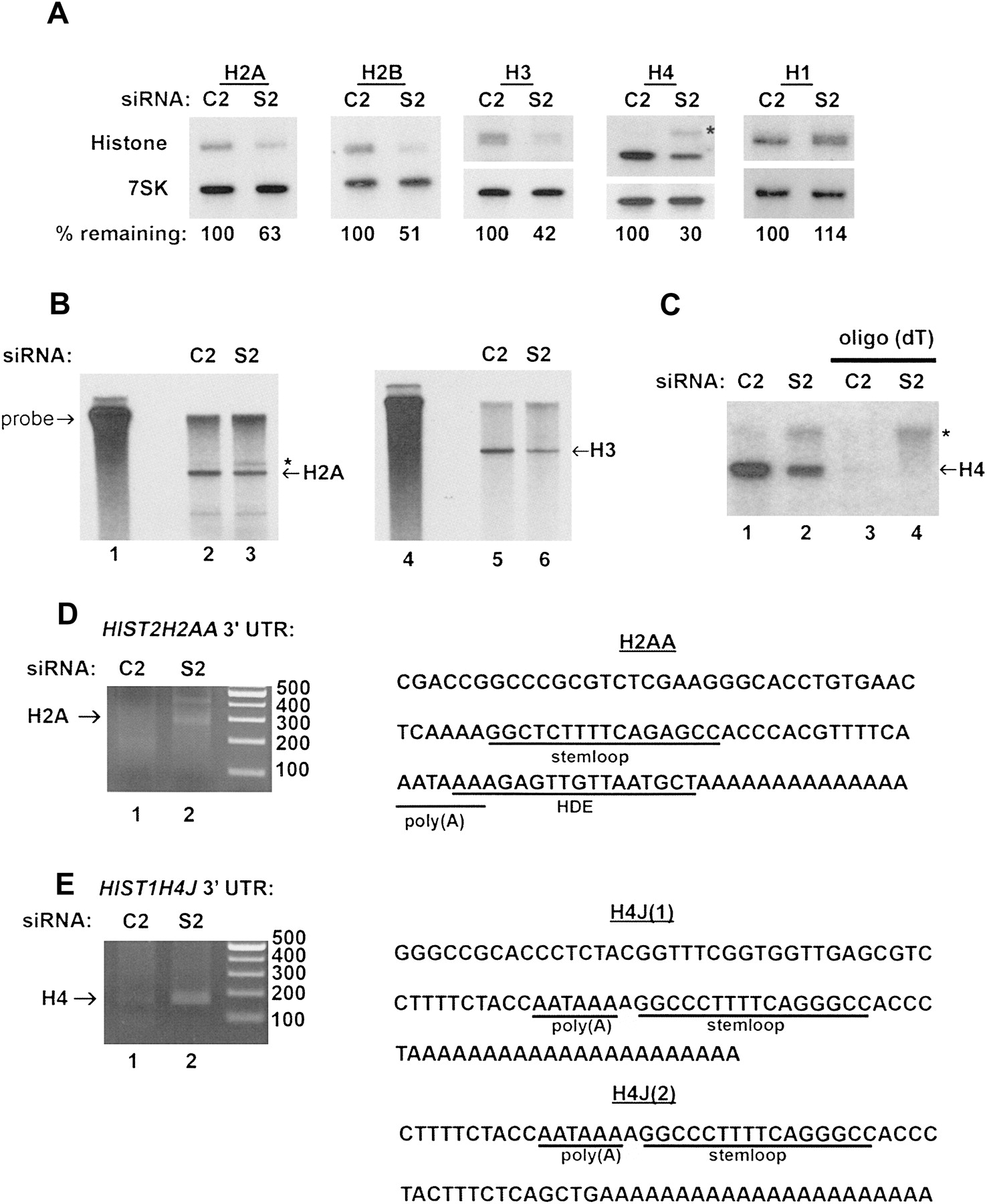
Histone mRNA levels are reduced in SLBP knockdown cells and a portion of the mRNA is misprocessed and polyadenylated. (A) Northern blot analysis was performed on 2 μg of total RNA from C2 and S2 treated cells. 7SK snRNA is used as a loading control. The percentage of histone mRNA present in the S2 treated cells was quantified using PhosphorImager analysis and ImageQuant software and normalizing mRNA to the 7SK snRNA levels. These results are representative of several different experiments. Note that a slowly migrating product reacting with the histone H4 probe (*) is present in the S2 cells. (B) 3′ S1 nuclease protection assays were used to map the 3′ ends of (lanes 2,3) histone H2A (HIST2H2AA) and (lanes 5,6) histone H3 (HIST2H3A/C) mRNAs. (Lane 3, *) The protected fragment indicates a longer mRNA that is polyadenylated (panel D). (C) Total RNA was selected on oligo(dT) cellulose, and equal proportions of (lanes 1,2) total RNA and (lanes 3,4) poly(A)+ RNA were analyzed by Northern blotting for histone H4 mRNA. (*) The longer polyadenylated H4 mRNA. (D,E) Total RNA from C2 and S2 U2OS cells was primed for reverse transcription with oligo(dT) fused to a T7 adaptor sequence and subjected to PCR using (D) a pan-H2A ORF oligo or (E) a pan-H4 oligo together with a T7 adaptor sequence. The products were analyzed by gel electrophoresis, the products were cloned, and multiple clones from each reaction were sequenced. A single polyadenylation site in histone H2a was found, and two sites in the histone HIST1H4J gene were identified.




