


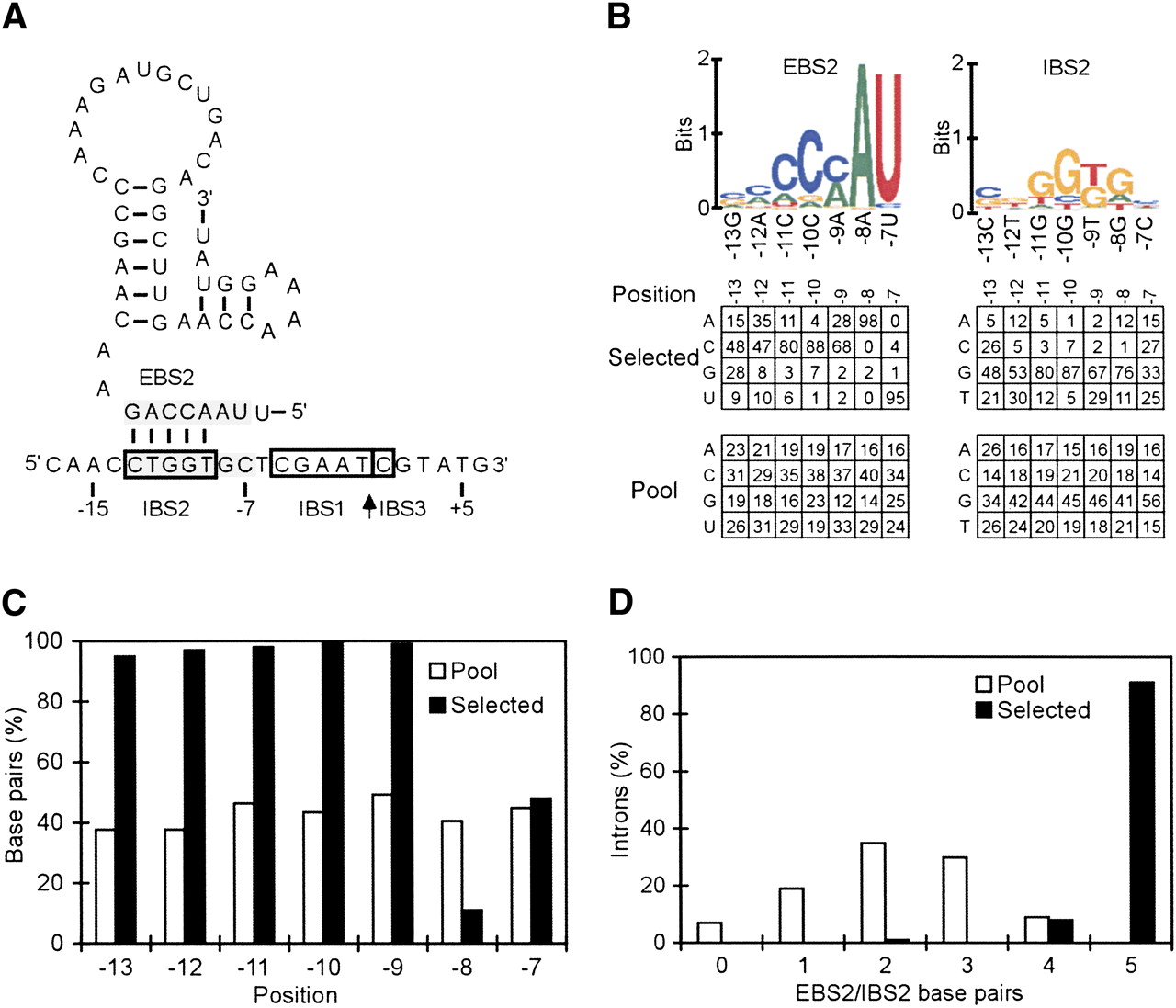
Analysis of EcI5 DNA target site EBS2/IBS2 base-pairing interactions by in vivo selection. A selection experiment was done as in Figure 6, using a pBRR3-EcI5-based recipient plasmid library with random nucleotide residues at DNA target site positions −13 to −7 and a pACD2-based donor plasmid library with random nucleotide residues at the corresponding positions in the EBS2 loop. The IBS2 positions in the 5′ exon of the donor plasmid were also randomized to provide complementary nucleotide combinations for RNA splicing. Colonies were selected and plasmid sequences determined via colony PCR, as described in Figure 6. (A) Predicted EBS2/IBS2 base-pairing interactions between the intron RNA and the top strand of the DNA target site. The nucleotide residues randomized in the selection are highlighted in gray. The arrow indicates the intron-insertion site. (B) WebLogo representation of nucleotide frequencies at randomized positions in 102 selected integration events, corrected for biases in the initial pools based on sequences of 99 unselected donor plasmids and 103 unselected recipient plasmids. Nucleotide frequencies (percent) at each position in the selected and unselected plasmids are summarized below. In some cases, percentage totals do not equal 100 due to rounding off. (C) Percentage of base pairs at each EBS2/IBS2 position in 102 selected integration events (black bars) and 99 randomly paired donor and recipient plasmids from the initial pools (white bars). (D) Percentage of introns that have different numbers of EBS2/IBS2 base pairs in 102 selected integration events (black bars) and 99 randomly paired donor and recipient plasmids from the initial pools (white bars). In C and D, both Watson–Crick and wobble U•G and G•T pairs are counted as base pairs.




