


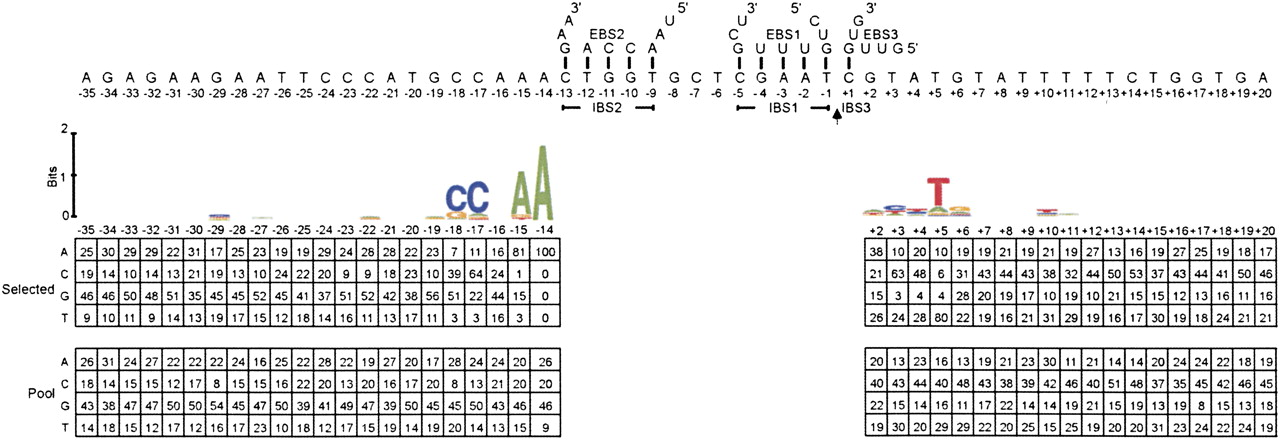
Identification of critical nucleotide residues in the distal 5′- and 3′-exon regions of the EcI5 DNA target site. E. coli HMS174(DE3) containing the wild-type intron-donor plasmid pACD2-EcI5 and a recipient plasmid library with random nucleotide residues at positions −35 to −14 and +2 to +20 from the intron-insertion site was grown at 37°C to early-log phase and induced with 100 μM IPTG for 1 h. The cells were then plated on LB agar containing tetracycline and ampicillin to select those in which the EcI5-ΔORF intron carrying a phage T7 promoter integrated into functional target sequences upstream of the promoterless tet R gene in the recipient plasmid. The plasmids were isolated by a mini-prep procedure and sequenced, using primer ForpBRR for the 5′-integration junction and Rev2pBRR for the 3′-integration junction (Supplemental Table 2). The top shows the EcI5 DNA target sequence from positions −35 to +20 and its predicted EBS2/IBS2, EBS1/IBS1, and EBS3/IBS3 base-pairing interactions with the intron RNA. The arrow indicates the intron-insertion site. The WebLogo representation (Crooks et al. 2004) depicts nucleotide frequencies at each randomized position in 101 selected target sites, corrected for biases in the initial pool based on sequences of 108 unselected recipient plasmids, as described in Materials and Methods. Nucleotide frequencies (percent) at each position in the selected and unselected plasmids are summarized below. In some cases, percentage totals do not equal 100 due to rounding off.




